The Runic Alphabet of the Viking Age and the Magic Carved in Stone
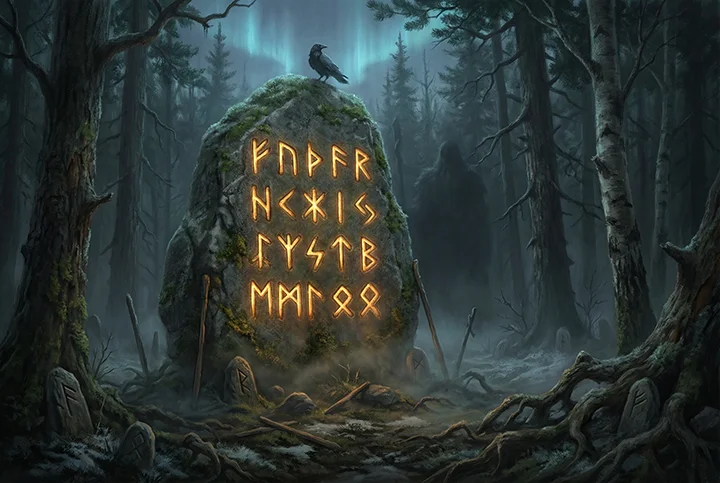
Overview
The Elder Futhark is the oldest form of the runic alphabet, a writing system used across the Germanic world from approximately the second century to the eighth century, and the script in which the earliest Norse inscriptions were carved. It consists of twenty-four characters, each called a rune, and its name comes from the first six letters in sequence: F, U, Th, A, R, K. It was replaced in Scandinavia during the Viking Age by the Younger Futhark, a simplified sixteen-character variant, but the Elder Futhark remained in use in some contexts and was never entirely forgotten, surviving into the medieval period in manuscripts and in the memory of specialists who understood its older, fuller system.
Runes were not simply letters. In the Norse and Germanic world, the act of carving a rune was understood as something more than writing: it was an act that could call on the power the rune represented, could bind, protect, curse, commemorate or reveal, depending on which runes were used, how they were combined, and the intention of the carver. Odin himself is said to have discovered the runes by hanging for nine days and nights on Yggdrasil, wounded by a spear, looking down into the water below until the shapes rose up to meet him. The runes were not invented; they were found, and what they were found in was the deep structure of the cosmos itself.
Origins and History
The precise origin of the runic alphabet has been debated by scholars for more than a century. The most widely accepted theory traces the Elder Futhark to a North Italic alphabet, possibly the Old Latin or Etruscan script, transmitted to the Germanic peoples through contact with the Roman world in the first centuries of the common era. The directional flexibility of runes, which can be written left to right, right to left or in boustrophedon, and the preference for straight lines that avoid horizontal strokes, suggests that the script was adapted for carving in wood or stone rather than writing on flat surfaces with ink.
The earliest securely dated runic inscriptions come from the second century. They appear on a wide range of objects: weapons, jewelry, combs, bracteates, memorial stones and votive objects. The distribution of these inscriptions across the Germanic world, from Scandinavia to the Black Sea region where Gothic-speaking peoples lived, indicates that runic literacy was a property of the broader Germanic cultural sphere before it became specifically associated with Scandinavia.
The transition from the Elder Futhark to the Younger Futhark during the eighth century is one of the more puzzling developments in the history of writing: the new alphabet had fewer characters than the old one, making it less phonetically precise at exactly the moment when the Norse language was undergoing significant changes. The most common explanation is that the simplification reflects a change in the social function of runes, from a relatively widespread literacy to a more specialized set of uses in which precision of phonetic representation mattered less than the symbolic and magical associations of the characters.
The Twenty-Four Runes and Their Meanings
Each of the twenty-four Elder Futhark runes had a name, a phonetic value and a set of associated meanings that went beyond the purely linguistic. The rune poems, medieval texts that survive in Norwegian, Icelandic and Anglo-Saxon versions, preserve stanzas describing the significance of each rune, giving us a partial record of how these characters were understood by those who used them.
Fehu, the first rune, represented cattle and by extension wealth, abundance and the productive power of the natural world. Uruz, the second, represented the aurochs, the wild ox, and carried associations of primal strength and untamed nature. Thurisaz, the third, represented giants or thorns, a force of chaos and difficulty that could be invoked against enemies. Ansuz was the rune of the Aesir gods, particularly Odin, associated with wisdom, communication and divine inspiration. Raidho was the rune of the ride or journey, of ordered movement through the world. Kenaz was the rune of fire, torch and knowledge, the controlled flame that illuminates and transforms.
Further in the sequence, Gebo represented the gift and the reciprocal obligation it created. Wunjo was the rune of joy and fellowship. Hagalaz was hail, the destructive force that cannot be controlled. Nauthiz was need and constraint, the rune of necessity and the hardship that forges strength. Isa was ice, stillness, the arrested state. Jera was the year and the harvest, the cycle of time and the reward of patient labor. Eihwaz was the yew tree, associated with Yggdrasil, death and rebirth. Perthro remains one of the most debated runes, possibly associated with fate or the casting of lots. Algiz was the elk or the protective instinct. Sowilo was the sun, victory and vital force.
Tiwaz was the rune of the god Tyr, associated with justice, law and the sacrifice made in service of order. Berkano was the birch tree, femininity, growth and new beginnings. Ehwaz was the horse, partnership and trust. Mannaz was the human being and the community. Laguz was water, the sea and the flow of things. Ingwaz represented the god Ing or Freyr, associated with fertility and the completion of cycles. Dagaz was the day and the transformative moment of dawn. Othala was the ancestral homestead, inheritance and the connection between the living and those who came before.
Runes in Magic and Ritual
The Havamal, the collection of wisdom verses attributed to Odin in the Poetic Edda, contains a section in which Odin describes eighteen magical applications of runic knowledge, covering healing, protection, binding enemies, rendering weapons harmless, calming storms, awakening the dead to speak, winning love and securing victory in battle. Whether these represent actual ritual practices or literary elaborations of a simpler reality is not possible to determine with certainty, but the inscriptions that survive on archaeological objects make clear that runes were used in contexts that went beyond simple record-keeping or commemoration.
Runic inscriptions on weapons asked for victory or damage to enemies. Inscriptions on jewelry provided protection to the wearer. Memorial stones recorded names and deeds in a form intended to last, which was itself a form of power: to have your name carved in stone was to persist in the world in a way that oral memory alone could not guarantee. The runic inscription on the Rök stone in Sweden, the longest runic inscription ever found, runs to approximately eight hundred characters and contains references to mythology, history and what appear to be riddles whose answers have not been fully recovered after a thousand years of scholarly attention.
Legacy and Significance
The Elder Futhark is the foundation of all subsequent runic traditions, the source from which the Younger Futhark, the Anglo-Saxon Futhorc and the medieval runic alphabets all derived. Its twenty-four characters encode a worldview as much as a phonetic system, each one carrying a weight of meaning that accumulated over centuries of use in carving, magic and commemoration. The rune poems that preserve their names and associations are among the most compressed and allusive texts in the Norse and Germanic literary traditions, each stanza a meditation on a force or principle that the carver of runes needed to understand before putting blade to stone.
The modern interest in runes has been both a continuation of their cultural significance and a complication of it. Runic characters appear in contemporary jewelry, tattoo culture and esoteric practice in ways that reflect genuine fascination with the pre-Christian Germanic world. They also appeared in the iconography of twentieth-century German nationalism in ways that cast a shadow still visible today. Understanding the Elder Futhark requires separating it from both the romantic idealization and the political appropriation, and engaging with it as what it actually was: the most sophisticated writing system of the early Germanic world, used by real people for real purposes across more than a thousand years of documented history.