The Architect of the Great Heathen Army and the Most Feared Viking Commander
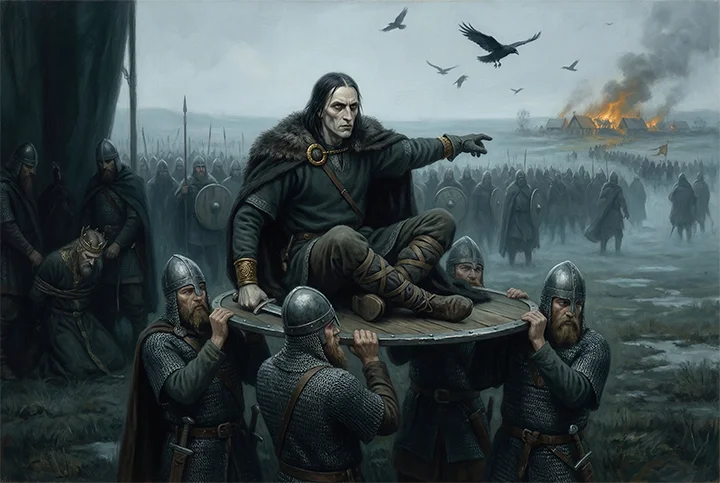
Overview
Ivar the Boneless, Old Norse Ívarr hinn Beinlausi, was a Norse warlord of the mid-ninth century and one of the most effective military commanders of the Viking Age. He was the son of the legendary Ragnar Lothbrok and the leader, alongside his brothers, of the Great Heathen Army that invaded England in 865 and spent the following decade conquering large portions of it. He is credited in the Norse sources with the execution of King Ælla of Northumbria by the ritual method known as the blood eagle, carried out in vengeance for his father's death in Ælla's snake pit. He founded a dynasty in Dublin that persisted for generations.
Sources
The primary sources for Ivar are a combination of the Icelandic saga tradition and the Anglo-Saxon and Irish annalistic tradition. The Norse sources include the Ragnars saga Lodbrókar and the Ragnarssona þáttr. The Anglo-Saxon Chronicle records the arrival of the micel hæþen here, the great heathen army, in East Anglia in 865. The Irish Annals, particularly the Annals of Ulster and the Annals of the Four Masters, record a figure named Ímar as a major Norse leader in Ireland from the 850s onward and his death in 873, generally identified with the Ivar of the English sources. The identification of the Ivar of the sagas, the Ivar of the Anglo-Saxon Chronicle and the Ímar of the Irish Annals as a single historical person is accepted by most scholars on chronological and onomastic grounds.
The Cognomen Boneless
The meaning of the cognomen Boneless, Old Norse Beinlausi, has been the subject of sustained scholarly discussion. Several interpretations have been proposed. The oldest and most literal reading suggests a physical condition, either that Ivar had abnormally flexible limbs suggesting a connective tissue disorder such as Ehlers-Danlos syndrome, or that he had some form of lower limb impairment. The sagas describe him as being carried on a shield by his warriors in battle, which would be consistent with an inability to walk. A second interpretation connects Beinlausi to a term for sexual impotence rather than physical bonelessness. A third interpretation suggests the name is a nickname derived from his extraordinary physical flexibility. A fourth interpretation reads the cognomen as a poetic or metaphorical term meaning someone whose character is supple or shifting rather than rigid, an ironic description of a man noted for strategic cunning. None of these interpretations has achieved consensus.
The Great Heathen Army and the Conquest of Northumbria
In 865 a large Norse force landed in East Anglia and was provided with horses by the East Anglian king in exchange for peace. The Great Heathen Army used these horses to move north into Northumbria the following year. Northumbria in 866 was in the middle of a civil war between two rival kings, Ælla and Osberht. The Norse army captured York in November 866. The two Northumbrian kings launched a joint assault to retake the city in March 867. The assault failed catastrophically: both kings were killed, the Northumbrian army was destroyed, and the Norse installed a client king. The capture of York established the strategic base from which the Norse would control northern England for generations; the city became Jórvík, the principal urban center of the Danelaw. The Norse sources describe the death of King Ælla as occurring by the blood eagle, attributed to Ivar specifically as the act of vengeance for Ragnar's death in Ælla's snake pit. Whether the blood eagle was a historical practice or a literary elaboration remains debated.
The Campaign in England: East Anglia, Mercia and Wessex
After securing Northumbria, the Great Heathen Army moved south into East Anglia in 869. King Edmund of East Anglia fought the Norse and was captured. Later hagiographical tradition describes him being tied to a tree, shot with arrows and beheaded after refusing to renounce his Christian faith. The army then moved against Mercia, extracting tribute, and subsequently against Wessex under its king Æthelred and his brother Alfred. The campaign against Wessex in 870 and 871 resulted in a series of battles with varying outcomes. The Norse were not able to conquer Wessex as they had conquered Northumbria and East Anglia. Ivar appears to have left the English campaign at some point in the early 870s, with the Irish annals recording Ímar's activities in Ireland from around 871 onward.
Ivar in Ireland and the Uí Ímair Dynasty
The Irish annals record a Norse leader named Ímar operating in Ireland from at least the late 850s. The 869 entry records Ímar and Óláfr returning to Ireland from Britain with a large host and two hundred ships carrying British captives. The 873 entry records the death of Ímar, king of the Norsemen of all Ireland and Britain. The dynasty founded by Ímar, known to historians as the Uí Ímair or descendants of Ivar, dominated Norse Dublin and exerted influence across a wide area of the British Isles and Ireland for more than a century. Members of the family ruled Dublin, controlled the Isle of Man and the western isles of Scotland, intervened in northern English politics, and maintained connections with Norse York. The Uí Ímair represented the most successful example of a Norse dynasty establishing long-term political authority in the British Isles outside of the Danelaw itself.
Legacy and Significance
Ivar the Boneless is one of the most historically significant Norse leaders of the ninth century. His role in the Great Heathen Army established the political and demographic transformation of northern and eastern England that became the Danelaw. His Irish activities and the dynasty he founded shaped the political landscape of Ireland and western Britain for more than a century. The combination of his legendary status in the saga tradition, where he appears as the calculating avenger of Ragnar, and his documented historical impact in two separate countries makes him one of the most fully attested and most consequential Viking Age figures whose career can be examined across multiple independent source traditions.