Runestones, Seiðr, Galdr and the Magical Traditions of the Norse World
Overview
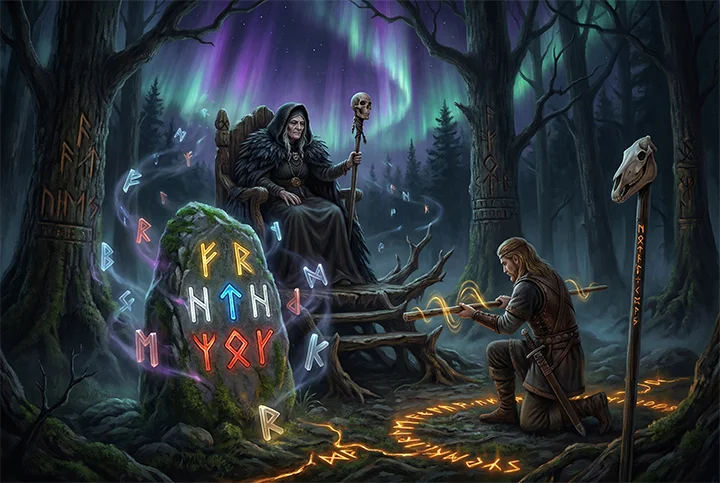
Magic in the Norse world was not a single unified practice but a complex of overlapping traditions that included runic magic, the seiðr tradition associated with the Vanir and with Freya, galdr or incantation magic, and a range of folk magical practices attested in the sagas and in the archaeological record. These traditions were embedded in a cosmological framework in which the ability to influence events through non-physical means was understood as real and in which the knowledge required to do so was held to have been obtained by Odin himself at enormous personal cost.
Runic Magic
The connection between runes and magic is established in the mythological tradition through the account of Odin's self-sacrifice on Yggdrasil in the Hávamál. Odin hung on the world tree for nine nights, wounded by a spear, in a sacrifice of himself to himself, until the runes rose up from the depths and he seized them. The Hávamál then lists eighteen specific magical applications of runic knowledge that Odin commands as a result: healing the sick, blunting enemy weapons, freeing himself from bonds, extinguishing fire, calming storms, turning spells back on their senders, winning love, securing victory in battle, waking the dead to speak, and others. This mythological foundation establishes the runes not as a writing system secondarily given magical associations, but as inherently magical characters whose phonetic function was an extension of their deeper power.
In practice, runic magic operated through the carving of specific runes or runic sequences on objects, surfaces or the human body to achieve specific effects. Inscriptions on weapons asked for victory. Inscriptions on jewelry provided protection to the wearer. The practice of níð, formal poetic defamation combined with runic inscription, was a recognized magical and legal weapon. Egils saga describes Egill Skallagrímsson erecting a níð pole with a horse's head directed at King Eiríkr and Queen Gunnhildr and the land spirits of Norway, carving defamatory runes to enforce a curse.
Seiðr
Seiðr was a form of magic specifically associated with the Vanir gods and particularly with Freya, who is described in the Ynglinga saga as the one who first taught this art to the Aesir. It involved entering a trance state in which the practitioner's consciousness traveled through the Norse cosmos, gaining prophetic knowledge or the ability to influence events at a distance. The practitioner performed the working from a raised platform called a seiðhjallr, often with assistants who sang a chant called a varðlokur to facilitate the trance. Seiðr was closely associated with the Sámi shamanic tradition and with the concept of ergi, a complex of ideas related to unmanliness, which made male practitioners of seiðr subject to social stigma. Odin himself is described as practicing seiðr, and Loki uses this as an accusation against him in the Lokasenna.
Galdr and the Völva
Galdr, from a verb meaning to sing or chant, was the practice of spoken or sung magical incantation. It is distinguished from seiðr by its active, verbal character and its association more clearly with the Aesir tradition. The völva was a professional female practitioner of seiðr and prophecy, a wandering seeress who traveled from settlement to settlement. The Völuspá of the Poetic Edda is narrated by a völva who recounts the entire history and fate of the cosmos to Odin, positioning the völva as the supreme reservoir of prophetic knowledge in the Norse tradition. Eiriks saga rauða describes a völva named Þorbjörg lítilvölva being received at a Greenland farm and successfully prophesying the end of a famine, providing one of the most detailed descriptions of seiðr practice in the saga literature.
Magical Objects and Amulets
The archaeological record contains numerous objects with apparent magical functions. Thor's hammer pendants, the Mjolnir-shaped amulets found in large numbers across Scandinavia and Norse settlement areas in Britain and Ireland, were the most widely distributed magical protective objects in the Viking Age. The Ribe skull fragment, a cranial fragment found in Denmark with a runic inscription addressing specific named supernatural beings and asking them not to harm the person named, is one of the most direct surviving examples of an object designed for a specific magical protection purpose.
Legacy and Significance
The Norse magical traditions represent one of the richest bodies of documented pre-Christian European magical practice, combining a sophisticated cosmological framework, a detailed mythological origin narrative, a range of specialist practitioners and techniques, and a material culture of magical objects that survives in the archaeological record. The integration of runic magic, seiðr and galdr into a coherent worldview gives the Norse magical tradition a philosophical depth that distinguishes it from the more fragmentarily attested magical practices of most other pre-Christian European cultures.