The Networks That Connected the Viking World from Vinland to Baghdad
Overview
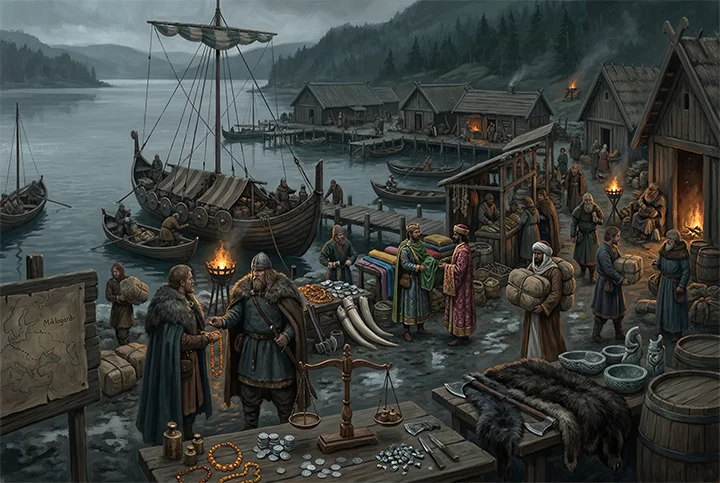
Norse merchants and traders operated across one of the most extensive commercial networks in the medieval world, spanning from the coasts of North America in the west to the Caspian Sea and the Abbasid Caliphate in the east, from the Arctic hunting grounds of northern Scandinavia in the north to the Mediterranean ports of Byzantium and the Islamic world in the south. The trade routes they established and maintained between the eighth and eleventh centuries carried furs, slaves, amber, walrus ivory, iron, timber, wool and honey outward from Scandinavia and the Norse settlement regions, and returned silver, silk, spices, wine, glass, weapons and prestige goods to the Norse homeland. The network was not a single unified enterprise but a web of overlapping routes operated by individual merchants, trading associations and royal agents, each segment of which connected into adjacent segments to create a system of exchange that moved goods across thousands of miles through dozens of intermediate hands.
The Eastern Routes: Varangian Paths to Byzantium and Baghdad
The eastern trade routes, collectively known to the Norse as the Austrvegr or eastern way, were among the most economically significant in the entire Norse commercial system. They ran from the Baltic coast, particularly from the Swedish trading centers of Birka and Hedeby, eastward into the river systems of what is now Russia, Belarus and Ukraine, and from there southward to the Black Sea and Constantinople or to the Caspian Sea and the markets of the Abbasid Caliphate.
The primary route to Byzantium followed the Dnieper River southward from the vicinity of Lake Ladoga and Novgorod to the Black Sea. The Rus Primary Chronicle, compiled in the early twelfth century, describes this route in detail, including the series of dangerous rapids on the Dnieper that required ships to be unloaded, carried overland or dragged past the obstacles, and then reloaded before continuing south. Byzantine sources from the tenth century, particularly the work of the emperor Constantine VII Porphyrogennetos, provide additional detail on the operation of this route and on the goods exchanged at Constantinople.
The primary route to the Islamic world followed the Volga River southward from the upper Volga trading centers to the Caspian Sea and the cities of the Khazar Khaganate and beyond. The Arab geographer Ibn Khurradadhbih, writing around 870, describes Rus merchants traveling to Baghdad and selling furs, swords and slaves to Muslim buyers. The Arab traveler Ahmad ibn Fadlan encountered a group of Rus merchants on the Volga in 921 and left one of the most detailed eyewitness accounts of Norse traders in any medieval source, describing their physical appearance, their trading practices, their religious observances and the funeral of one of their chieftains in precise detail.
The primary commodity moving east on these routes was slaves, followed by furs from the northern forests, walrus ivory from the Arctic, and amber from the Baltic coast. The primary commodity moving west was silver, particularly the Islamic dirham, which flooded into Scandinavia in such quantities that silver hoards of dirhams are among the most common archaeological finds from the Viking Age in Sweden, Norway and Denmark. Approximately eighty-five thousand Islamic coins have been recovered from Scandinavian archaeological contexts, representing a fraction of the total that must have circulated.
The trading centers that served as nodes on the eastern routes included Staraya Ladoga, established in the mid-eighth century on the Volkhov River near Lake Ladoga, which is the earliest securely identified Norse settlement in the east. Novgorod, Gnezdovo near Smolensk, and Kyiv were subsequent major centers, each positioned at a strategic point on the river network to facilitate the exchange of goods between Baltic merchants and the populations of the interior.
The Western Routes: Britain, Ireland and the North Atlantic
The western trade routes operated across the North Sea and the Irish Sea, connecting Scandinavia to the trading centers of England, Ireland, Frankia and the emerging Norse settlement regions of the North Atlantic. The primary commodities moving west from Scandinavia were iron, soapstone vessels, whetstones and timber, all materials in which Scandinavia was well supplied and the British Isles were deficient. Moving east in return were wool, grain, tin, silver and manufactured textiles.
York, known to the Norse as Jórvík, was the principal trading center of Norse England, and the archaeological excavations of Coppergate in the 1970s and 1980s produced one of the most detailed pictures of urban commercial life in the Viking Age available anywhere in the archaeological record. The finds at Coppergate include evidence of craft production in leather, wood, bone, amber and metal, imported goods from across the Norse world and beyond, and structural remains of the workshops and dwelling houses of a densely occupied commercial district active from the late ninth to the late tenth centuries.
Dublin, established as a Norse longphort in 841, became one of the most important trading centers in the Irish Sea region and remained so through the eleventh century. The Norse trading network in the Irish Sea connected Dublin to York, to the Isle of Man, to the Norse settlements in the western and northern isles of Scotland, and to the Norse communities on the coasts of Wales and southwest England. The Dublin excavations at Wood Quay, conducted between 1974 and 1981, revealed extensive evidence of Norse urban commercial activity including imported goods from Scandinavia, England, Frankia and the Islamic world.
The Northern Routes: Arctic Resources and the Faroe Islands
The northern trade routes ran into the Arctic regions of Norway and, after settlement, into Iceland, Greenland and ultimately North America. The primary commodities produced by the Arctic trade were walrus ivory, walrus hide rope, polar bear skins, live polar bears, narwhal tusks sold as unicorn horn, white gyrfalcons prized throughout the medieval world as hunting birds, and eiderdown. These luxury goods commanded high prices in the markets of southern Scandinavia and Europe, and the trade in them sustained the Norse settlements in Greenland economically for centuries.
The Faroes, settled by Norse colonists from approximately 800, served as a staging point for the North Atlantic routes to Iceland. Iceland, settled from approximately 870, became both a destination and a transit point, supplying sulphur, fish, woolen cloth called vaðmál which served as a currency medium, and animal products to the Norse world in exchange for grain, timber, iron and manufactured goods that the island could not produce itself. The Greenland settlements, established by Eirik the Red around 985, supplied the luxury Arctic goods described above in exchange for the same imports that Iceland required.
Trading Centers and Market Towns
The Norse commercial network was organized around a series of market towns and seasonal trading sites that served as collection and distribution points for regional goods. The most important of these in Scandinavia were Hedeby in southern Jutland, Birka on an island in Lake Mälaren in Sweden, Kaupang in Vestfold in Norway, and Ribe on the west coast of Jutland. Each of these sites has been extensively excavated and each has produced evidence of wide-ranging international commercial connections.
Hedeby, occupied from approximately 770 to its destruction around 1050, was at various times under Danish, Swedish and German control, reflecting its position at the junction of the overland route across the Jutland peninsula and the sea routes of the Baltic and North Sea. The excavations at Hedeby have produced evidence of craft production and trade goods from England, Frankia, the Rhineland, Scandinavia and the eastern routes, making it one of the most cosmopolitan sites in the Viking Age archaeological record.
Birka, active from approximately 750 to around 975, was the principal trading center of Svealand and the main point of entry for goods arriving from the eastern routes. The cemetery at Birka contains graves with goods from across the Norse world and from Byzantium and the Islamic world, including silk textiles, glass beads and silver jewelry of eastern manufacture, demonstrating the depth of commercial integration between Sweden and the distant markets of the east.
Ships, Merchants and Commercial Practice
The commercial vessel of the Norse trade network was the knarr, a broad, deep-keeled sailing ship designed for cargo capacity rather than speed, capable of carrying several tons of goods across open ocean. The knarr differed substantially from the longship in its proportions and its reliance on sail rather than oar power, reflecting the different requirements of commercial and military navigation. Several knarrs have been preserved in archaeological contexts, most notably the five Skuldelev ships found in Roskilde Fjord in Denmark, of which two were identified as knarrs of different sizes.
Norse merchants operated within a system of weights and measures that facilitated exchange across the network. The Norse weight system was based on the mark and its subdivisions, and the uniformity of weights found across the Norse world in archaeological contexts suggests a common standard that enabled merchants from different regions to transact business without dispute over the value of goods. Silver was the primary medium of exchange, weighed out rather than used as coin in many transactions, which is why Viking Age silver hoards frequently contain chopped fragments of silver objects alongside whole coins.
The legal framework for Norse commercial activity was provided by the Thing system, the assembly of free men that governed Norse communities, which established and enforced the rules under which trade was conducted, arbitrated disputes between merchants, and provided the guarantees of personal safety that made it possible for merchants to travel into foreign territories and conduct business. The Bjärköarätten, a set of town laws preserved in Swedish sources, provides detailed evidence of the legal regulations governing commercial activity in Norse market towns.
Decline and Legacy
The Norse trade network began to decline in the late tenth and eleventh centuries for several reasons. The collapse of the Abbasid Caliphate reduced the supply of Islamic silver that had been the primary return commodity on the eastern routes. The consolidation of political authority in England, Frankia and the Rhineland made raiding-based commercial activity less viable and shifted the balance toward more regulated trade conducted under royal supervision. The Christianization of Scandinavia brought Norse merchants into the European commercial system on terms more closely governed by the emerging merchant law of the Latin church.
The legacy of the Norse trade network is visible in the place names, linguistic borrowings and archaeological distributions that it left across half the world, in the silver hoards of Scandinavia that record the wealth that flowed back from the eastern markets, in the Norse loan words present in Russian, Irish, English and the Turkic languages of central Asia, and in the urban centers of Dublin, York, Kyiv and Novgorod whose foundations were laid or substantially developed by Norse commercial activity.