Norse Warriors in the Service of the Byzantine Emperors
Overview
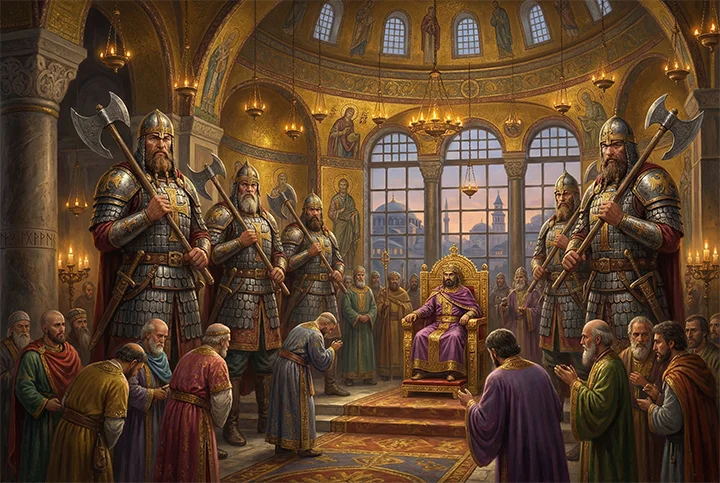
The Varangian Guard was an elite military unit of the Byzantine Empire composed primarily of Norse and later Anglo-Saxon warriors who served as the personal bodyguard of the Byzantine emperors from the late tenth century until the sack of Constantinople in 1204. The name Varangian derives from Old Norse Væringjar, meaning men of the pledge or sworn men, reflecting the oath of personal loyalty that bound each guardsman to the emperor. The unit was founded in 988 when the Byzantine emperor Basil II received six thousand Norse warriors from the Rus prince Vladimir of Kiev as part of a diplomatic and military alliance. It continued to recruit from Scandinavia, Kievan Rus and later from England, particularly after the Norman Conquest of 1066 brought large numbers of Anglo-Saxon aristocrats and warriors into exile. The Varangians fought in every major Byzantine military campaign from the late tenth to the early thirteenth century, serving in Syria, Bulgaria, Italy, the Holy Land and across the Balkans.
Sources
The primary sources for the Varangian Guard are Byzantine chronicles, particularly the works of John Skylitzes, Anna Komnene whose Alexiad describes Varangian participation in late eleventh-century campaigns, and John Kinnamos. Norse sources include the sagas of Icelanders who served in the Guard and the Kings' Sagas in the Heimskringla of Snorri Sturluson. A runic inscription on the upper gallery of Hagia Sophia, discovered in the nineteenth century and reading Halfdan carved these runes, is one of the most famous pieces of evidence for the Norse presence in the Byzantine capital.
The Foundation of the Guard
The formal foundation of the Varangian Guard in 988 followed the agreement between Emperor Basil II and Prince Vladimir I of Kievan Rus. Vladimir needed Byzantine support, including the hand of the emperor's sister Anna in marriage, to consolidate his own political position. Basil II needed military reinforcements urgently, as he was facing a dangerous rebellion by the general Bardas Phokas. The six thousand Rus warriors Vladimir sent arrived in time to decisively defeat Bardas Phokas at the Battle of Chrysopolis in 989. Basil II incorporated these warriors into a permanent imperial guard unit, recognizing the military value of foreign troops whose loyalty was directly to the emperor rather than to Byzantine aristocratic factions. The political logic of employing foreign guardsmen was well established in Byzantine imperial practice, and what distinguished the Varangian Guard from previous foreign units was the intensity of the personal loyalty bond it required, the quality of its warriors, and the prestige it rapidly acquired as the emperor's most reliable fighting force.
Recruitment and Service
Recruitment into the Varangian Guard was a prestigious and lucrative career for Norse warriors. The pay was substantial by Scandinavian standards, the opportunities for plunder in Byzantine military campaigns were considerable, and the social prestige of having served in Constantinople, which the Norse called Miklagarðr, the great city, was significant on return to Scandinavia. Several Icelandic sagas describe the careers of men who served in the Guard. Harald Hardrada, who became king of Norway in 1046 and was killed at the Battle of Stamford Bridge in 1066, served in the Varangian Guard in the 1030s and 1040s, rising to a command position. On completing their service and returning to Scandinavia, Varangian veterans brought home Byzantine gold, silk textiles, prestige objects and cultural influences traceable in the archaeological and artistic record of Scandinavia.
The Anglo-Saxon Varangians
After the Norman Conquest of England in 1066, a significant number of Anglo-Saxon aristocrats and warriors who refused to accept Norman rule emigrated from England. Many of these exiles, bearing a deep hostility to the Normans, made their way to Constantinople and joined the Varangian Guard. Byzantine sources from the late eleventh century onward describe the English element of the Guard as significant, and some sources suggest that English replaced Norse as the primary language of the Guard by the early twelfth century. The presence of Anglo-Saxon warriors in Constantinople is attested by Byzantine chronicles and by Anna Komnene's Alexiad describing English warriors in the Guard during the reign of Alexios I Komnenos.
The Guard in Battle
The Varangian Guard was deployed in battle as a heavy infantry shock force, typically equipped with the long-handled Danish axe, the characteristic weapon associated with Varangian warriors in Byzantine sources. Byzantine military treatises describe the Varangians as fierce and effective in close combat, particularly in the initial assault where their size, equipment and ferocity gave them an advantage over most opponents. They fought in Bulgaria against the Bulgarians, in Asia Minor against the Seljuk Turks, in Italy against the Normans, in the Holy Land during the First Crusade period, and in numerous other theaters of Byzantine military operations. The defeat at the Battle of Manzikert in 1071 severely reduced the effectiveness of the imperial military including the Varangian Guard.
Legacy and Significance
The Varangian Guard is one of the most striking examples of the long-range reach of Norse military activity in the Viking Age, a direct institutional connection between the fjords of Scandinavia and the court of the Byzantine emperors in one of the world's most sophisticated and ancient cities. The Guard demonstrates that the same Norse capacity for travel, fighting and the formation of personal loyalty bonds that produced the Viking raids of western Europe could, in the right political context, produce an institutional presence at the heart of a major imperial power. The runic inscription in Hagia Sophia remains the most evocative physical evidence of this connection: a Norse warrior, in the greatest church in Christendom, carving his name into the stone of the empire he was sworn to defend.