The King Who Saved England and Built the Foundations of a Nation
Overview
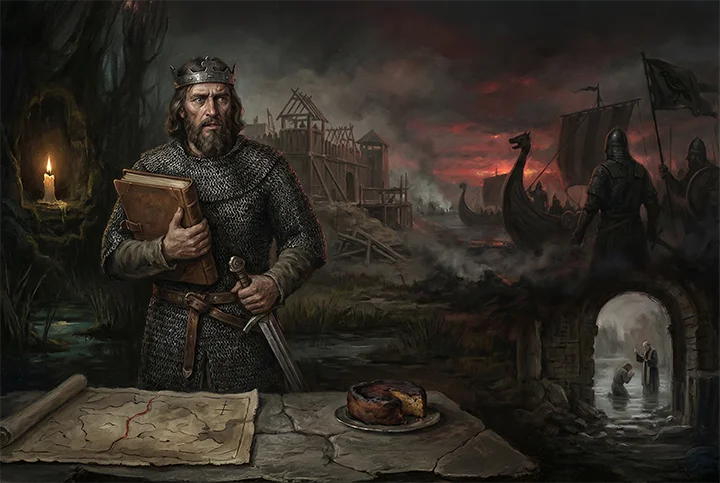
The conflict between King Alfred of Wessex and the Norse forces that had already conquered Northumbria, East Anglia and large parts of Mercia is one of the most consequential political and military confrontations in the history of medieval Europe. Alfred, who ruled Wessex from 871 until his death in 899 and is the only English king to whom history has given the epithet the Great, came to the throne of the one surviving Anglo-Saxon kingdom that had not yet been conquered by the Norse. He spent the first years of his reign paying tribute to avoid destruction, then suffered a catastrophic near-defeat in 878 when the Norse king Guthrum launched a surprise winter attack that drove him from his kingdom. From hiding in the Somerset marshes, Alfred rebuilt his forces, defeated Guthrum at the Battle of Edington, imposed the Treaty of Wedmore and the subsequent Treaty of Alfred and Guthrum that divided England between Wessex and the Danelaw, and spent the rest of his reign building the defensive and institutional foundations that made the eventual English reconquest of the Danelaw possible.
Sources
The primary sources for Alfred's conflict with the Norse are the Anglo-Saxon Chronicle, compiled under Alfred's supervision and therefore reflecting the West Saxon perspective, Asser's Life of Alfred written by the Welsh bishop Asser who was a member of Alfred's court, and archaeological evidence from the fortified towns called burhs that Alfred constructed across Wessex. The Chronicle entries for 871 to 878 are among the most detailed and temporally proximate records of any event in early medieval England. Asser's biography, written in 893 during Alfred's lifetime, provides personal detail and context not available in the Chronicle entries.
The Situation When Alfred Became King
Alfred became king of Wessex in 871 in circumstances of acute military crisis. The Great Heathen Army had been operating in England since 865. In 871 it moved against Wessex and fought a series of battles that the Anglo-Saxon Chronicle records with unusual density: the battles of Englefield, Reading, Ashdown, Basing, Meretun and Wilton are all recorded within a single year. Alfred's brother King Æthelred died in April 871, and Alfred succeeded him during an active military campaign. The Norse could not be decisively defeated in the field, and Alfred's first significant act as king was to purchase peace by paying tribute.
The Crisis of 878: Chippenham and the Somerset Marshes
In January 878, during the period between Christmas and Epiphany when large-scale military campaigns were conventionally suspended, Guthrum launched a surprise attack on Alfred's royal estate at Chippenham. The attack achieved almost complete surprise. Alfred's household was dispersed or captured. Alfred himself escaped with a small band of followers into the marshland of Somerset, where he established a refuge at or near the island of Athelney. What is recorded in the contemporary sources is that Alfred sent messengers throughout Somerset, Wiltshire and western Hampshire summoning his fighting men to Egbert's Stone. A large force assembled. Alfred led it against Guthrum's army at Edington in Wiltshire. The Battle of Edington, fought in May 878, resulted in a decisive West Saxon victory. Guthrum's army retreated to Chippenham and was besieged for two weeks before surrendering.
The Treaty of Wedmore and the Conversion of Guthrum
The terms Alfred imposed after Edington combined military settlement with religious conversion. Guthrum and thirty of his leading men agreed to receive Christian baptism. Alfred stood as Guthrum's godfather at the baptism, which took place at Aller in Somerset. Guthrum took the Christian name Æthelstan. The subsequent Treaty of Alfred and Guthrum established the boundary between Alfred's kingdom and the Danelaw, running roughly along the Thames, then north along the River Lea, then across to Bedford and along the Ouse to Watling Street. The treaty also established legal provisions for the resolution of disputes between English and Norse inhabitants of the two zones.
The Burh System and Alfred's Military Reforms
After Edington, Alfred undertook a systematic program of military and administrative reform. The central element was the construction of a network of fortified towns, called burhs, distributed across Wessex at intervals calculated to ensure that no point in the kingdom was more than twenty miles from a burh. A document known as the Burghal Hidage lists thirty burhs and specifies the number of men required to garrison each one. The burh system served multiple functions: each burh was a fortified refuge where the local population could shelter during a Norse raid, and together they formed a network that prevented the kind of rapid deep-penetration raids that had characterized Norse operations before Edington. The burhs also became administrative and commercial centers, including Winchester, Oxford and Exeter, and the network was the foundation of the English state that Alfred's son Edward and grandson Æthelstan would use to conquer the Danelaw.
Alfred's Naval Reforms
Alfred also reformed Wessex's naval capacity, ordering the construction of ships described in the Anglo-Saxon Chronicle as longer and swifter than the Norse ships and neither of the Frisian nor of the Danish pattern but as it seemed to Alfred himself that they could be most useful. The Chronicle records several engagements in which these ships fought Norse raiders with mixed results.
Legacy and Significance
Alfred's conflict with the Norse and its outcomes represent one of the decisive moments in the formation of England as a political entity. His survival of the 878 crisis, his victory at Edington and the institutional reforms he implemented created the conditions under which his successors were able to reconquer the Danelaw and establish the unified kingdom of England. Without Alfred's survival and the organizational infrastructure he built, the Norse conquest and permanent settlement of England south of the Thames was the likely outcome.