The King Who Unified Norway and Changed the Norse World Forever
Overview
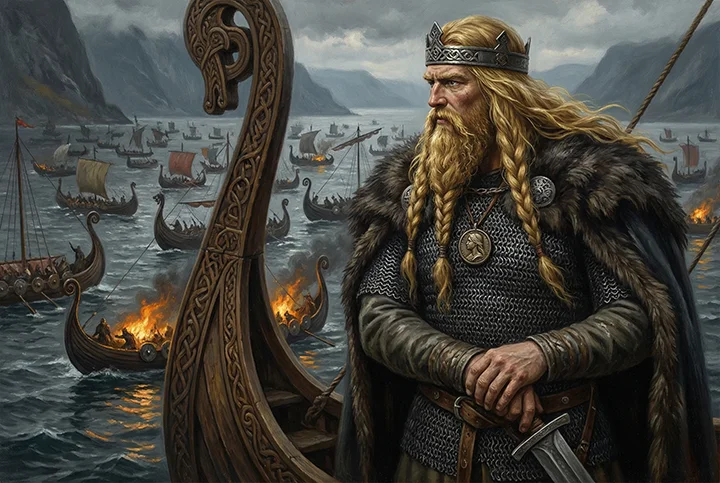
Harald Fairhair, Old Norse Haraldr hárfagri, is traditionally credited with being the first king of a unified Norway, the ruler who brought the previously independent petty kingdoms and chieftaincies of the Norwegian coastline under a single royal authority through a combination of military conquest, strategic alliance and dynastic marriage. His reign is conventionally dated to approximately 872 to 930, and the decisive battle of Hafrsfjord, at which he defeated a coalition of regional kings and established his dominance over western Norway, is traditionally dated to 872, though modern scholars place it more likely in the 880s or 890s. The consequences of his unification campaign extended far beyond Norway itself: the Norse settlers who colonized Iceland in the late ninth century included a substantial number of chieftains and their followers who chose emigration over submission to Harald's centralizing authority, and Icelandic tradition is explicit that the settlement of Iceland was driven in large part by the political disruption caused by Harald's campaigns.
Sources
The primary sources for Harald Fairhair are the kings' sagas of the twelfth and thirteenth centuries, particularly the Heimskringla of Snorri Sturluson, completed around 1230, which contains the Hárfagra saga as part of its comprehensive history of the kings of Norway. Additional information appears in the Fagrskinna, the Agrip af Noregskonunga sögum, the Landnámabók, and several skaldic poems composed during or shortly after Harald's reign, including verses attributed to the skalds Þorbjörn hornklofi and Auðunn illskælda.
The skaldic poems are the closest in time to the events they describe and therefore the most reliable sources for specific details of Harald's reign. Þorbjörn hornklofi's Haraldskvæði and Glymdrápa are court poems celebrating Harald's victories and his court, and they provide the earliest contemporary or near-contemporary evidence for his kingship. The sagas, compiled two to three centuries after the events they describe, reflect both genuine historical tradition and the literary elaboration of that tradition by Icelandic authors working in a specific legal and political context. Snorri's account in the Heimskringla is the fullest but is also the most literarily developed.
The Vow and the Campaign
The Heimskringla preserves the most famous account of the origin of Harald's unification campaign. According to Snorri, Harald was a minor king in the Vestfold region of southeastern Norway whose proposal of marriage to Gyða, daughter of a king of Hordaland, was refused on the grounds that she would not marry a man who ruled only a small part of Norway. She said she would only become his wife if he first unified all of Norway under his rule. Harald is said to have made a vow not to cut or comb his hair until he had accomplished this, which gave rise to the nickname hárfagri, fair hair or well-groomed hair, given to him when he finally had his hair cut after achieving his goal.
Whether this story is historical or legendary is not resolvable with the available evidence. The motif of a king making a vow of abstinence from grooming as a sign of unfinished business is found in other contexts and may be a literary framework applied to Harald's career by later saga writers. The core of the account, that Harald undertook a systematic campaign to extend his authority over Norway, is confirmed by the skaldic poetry and by the broad consistency of the saga tradition.
The Battle of Hafrsfjord
The battle of Hafrsfjord, fought near the modern city of Stavanger in southwestern Norway, is described in both the Heimskringla and in skaldic verse as the decisive engagement of Harald's unification campaign, the battle in which he defeated a coalition of regional kings who had united against his expansion. The Haraldskvæði of Þorbjörn hornklofi contains verses celebrating the victory at Hafrsfjord, describing the forces Harald defeated and the flight of his enemies. These verses are the nearest to contemporary evidence available for the battle.
The traditional date of 872 for the battle derives from the Icelandic annals and from the synchronization of Norse and Irish chronologies in medieval sources. Modern scholarly chronology places the battle in the 880s or 890s based on recalculation of the regnal years of the kings mentioned in the sagas and cross-referencing with external sources. The exact date remains uncertain, but the battle's status as the turning point of Harald's campaign is consistent across the sources.
Harald's Kingdom and Administration
Following his victories, Harald established a system of royal administration over Norway that represented a significant departure from the previous decentralized political structure of the Norwegian chieftaincies. He appointed his own men, called lendir menn or landed men, to administer districts throughout Norway, replacing the previous local rulers or reducing them to subordinate status. He claimed the right to odal land, the hereditary freehold land that was the economic and social foundation of Norse chieftaincy, asserting that all odal land in Norway was ultimately held from the king. This claim was deeply unpopular and is described in the sagas as one of the primary causes of emigration to Iceland.
Harald's court at Avaldsnes on the island of Karmøy in Rogaland was a major center of royal power and patronage. The Heimskringla describes it as a place where Harald kept a large household of warriors and retainers, received tribute from the districts of Norway, and was served by skalds who composed and performed poetry in his honor. Þorbjörn hornklofi's description of Harald's court in the Haraldskvæði includes details of the warriors who served him, the foreign visitors who attended, and the entertainers and skalds who performed there.
Harald's Marriages and Descendants
Harald Fairhair is described in the sagas as having married numerous times, with the Heimskringla listing nine wives and a substantial number of concubines, and attributing to him more than twenty sons, several of whom became significant figures in the subsequent history of Norway. The large number of sons created a succession problem that the saga tradition treats as a major source of political instability after Harald's death.
Among his sons, Eirik Bloodaxe, born of the Jutish princess Ragnhildr, is described as Harald's chosen heir and ruled Norway after his father's death, though he was eventually expelled by his brother Hákon the Good. Hákon, who had been fostered at the court of King Æthelstan of England, established himself as king of Norway and was the first Norwegian king to actively promote Christianity, though with limited success during his own lifetime. The descendants of Harald Fairhair ruled Norway until the male line died out in the twelfth century, and the dynasties of Norway, Denmark and Sweden all traced their royal genealogies back to him through various lines.
Among Harald's sons by the Sámi woman Snæfríðr, whom Snorri describes as a woman of supernatural beauty whose death Harald could not accept for three years, refusing to believe she was dead, was Rögnvaldr Réttilbeini, who was said to practice seidr magic and was killed by his brother Eirik on Harald's orders because seidr was considered unmanly for men to practice.
Harald and the Settlement of Iceland
The Landnámabók, the medieval Icelandic book of settlements, preserves the names and genealogies of approximately four hundred settler families who colonized Iceland between approximately 870 and 930. A significant proportion of these settlers are described as having come from Norway in response to Harald's unification campaign, either as men who had opposed him and feared his vengeance, or as chieftains who were unwilling to accept the subordinate status his kingship required of them. The Landnámabók records that several prominent settlers explicitly stated that their emigration was motivated by unwillingness to submit to Harald's authority.
The historical relationship between Harald's unification of Norway and the settlement of Iceland is more complex than the direct causal relationship described in the sagas. Archaeological and chronological evidence suggests that the settlement of Iceland began before Harald's campaigns were complete and that migration to Iceland was already underway from Norse communities in the British Isles as well as from Norway directly. Nevertheless, the correlation between the peak of Harald's campaigns and the peak of Icelandic settlement in the 870s and 880s supports the general outline of the saga tradition.
Harald in Skaldic Poetry
The skaldic poems composed in honor of Harald Fairhair are among the earliest securely datable compositions in the Norse skaldic tradition. The Haraldskvæði of Þorbjörn hornklofi, also known as the Hrafnsmál, praises Harald's victories, describes his fleet and his warriors, and portrays his court as a center of generosity and martial excellence. A second poem attributed to Þorbjörn hornklofi, the Hrafnsmál or Raven's Speech, takes the form of a dialogue between a raven and a valkyrie discussing the deeds of Harald and the warriors who serve him. These poems are significant not only as evidence for Harald's reign but as early examples of the court poetry tradition that would become one of the central institutions of Norse literary culture.
Legacy and Significance
Harald Fairhair's unification of Norway is one of the formative events of Scandinavian political history. It created the first recognizable Norwegian kingdom, established the precedent of royal authority over the previously independent chieftaincies, and set in motion the emigrations that populated Iceland and from Iceland contributed settlers to Greenland and Vinland. The saga tradition treats him as the foundation figure of Norwegian royal history, and the genealogical claims of subsequent Norwegian kings consistently traced their legitimacy back to descent from him.
The historical Harald is difficult to separate from the legendary Harald constructed by the saga tradition two to three centuries after his death. The core facts of his reign, a successful campaign to establish royal authority over Norway, a decisive battle in southwestern Norway, a court at Avaldsnes, a large number of sons, and a direct connection to the settlement of Iceland, are consistent across the sources and supported by the skaldic evidence. The details of his personal life, including the story of Gyða's refusal and the vow about his hair, belong to the literary elaboration of his legend and cannot be verified.