How Norse Raiders Became the Normans Who Changed the Medieval World
Overview
The settlement of Normandy by Norse raiders and the subsequent transformation of those settlers into the Normans is one of the most consequential processes in medieval European history. It begins in 911 with the Treaty of Saint-Clair-sur-Epte, in which the Frankish king Charles the Simple granted a tract of land in the lower Seine valley to the Norse leader Rollo in exchange for his conversion to Christianity, his homage to Charles as king, and his agreement to defend the coast against further Norse raiding. From this arrangement grew a duchy that within a century had become one of the most powerful political entities in western Europe, whose language had evolved from Norse to a Norman dialect of French, whose culture had absorbed and synthesized Norse, Frankish and Christian traditions, and whose military capacity was sufficient to conquer England in 1066, establish kingdoms in southern Italy and Sicily, and participate as a major force in the First Crusade.
Sources
The primary sources for the Normandy settlement are the Frankish annalistic tradition, particularly the Annales de Flodoard, the Annals of Flodoard of Reims, and the chronicle of Dudo of Saint-Quentin, written in the late tenth and early eleventh century at the request of the Norman dukes and presenting the founding of Normandy from the Norman perspective. Archaeological evidence, place name distributions and the early Norman charters supplement the narrative sources.
Rollo and the Treaty of Saint-Clair-sur-Epte
Rollo, Old Norse Hrólfr, was a Norse leader whose origins are described differently in different sources. The Norman chronicle tradition identifies him as a Norwegian of noble birth. The Icelandic saga tradition identifies him as the Norwegian chieftain Hrólf the Walker, so called because he was too large for any horse to carry him. What is established by contemporary Frankish sources is that a Norse leader operating in the Seine valley area agreed to a treaty with King Charles in 911. The Annals of Flodoard record the baptism of a Norse leader and his men and the granting of lands by Charles. The terms included Rollo's acceptance of Christianity, his homage to Charles, his marriage to Charles's daughter Gisela, and his obligation to defend the Frankish coast. In exchange he received the county of Rouen and the territory along the lower Seine.
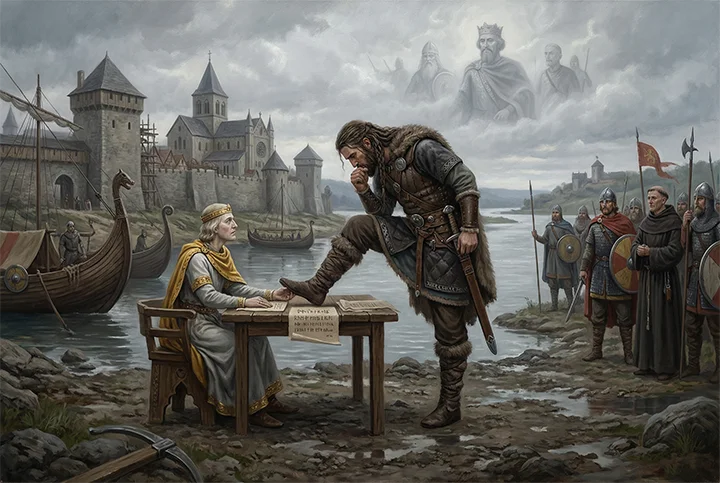
The ceremony by which Rollo performed homage is described in later Norman sources in terms that reflect the cultural gulf between the two parties. Rollo was required to kneel and kiss the king's foot. According to Dudo's account, Rollo refused personally and designated one of his men to do it in his place. The designated man grabbed Charles's foot and lifted it to his mouth while standing, causing the king to fall backward off his throne. Whether this episode is historical or legendary, it captures something real about the negotiation between two parties with very different frameworks for understanding hierarchy.
The Settlement Process
The settlement of Normandy was not accomplished in a single treaty. Over the following decades the Norse territory was extended through additional grants and through the forcible occupation of adjacent areas. Rollo's son William Longsword, who succeeded him around 927, extended Normandy westward to include the Cotentin and Avranchin regions. The place name evidence in Normandy reflects mixed origins: Norse place name elements are concentrated in the coastal areas and the lower Seine valley, where the original settlement was densest, and thin out inland.
The Transformation from Norse to Norman
The rapidity with which the Norse settlers of Normandy adopted the Frankish language and culture is one of the most discussed phenomena in Viking Age history. Within two or three generations of the initial settlement, the Norse language had effectively disappeared from Normandy as a spoken vernacular and had been replaced by a dialect of Old French that retained some Norse vocabulary. By the time of the Norman Conquest of England in 1066, the conquerors spoke a Romance language. Several explanations have been proposed for this rapid shift. The Norse settlers were a minority in a numerically much larger Frankish population. Intermarriage was extensive and rapid. Christianity was adopted as part of the political settlement and brought with it the cultural infrastructure of the Frankish church.
The Norman Achievement
The Duchy of Normandy became within a century one of the most powerful and culturally productive political entities in western Europe. The Norman conquests of England in 1066 under William the Conqueror, of southern Italy and Sicily from the 1050s onward, and the Norman role in the First Crusade established a Norman political presence from the British Isles to the Holy Land. The Norman Conquest of England had consequences still visible in the English language, English law and English institutions. The English words beef, pork and mutton derive from the Norman French boeuf, porc and mouton, while the animals themselves, cow, pig and sheep, retain their Old English names, a linguistic fossil of the social division between Norman lords and English peasants.
Legacy and Significance
The Normandy settlement is one of the most significant examples of Norse adaptability and cultural transformation in the historical record. It demonstrates that the same Norse capacity for long-range movement and forceful occupation that produced the raid-and-withdraw pattern of early Viking Age operations could, under the right conditions, produce a lasting territorial and political settlement that absorbed and ultimately surpassed the culture of the peoples it had initially disrupted. The Normans were, in a direct genealogical and political sense, the Norse of the Seine valley a hundred years later, and their achievement in reshaping England, southern Italy and the crusader states was built on foundations laid by the treaty of 911.