Blót, Mead Halls and the Culture of Feasting in the Viking Age
Overview
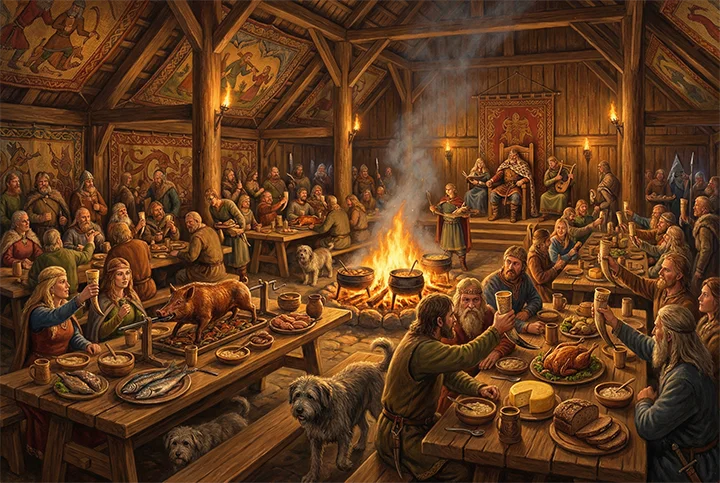
Food and feasting in the Norse world were not simply matters of sustenance but central elements of religious practice, political organization, social bonding and the expression of status and generosity. The feast, veizla in Old Norse, was the primary occasion for the reinforcement of social bonds between a lord and his followers, the redistribution of wealth downward through a hierarchy, and the performance of religious ritual through the blót, the sacrificial feast at which animals were killed, blood was sprinkled on participants and on sacred objects, and meat was consumed in a ceremony that combined nourishment with worship. The mead hall was the physical center of this culture, the building in which lord and retainer ate together, slept together, received gifts and gave gifts, and maintained the relationship of loyalty and generosity that was the foundation of Norse political organization at every level from the household to the kingdom.
Staple Foods
The diet of Viking Age Scandinavians was substantially shaped by the agricultural and environmental conditions of the regions they inhabited. Grain, particularly barley, rye and oats, formed the basis of the diet in the form of porridge, flatbreads and leavened bread, with wheat less common and more prestigious. Dairy products were central to the diet: butter, cheese, skyr, a strained yogurt product still consumed in Iceland today, and various forms of fermented milk were produced in large quantities from cattle and sheep. Fish, both fresh and preserved by drying, salting and fermenting, was enormously important in Norse diet and was the primary protein source in coastal and island communities. Meat, primarily from cattle, sheep, pigs and goats, was available seasonally and was preserved by smoking, salting and drying for winter consumption. Wild game including deer, elk, bear and birds supplemented the domesticated animal diet, and hunting was both a source of food and a prestigious activity associated with warrior culture.
The archaeological and archaeobotanical evidence for Norse diet is substantial. Analysis of stable isotopes in Norse skeletal remains from different periods and regions allows the reconstruction of dietary patterns across different social groups: the data consistently shows high levels of animal protein and marine protein in Norse diets, with variation between regions reflecting the relative importance of farming versus fishing in local economies. Seeds, plant remains and food residues preserved in cooking vessels and middens supplement the isotopic data with information about specific plant foods consumed.
Drink: Mead, Ale and the Feasting Culture
Mead, Old Norse mjöðr, was the prestige drink of the Norse world, made from fermented honey and water and consumed primarily in ritual and elite feasting contexts. Its mythological significance was extraordinary: the Mead of Poetry, brewed by the dwarves Fjalarr and Galarr from the blood of the wise being Kvasir mixed with honey, was the substance that gave the ability to compose skaldic poetry to whoever drank it, and Odin's acquisition of this mead from the giant Suttungr through a combination of deception, seduction and transformation is one of the major mythological narratives of the Norse tradition. The equation of mead with poetic inspiration, divine wisdom and the most prestigious form of human intellectual achievement reflects the central position of mead in Norse ritual and social life.
Ale, Old Norse öl, made from fermented grain, was the everyday drink of the Norse world, more widely available than mead because grain was more abundant than honey. Beer and ale were produced in household quantities for daily consumption and in larger quantities for feasts. The ale served at a feast was the medium through which the lord's generosity was most directly expressed to his followers: the serving of ale at a feast was the host's primary obligation to his guests, and the failure to provide adequate drink was a serious social failure equivalent to a failure of hospitality. The word for feast itself, veizla, is often glossed as a drinking occasion, reflecting how central drink was to the Norse conception of collective celebration.
The Blót
The blót was the primary form of Norse public religious practice, a sacrificial feast in which animals were killed and their blood used in ritual ways while their flesh was consumed by the participants. The Old Norse word blót means sacrifice or blood sacrifice, and the practice combined animal killing with communal eating in a way that made the consumption of meat itself a religious act. Adam of Bremen's description of the great blót at Uppsala, held every nine years, describes the sacrifice of nine individuals of every living species of male animal, including humans, whose bodies were hung in a sacred grove beside the temple. The reliability of Adam's description has been debated but the general practice of animal sacrifice at blóts is confirmed by multiple other sources and by archaeological evidence of animal bone deposits at ritual sites.
The main blóts of the Norse calendar included Dísablót in late winter or early spring, associated with the dísir, female supernatural beings connected to fertility and the household; Sigrblót in spring, associated with victory in the coming season; and Hökunótt or Winter Nights in mid-autumn, associated with the beginning of winter and with offerings to Odin for victory, to the Vanir for good harvests, and to the elves for health. The Yule celebrations at midwinter, jól, were also associated with sacrificial practice and formed the most important festival in the Norse calendar, with associations with Odin in his role as the leader of the Wild Hunt that survived into Scandinavian Christmas tradition as the figure of the gift-giving old man associated with this season.
The Mead Hall
The mead hall, Old Norse höll or skáli, was the central building of a Norse chieftain's or king's establishment and the physical space in which the feasting culture was enacted. The hall was long and rectangular, with a central hearth running down its length, sleeping benches along the long walls that served as seating by day and beds by night, and a high seat, öndvegi, for the lord at one end and often for the most honored guest at the other. The hall described in Heorot in the Old English poem Beowulf, built by the Danish king Hrothgar as the expression of his power and generosity, corresponds closely to what is known from the archaeology of Norse halls, demonstrating that the mead hall culture was common across the Germanic world of the Migration and Viking Ages.
Archaeological excavation of Norse halls at sites including Lejre in Denmark, Uppåkra in Sweden and the royal site at Borre in Norway has revealed structures of considerable size and sophistication, with evidence of feasting activity including large quantities of animal bone, fragments of imported glass drinking vessels, and residues of alcoholic beverages in pottery vessels. The construction of a great hall was one of the primary expressions of political authority in the Norse world, and the maintenance of a generous hall culture in which followers were regularly feasted was one of the primary obligations of a Norse lord.
Legacy and Significance
The food and feasting culture of the Norse world represents a dimension of Viking Age society that is less visible than the martial and navigational achievements that dominate popular representation but was equally central to the functioning of Norse political and religious life. The blót tied the community to its gods through shared consumption. The mead hall tied the lord to his followers through shared drink. The skaldic poetry that was composed and performed at these feasts was the medium through which the community's history was recorded and its values expressed. Food was not merely fuel in the Norse world but the medium of almost every form of social and religious bonding.