Tactics, Weapons and the Art of War in the Norse World
Overview
Viking warfare is one of the most misrepresented subjects in popular history, dominated by images of berserkers in horned helmets charging without formation or strategy into hopeless odds. The reality was considerably more sophisticated. Norse warriors were professional fighters who operated within a coherent tactical tradition, used a range of specialized weapons matched to specific combat roles, organized themselves into disciplined formations when circumstances demanded it, and supplemented direct combat with raiding strategies of exceptional cunning and logistical sophistication. The terror they inspired across two centuries of European history was not the product of reckless ferocity but of a combination of speed, surprise, tactical flexibility and a willingness to fight that their opponents, whose armies were often conscript levies with limited training, consistently underestimated until it was too late.
The Norse relationship with warfare was also deeply embedded in their religious and mythological worldview. Odin was the god of war and death in battle, and the warriors who died fighting went to Valhalla to feast and prepare for Ragnarok. The valkyries chose the slain on the battlefield. Battle was not merely a political or economic activity but a cosmic one, connected at every point to the divine order and to the fate that the Norns had already woven. A Norse warrior went into battle knowing that his death there, if it came, was the best death available to him, and this knowledge, whether it produced the calm of acceptance or the fury of the berserker, was a genuine psychological advantage over opponents who feared death as an ending rather than as a destination.
Weapons and Equipment
The primary weapon of the Norse warrior was the spear, not the axe as popular culture suggests. Spears were inexpensive to produce, effective in formation fighting, and versatile enough to be used for both thrusting and throwing. A well-equipped Norse warrior carried a spear of approximately two meters in length with an iron head and an ash shaft, a shield, and a knife or seax as a secondary weapon. The sword was a prestige weapon, expensive and time-consuming to produce, and carried by leaders and successful warriors who could afford them.
The axe, the most visually distinctive Norse weapon in modern imagination, was indeed used but was more commonly a tool than a dedicated weapon. The bearded axe, with its extended lower blade edge, was designed to hook an opponent's shield and pull it down to expose the body behind it, a technique that required training and practice to use effectively. The Dane axe, a large two-handed weapon with a long curved blade, was a genuine battlefield weapon of considerable power, capable of cutting through mail armor, but its size and the two-handed grip required meant that a warrior using it could not simultaneously hold a shield.
Norse armor varied considerably by wealth and status. A common warrior might have a leather cap, a shield and a spear. A more prosperous warrior might add a helmet, typically a simple iron cap with a nose guard rather than the horned variety of popular imagination, which has no archaeological basis and appears to have been invented in nineteenth-century romanticism. The wealthiest warriors and chieftains wore mail shirts, expensive garments of interlocked iron rings that offered substantial protection against cutting blows while allowing freedom of movement.
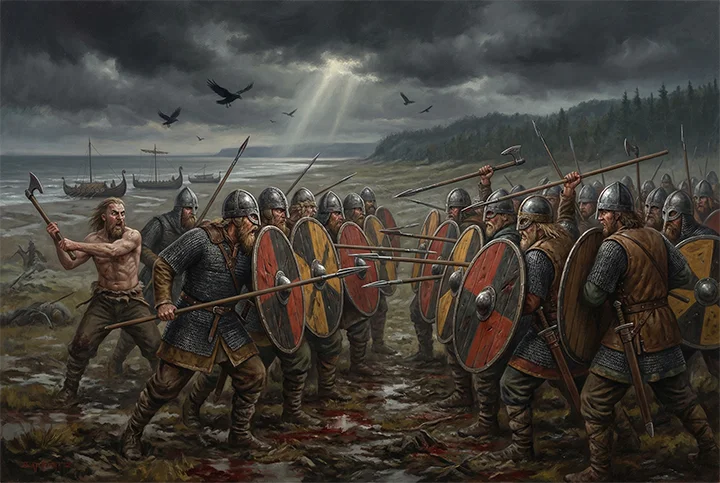
The shield was essential. Norse shields were round, approximately ninety centimeters in diameter, made of planks of linden or other light wood with a central iron boss that protected the hand. They were used both defensively and offensively: as cover against incoming blows, as a weapon to push or strike opponents, and as part of the shield wall formation that was the basis of Norse tactical organization on the battlefield.
Tactics and Formation Fighting
The skjaldborg, or shield wall, was the fundamental tactical unit of Norse warfare. Warriors stood side by side with overlapping shields, presenting a continuous barrier to the enemy while protecting each other's flanks. The front rank bore the brunt of the fighting, stabbing with spears or striking over the shield rim with swords, while the rear ranks provided weight and could step forward to replace casualties. The shield wall could advance, retreat or hold position, and its integrity was the primary tactical concern of Norse commanders.
The effectiveness of the shield wall depended on discipline and cohesion. Individual combat within it was limited: warriors could not move freely without opening gaps in the line, and the Norse sources describe experienced warriors specifically avoiding the temptation to break out of the formation to pursue individual glory. The heroic ideal of single combat existed alongside the tactical reality of formation fighting, and the best Norse commanders understood when each was appropriate.
The svinfylking, or swine array, was a wedge formation used to break an enemy shield wall at a single point, driving through the gap and attacking the flanks from within. The hamalt, a formation in which warriors protected each other in a circle, was used when a small force was surrounded. The sea battle, fought between ships at close quarters, required its own set of tactics: ships were lashed together to create a floating battlefield, and warriors fought across the decks in conditions where formation discipline was difficult to maintain and individual skill became more decisive.
Raiding Strategy and the Viking Method
The raiding campaigns that gave the Viking Age its name were not random outbursts of violence but carefully planned operations that exploited specific strategic advantages. The longship gave Norse raiders the ability to appear anywhere on a coastline without warning, strike a target before a defense could be organized, load the proceeds onto their ships and be gone before pursuit was possible. The combination of mobility, surprise and the ability to withdraw immediately if resistance proved too strong made Norse raiding extremely difficult to counter with the military technologies and organizational capabilities available to their targets in the ninth and tenth centuries.
The raiders were also careful students of their targets. They knew which monasteries and market towns held the most wealth, which rivers led to those targets, which tides would allow a quick departure, and which local power structures were weak enough that no coordinated defense would be organized. The sack of Lindisfarne in 793 was not a random choice: it was a wealthy, prestigious, inadequately defended target on an island accessible by sea. The pattern repeated across western Europe for two centuries because the strategy worked.
As Norse activity shifted from raiding to settlement, the military methods adapted accordingly. The Great Heathen Army that Ragnar Lothbrok's sons brought to England in 865 was not a raiding force but an army of conquest, operating over fourteen years with a strategy that combined battlefield victory, political manipulation of existing English kingdoms, the establishment of winter camps and the gradual replacement of English political authority with Norse control. This was warfare at a level of strategic sophistication that bore little resemblance to the opportunistic coastal raids of the earlier period.
Berserkers and the Ulfhednar
The berserkers, whose name probably derives from bear shirt or bare shirt, were warriors who entered a state of battle frenzy described in the sagas as making them impervious to pain and fear and endowing them with superhuman strength. They were associated with Odin, whose own nature encompassed both wisdom and uncontrolled fury, and they occupied a specific role in Norse armies as shock troops placed at the front of the formation or used for the initial assault. The sagas describe them howling, biting their shields and foaming at the mouth before combat.
The ulfhednar, wolf warriors, were a related phenomenon, associated with the wolf rather than the bear and appearing in sources alongside berserkers as a category of warrior who had taken on an animal nature. Both types may represent a tradition of ritual preparation for battle in which warriors entered a dissociative state through drumming, fasting, hallucinogenic substances or other means that lowered their inhibitions and their sensitivity to pain. Whether this was a widespread practice or a specialized role occupied by a relatively small number of warriors is not established, but the fear they inspired in opponents was consistent enough to appear across multiple independent sources.
Legacy and Significance
Norse warfare shaped the political landscape of medieval Europe in ways that are still visible. The Danelaw established Norse governance over large parts of England. Normandy, whose Norse settlers became the Normans, produced the army that conquered England in 1066 and the crusading forces that established kingdoms in southern Italy and the Holy Land. The Varangian Guard that protected the Byzantine emperors in Constantinople was composed of Norse warriors. The political and military presence of the Norse world across the full breadth of medieval Europe, from Vinland in the west to Miklagarðr in the east, was the direct product of a military tradition that combined exceptional individual skill with tactical intelligence, strategic planning and a relationship with violence that was embedded in the deepest structures of Norse culture and belief.