Shield-Maidens, Landowners and the Role of Women in the Norse World
Overview
Women in the Norse world occupied a position that was simultaneously more constrained and more varied than popular mythology suggests. The saga literature preserves portraits of women who managed estates, commanded respect in legal proceedings, directed vengeance campaigns, crossed the Atlantic as settlers, and in legendary tradition took up weapons and fought as shield-maidens. The archaeological record provides evidence of women buried with weapons, of wealthy female landowners, of professional practitioners of magic, and of the central role women played in the textile production that was one of the primary economic activities of Viking Age households. Norse women could own property, initiate divorce, retain their dowry on separation, and manage their own legal affairs in specified contexts, rights that placed them ahead of women in many contemporary medieval societies while still excluding them from public political life.
Legal Status and Property Rights
Norse women had a distinctive legal position under the laws of the Thing system. They could own property in their own name, inherit from their families, conduct commercial transactions, and bring legal cases. They could not, however, hold public office, speak at the Thing, stand as legal witnesses, or conduct the formal prosecution of legal cases without a male guardian. The mundr, the bride-price paid by the groom to the bride's family, and the heimanfylgja, the dowry brought by the bride, were both the property of the woman rather than of her husband, and she retained them in the event of divorce. Divorce was legally available to both spouses on grounds that included incompatibility, the husband's failure to support the family, and in some law codes his wearing of clothing considered unmanly, a provision that illustrates how closely the Norse legal system connected honour, gender presentation and legal standing.
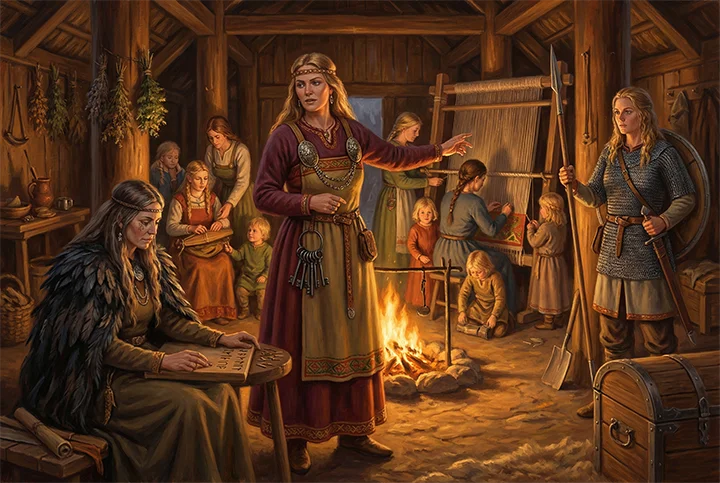
The management of the household farm, the búsýsla, was conventionally the domain of the housewife, húsfreyja, whose authority within the household was as complete as her husband's in external affairs. The keys of the household, which gave access to the locked stores of food, valuables and equipment that constituted the household's reserve wealth, were the physical symbol of the húsfreyja's authority and appear in Norse graves as markers of high-status female burials.
Women in the Sagas
The saga literature preserves a remarkable range of female characters whose actions drive the narratives in which they appear. The instigators of vengeance, kvennaskapr or female urgings, are a recognized narrative type in the sagas: women who remind male kinsmen of their obligation to avenge an insult or killing, sometimes by extraordinary means such as the presentation of a bloodstained garment or the public recitation of the injury at the Thing. Hildigunnr in Njáls saga, who places the blood-soaked cloak of her murdered husband around Flosi's shoulders and demands that he either avenge the killing or be publicly shamed, is one of the most powerful examples of this type. Her action is the immediate cause of the burning of Njáll and the catastrophe that occupies the saga's second half.
Guðríðr Þorbjarnardóttir, who appears in both Vinland sagas, is the most extensively traveled woman in the medieval Norse literary tradition. She sailed from Iceland to Greenland, from Greenland to Vinland where she gave birth to the first child of European descent born in North America, from Vinland back to Greenland, then to Norway, then to Iceland, then to Rome on pilgrimage, and back to Iceland where she became a nun at the church her son built. Her career, documented across multiple independent sources, is the most geographically extraordinary life of any individual in the Norse literary tradition.
Shield-Maidens and Warrior Women
The shield-maiden, skjaldmær, is a recognized figure in the Norse legendary tradition, a woman who takes up weapons and fights alongside men. The most fully developed shield-maiden figures appear in the heroic poetry and legendary sagas rather than in the family sagas, which deal with historically grounded material. Brynhild in the Volsunga cycle is a valkyrie and shield-maiden who was placed in enchanted sleep by Odin as punishment for disobeying him in battle; she is simultaneously a supernatural being, a warrior woman and the most powerful female character in the entire Norse legendary tradition. Hervor in the Hervarar saga and Lagertha in Saxo Grammaticus's Gesta Danorum are other significant examples. Freydís Eiríksdóttir in the Eiriks saga rauða, who faces attacking Skrælingar alone after the Norse men have fled and drives them off by slapping a sword against her bare breast, provides a historical-saga parallel to the legendary shield-maiden type.
The archaeological evidence for female warriors is contested but not absent. The Birka warrior grave, excavated in the late nineteenth century and long assumed to be male, was demonstrated by DNA analysis published in 2017 to contain a biological female. The grave contained a full set of weapons including a sword, an axe, a spear, armor-piercing arrows, a knife, two shields and two horses, as well as gaming pieces interpreted as indicating a role in military planning or strategy. The identification of this burial as that of a female warrior has been debated since publication, with some scholars arguing that biological sex and gender role may not have aligned in this individual's case, but the grave remains the most direct archaeological evidence for the existence of women buried with full warrior equipment in the Viking Age.
Women and Magic
The practice of seiðr, the trance-based prophetic and magical tradition associated with the Vanir and with Freya, was primarily a female domain in the Norse world. The professional practitioners of seiðr, the völur or seers, were women who traveled from settlement to settlement offering prophetic services. Their social role combined considerable prestige with a certain social ambiguity: they were sought out and treated with ceremony but also associated with a transgressive disruption of normal social order that made them figures of both respect and wariness. Freya herself is the paradigmatic female magic practitioner in the Norse tradition, the one who brought seiðr to the Aesir and the one whose knowledge of it exceeds Odin's, despite Odin's reputation as the supreme master of the tradition.
Legacy and Significance
The women of the Norse world have been both romanticized and underestimated in subsequent tradition. The romanticization produces the shield-maiden stereotype that dominates contemporary popular culture representations of the Viking Age; the underestimation produces accounts of Norse society that treat women as peripheral to the main business of raiding, trading and political competition. The historical reality, as the saga literature and the archaeological record together demonstrate, is more interesting than either: Norse women were active participants in the economic, legal, religious and sometimes military life of their communities, operating within constraints that were real but not absolute, and leaving a literary record of sufficient depth and individuality to make them among the most fully realized female characters in any medieval European literary tradition.