The Light That Could Not Be Saved
Overview
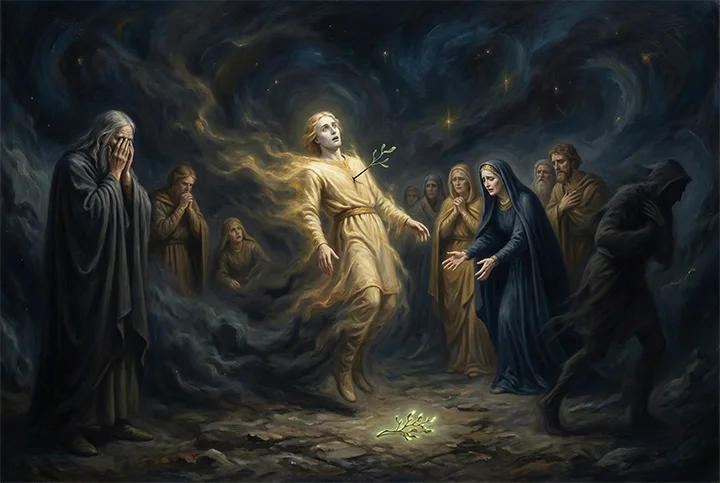
The death of Baldur is the most sorrowful event in Norse mythology and the moment that sets the end of the world in motion. Baldur, son of Odin and Frigg, was the god of light, purity and beauty, beloved by every being in the Nine Worlds. His mother Frigg extracted an oath from every substance and creature in existence that none would harm him, and the gods celebrated his invulnerability as proof that joy could be made permanent. One plant was overlooked. One god noticed. The result was a dart thrown by a blind hand that extinguished the brightest light in Asgard and made Ragnarok inevitable.
What makes the myth remarkable is not the death itself but the machinery around it. Frigg's protective oath, Loki's patient extraction of the single weakness, the blind throw, the refusal of one giantess to weep: each piece fits together with the precision of a trap closing. The death of Baldur is Norse mythology's most thorough demonstration of the principle that doom, once set in motion, cannot be turned aside by love, by cleverness or by grief.
Origins and Mythology
Baldur began experiencing prophetic dreams of his own death. The dreams were not vague unease but specific, recurring visions of destruction. When Odin heard of them, he rode his eight-legged horse Sleipnir down to Hel and summoned a dead seeress from her grave to question her about his son's fate. Her answer was unambiguous: the hall of Hel was being decorated and mead was being brewed in anticipation of Baldur's arrival. The dreams were prophecy, not anxiety.
Frigg responded by traveling to every corner of existence and extracting an oath from every substance, every creature, every force in the Nine Worlds that none would harm Baldur. Fire, water, iron, every poison, every disease, every animal and plant and stone: each swore. When she returned, the gods tested her work by throwing weapons at Baldur in the courtyard of Asgard. Nothing could touch him. Spears bent away. Stones skipped harmlessly to the ground. The gods turned the test into a celebration, laughing as they hurled things at their invulnerable companion.
Loki, watching, disguised himself as an old woman and sought out Frigg. Through patient and apparently innocent conversation he drew out the one detail she had omitted: the mistletoe had seemed too young and too small to bother with. She had not asked it to swear. Loki cut a branch of mistletoe, shaped it into a dart, and returned to the courtyard.
Key Events
Baldur's blind brother Hodr stood apart from the game, unable to participate without sight or a weapon to throw. Loki approached him with apparent sympathy, placed the mistletoe dart in his hand, aimed him toward Baldur and told him to throw. Hodr threw. The dart passed through Baldur and he fell. The laughter in the courtyard stopped. The gods of Asgard, who had never witnessed death among themselves, stood helpless as Baldur's light went out.
Baldur's body was carried to the shore and placed on his great ship Hringhorni. A funeral pyre was built upon it. Odin bent down and whispered a single word into Baldur's ear before the flames were lit. No myth records what that word was. Baldur's wife Nanna died of grief on the shore and was laid beside him so they would not be separated even in death.
Odin's son Hermod volunteered to ride to Hel and beg for Baldur's return. He borrowed Sleipnir and rode nine nights through lightless valleys until he reached the bridge over the river of the dead. He found Baldur seated in the place of honor in Hel's hall, calm and dignified even in death. Hel agreed to release him on one condition: every being in every world, living and dead, must weep for Baldur. If a single creature refused to mourn, Baldur would remain.
The gods sent messengers to every corner of existence. Everything wept. Stones ran with moisture, trees dripped sap, animals cried in their dens. Then the messengers found a giantess named Thokk sitting alone in a cave. She refused. She said Baldur had never done anything for her and Hel could keep what was hers. Her eyes stayed dry. Because of her refusal, Baldur could not return. Most versions of the myth agree on what followed: Thokk was Loki in yet another disguise.
Legacy and Significance
When the gods understood what Loki had done, they captured him and bound him in a cave beneath the earth with a serpent placed above him to drip venom onto his face without pause. His wife Sigyn sits beside him holding a bowl to catch the poison, but whenever she turns away to empty it the drops fall and Loki's agony shakes the earth. The Norse tradition identifies this as the source of earthquakes. He will remain there until Ragnarok, when the chains will break and he will sail against the gods on the ship Naglfar, built from the fingernails and toenails of the dead.
Baldur's death is not only an ending. The Voluspa, one of the most significant poems in the Poetic Edda, describes what will come after Ragnarok: when the old world has burned and a new earth rises from the sea, Baldur and Hodr will return together from Hel. The blind god who threw the dart and the god of light who fell from it will be reconciled and will sit together in the fields of a renewed world. In the deepest structure of Norse belief, the death of Baldur was both the beginning of the end and the seed of a new beginning.
The primary source for this myth is Snorri Sturluson's Prose Edda, written in thirteenth-century Iceland. Earlier and sometimes divergent versions appear in the Voluspa and Baldrs Draumar in the Poetic Edda. A strikingly different account in Saxo Grammaticus's Gesta Danorum presents Baldur as a warrior competing with Hodr for a woman named Nanna, suggesting the myth carried multiple regional variants across the Norse-Germanic world.
OTHRAVAR — Musical Tribute
Experience the grief of Asgard and the dimming of the world's light through the ancient sounds of Norse folk music. This original composition draws from the skaldic tradition, performed with traditional instruments including tagelharpa, frame drum and bone flute.