The Dynasty of Heroes, the Cursed Gold and the Tragedy That Shaped a World
Overview
The Völsunga Saga is the great dynastic epic of Norse mythology, the story of the Volsung lineage from its divine origin through its most brilliant flowering and its total destruction. It spans generations, beginning with Sigi, a son of Odin, and ending with the deaths of Gudrun's children in the hall of Atli the Hun, encompassing the full arc of a family that was made extraordinary by divine favor, sustained by exceptional individuals, and destroyed by a cursed treasure and the inexorable pressure of fate. No single saga in the Norse tradition covers more ground or achieves a higher concentration of the tradition's central themes: the relationship between fate and choice, the cost of loyalty, the nature of heroism, and the question of what it means to live well in a world where the end is already determined.
The saga's greatest figure is Sigurd, the dragon slayer, but Sigurd occupies only the middle section of a much longer story. Before him come Volsung himself, his son Sigmund, and the tragedy of Sigmund's twin sister Signy, who commits acts of terrible necessity to preserve the bloodline. After Sigurd come Gudrun, Brynhild, Gunnar and the long, catastrophic consequences of the oath-breakings and betrayals that surrounded the cursed gold of Fafnir. The saga is a complete world, with its own internal logic and its own moral weight, and it was the most influential single narrative in the Norse-Germanic tradition, providing the source material for Wagner's Ring Cycle and shaping the conception of heroic tragedy across northern European literature for a thousand years.
Origins and Mythology
The Völsunga Saga survives in a single Icelandic manuscript from the late thirteenth century, but the stories it contains are much older, drawn from lays of the Poetic Edda that predate the saga by centuries and from an oral tradition that was already ancient when those lays were composed. It is the prose compilation of a heroic cycle that existed in fragmented poetic form, gathered and arranged into a continuous narrative by an unknown Icelandic author who understood both the individual episodes and their cumulative meaning.
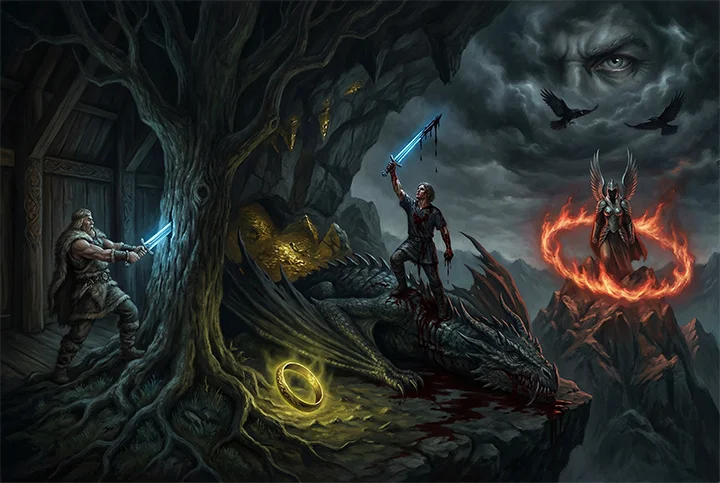
The saga begins with the god Odin's direct involvement in the founding of the Volsung line. Sigi, Odin's son, kills a thrall in a hunting dispute and is outlawed. He builds a kingdom, and from him descends Volsung, the first great king of the line, who builds his hall around a great oak tree with the trunk passing through the roof. Into this hall comes a one-eyed stranger who drives a sword named Gram into the oak up to its hilt and says it belongs to whoever can pull it free. Only Sigmund, Volsung's son, can remove it. The sword Gram will pass through the saga, broken and reforged, and it is the weapon with which Sigurd ultimately kills Fafnir.
Signy and the Preservation of the Line
The saga's darkest and most morally complex section concerns Signy, Sigmund's twin sister, and the destruction of Volsung and all his sons except Sigmund by the treachery of Signy's husband King Siggeir. Siggeir kills Volsung and captures all ten sons, who are then chained to a log in the forest and eaten one by one each night by a she-wolf. Signy sends Sigmund a means of escape and he survives alone in the forest for years, waiting for the moment of vengeance.
When Signy's sons by Siggeir prove too cowardly to help Sigmund in his revenge, she makes a decision that the saga presents without flinching: she exchanges forms with a sorceress, goes to Sigmund in disguise, and sleeps with him without his knowledge. The son born from this union is Sinfjotli, who has the Volsung blood doubled in his veins and who is strong enough and ruthless enough to be the instrument of the vengeance Sigmund has spent his life preparing. Together they burn Siggeir's hall with him in it. Signy, having achieved the purpose for which she endured everything, walks into the fire herself. She does not want to live after what she has done and what she has had to become to do it. It is one of the most quietly devastating endings in the saga tradition.
Sigurd, the Dragon and Brynhild
Sigmund's son Sigurd is the saga's central figure, the culmination of everything the Volsung line was built toward. He is raised by the smith Regin, kills the dragon Fafnir, tastes the dragon's blood and gains the speech of birds, kills Regin on the birds' advice, takes the cursed gold and rides through the ring of fire that surrounds the sleeping valkyrie Brynhild. He wakes her, they swear oaths of love, and he rides on.
At the hall of the Nibelungs, Sigurd is given a drink that causes him to forget Brynhild entirely. He marries Gudrun, daughter of the Nibelung king Gjuki. His oath-brother Gunnar wants to marry Brynhild, but only Sigurd's horse Grani and Sigurd himself can ride through the fire that surrounds her. Sigurd exchanges appearances with Gunnar and rides through in his form, woos Brynhild on Gunnar's behalf, and places the sword Gram between himself and Brynhild each night as a boundary. Brynhild believes she was won by Gunnar and agrees to the marriage.
The catastrophe breaks open when Gudrun and Brynhild quarrel over whose husband is the greater man. Gudrun reveals that it was Sigurd, not Gunnar, who rode through the fire. Brynhild, understanding that she was deceived, that the man she loved and was oathbound to has lived in the same hall with her while married to another woman, and that this was accomplished through a trick, is destroyed. She engineers Sigurd's death, manipulating Gunnar and his brother Guttorm into carrying it out. Guttorm, who had sworn no oath to Sigurd and was therefore not bound by oath-fellowship, stabs Sigurd in his bed through the single point on his back where he was vulnerable. Sigurd lives long enough to throw his sword and cut Guttorm in half. Brynhild kills herself on his funeral pyre, saying she will lie beside him as a wife should lie beside her husband.
Gudrun and the Fall of the Nibelungs
The saga does not end with Sigurd's death. Gudrun survives, remarries against her will, and is eventually manipulated into inviting her brothers, the last of the Nibelungs, to the hall of her new husband Atli, who is based on Attila the Hun. Atli wants the Nibelung gold, which was thrown into the Rhine after Sigurd's death and whose location only the surviving Nibelungs know. Gudrun warns her brothers but they come anyway, because refusing the invitation of a king would be cowardice, and the Volsung tradition does not permit cowardice regardless of what it costs.
The battle in Atli's hall is one of the most sustained and brutal combat sequences in Old Norse literature. The Nibelungs fight until they are overwhelmed by numbers alone, not by any failure of courage or skill. Gunnar is taken alive and thrown into a snake pit. He is given a harp and plays it with his toes, since his hands are bound, and plays until he dies. It is the saga's final image of the heroic tradition: beauty and skill maintained past all reason, in the pit, with the snakes, to the end.
Gudrun takes her revenge on Atli that night, killing their sons and serving them to him at dinner, telling him afterward what he has eaten. She then kills Atli and burns the hall. The Volsung saga ends in total destruction: the dragon's gold is at the bottom of the Rhine, every man who touched it is dead, every woman who loved any of them is destroyed or transformed by the experience, and the hall burns.
Legacy and Significance
The Völsunga Saga is the most complete expression of the Norse heroic ideal and the Norse understanding of tragedy. Its heroes are not destroyed by weakness or by moral failure: Sigurd is the greatest man alive, Gunnar is brave beyond reason, Gudrun is loyal past the point of self-preservation. They are destroyed by the cursed gold, by the oaths that bind them, by the consequences of choices made before they were born, and by the specific, structural incompatibility between what fate has arranged and what loyalty requires. The saga demonstrates, across multiple generations and with accumulating weight, that in a world where fate is real, even the best people doing their best will not be enough, and that this does not make their actions meaningless but makes them more significant, not less.
Richard Wagner drew on the Nibelungenlied, the Old High German version of the same legend, for his Ring Cycle, but the Norse version in the Völsunga Saga is darker, more complete and more honest about what it costs to be the kind of person the tradition most admires. It remains one of the foundational texts of world literature, a story that has not stopped being told in some form since it was first assembled from older songs in thirteenth-century Iceland.