The Realm of the Light Elves and Freyr's Gift at the Edge of the Divine World
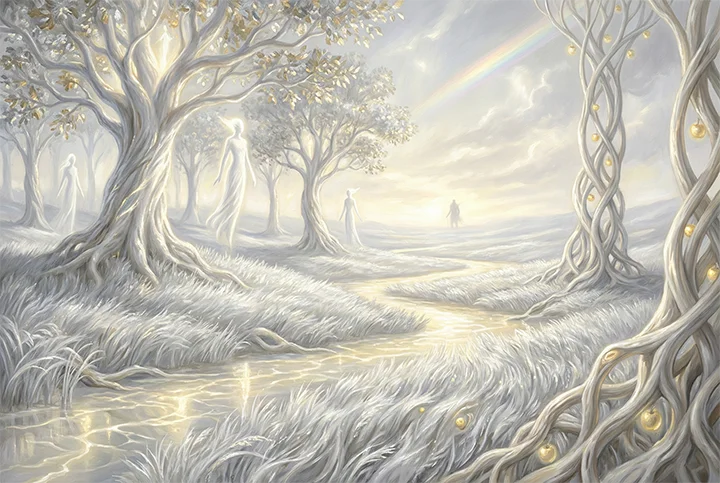
Overview
Álfheimr is one of the Nine Worlds of Norse cosmology, the realm of the light elves, the álfar, beings described in the sources as more beautiful than the sun and associated with light, radiance and a kind of divine proximity that places them closer to the gods than to humans. The realm is most specifically associated with the god Freyr, who was given Álfheimr as a gift on the day of his first tooth, making it his personal domain within the structure of the Nine Worlds. Álfheimr is one of the least described of the Nine Worlds in the surviving texts, appearing primarily in lists of the worlds and in the kenning tradition of skaldic poetry.
Sources
The primary sources for Álfheimr are the Grímnismál of the Poetic Edda, which lists it among the halls of the gods, the Gylfaginning of the Prose Edda, where Snorri Sturluson describes the distinction between light elves and dark elves, and scattered references in skaldic poetry. The Grímnismál states that Freyr was given Álfheimr by the gods as a tooth-gift, the gift given to a child when the first tooth appears. Snorri in the Gylfaginning distinguishes between the light elves, ljósálfar, who are more beautiful than the sun and live in Álfheimr, and the dark elves, dökkálfar, who are blacker than pitch and live underground.
The Elves in Norse Mythology and Religion
The álfar appear throughout Norse mythology and Norse religious practice as beings of significant power, though the surviving literary sources preserve relatively little narrative material about them directly. They are mentioned in conjunction with the gods in the formulaic phrase the Aesir and the elves, which appears repeatedly in the Poetic Edda as a description of the full company of divine beings, suggesting the elves were a category of being parallel to or closely associated with the gods.
In Norse religious practice, sacrifices to the elves, called álfablót, are attested in several sources. The most detailed description appears in the skaldic poem Austrfararvísur by Sigvatr Þórðarson, around 1020, in which the poet describes being turned away from a farmhouse in Sweden because an álfablót was in progress and no strangers could be admitted. The álfablót was apparently a private household ceremony performed in autumn, connected to the elves as spirits of the ancestral dead and to the fertility of the land.
Álfheimr and Freyr
The gift of Álfheimr to Freyr at his first tooth is consistent with Freyr's character and domains. Freyr is the Vanir god most closely associated with light, sunlight, growing things, abundance and the generative powers of nature; the light elves, beings more beautiful than the sun who dwell in a celestial realm, are natural extensions of his domain. The tooth-gift tradition, in which a valuable object is given to a child on the first tooth's appearance, is attested in several Norse contexts, and an entire world as Freyr's tooth-gift establishes Álfheimr as a primordial endowment rather than an acquired possession.
Elves in Old English and Wider Germanic Tradition
The Norse álfar have cognates across the Germanic language family, most importantly the Old English ylfe and ælf from which the modern English word elf derives. Old English medical texts describe elf-shot, the condition of being struck by elf arrows, and the charm Wið færstice addresses elves as agents of disease, suggesting that the Germanic elf tradition was considerably richer and more integrated into everyday religious practice than the surviving Norse literary sources directly reflect.
Legacy and Significance
Álfheimr represents the dimension of Norse cosmology most clearly identified with light, beauty and the celestial aspect of divine power. Its association with Freyr connects the realm of the light elves to the generative, abundant, solar aspects of Norse religion. The scarcity of narrative material about Álfheimr in the surviving texts should not be taken as evidence of minor importance in actual Norse religious life, where the álfablót and the identification of honored dead with elves suggest a rich practical tradition the literary sources only partially preserve.