The Rainbow Bridge Between the Worlds
Overview
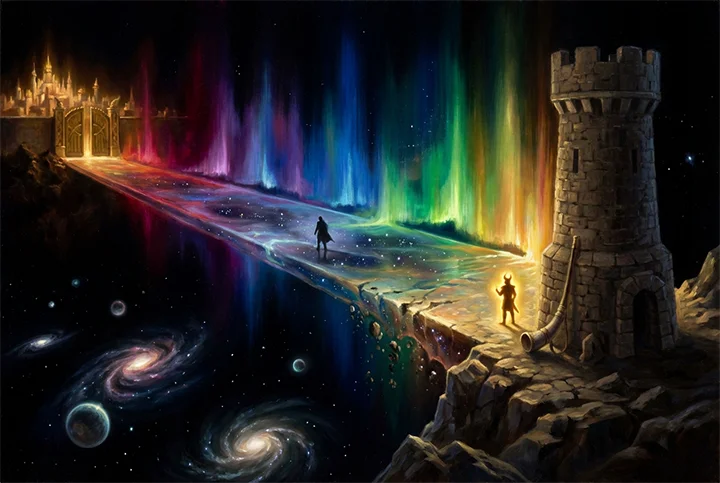
Bifrost is the burning rainbow bridge that connects Asgard, the realm of the gods, to the other worlds of Norse cosmology, most importantly to Midgard, the world of humans. It is one of the most visually distinctive structures in all of Norse mythology: a shimmering arc of three colors, described in the sources as burning with fire that prevents the frost giants from crossing it even as it bears the weight of gods traveling between worlds. It is both a road and a barrier, both a connection and a defence, and it is guarded at its end by Heimdall, the watchman of the gods, who requires less sleep than a bird and can hear the grass growing and the wool growing on sheep.
Bifrost is not merely a piece of cosmic infrastructure. In the Norse worldview the bridge is the threshold between the ordered world of the gods and everything that lies beyond it. Its existence makes communication between Asgard and the other realms possible. Its destruction at Ragnarok is one of the clearest signals that the old order has ended: when the fire giants ride across it from Muspelheim and it collapses under their weight, the separation between worlds that it maintained collapses with it.
Origins and Mythology
The primary sources for Bifrost are the Prose Edda of Snorri Sturluson and several poems of the Poetic Edda, particularly the Grimnismal. Snorri describes Bifrost as the finest construction the gods ever made, built from three colors with great skill and cunning. He identifies the red color in the bridge as burning fire, placed there specifically to prevent the frost giants and mountain giants from climbing into Asgard. The bridge is strong enough to bear anything except the weight of Surtr's forces at Ragnarok, when it will break.
The name Bifrost is interpreted by scholars in several ways. One reading connects it to a word meaning the shimmering or trembling path, a reference to the way a rainbow appears to shift and waver when seen from a distance. Another older name for the bridge found in the sources is Bilrost, which some interpret as the fleeting glimpse of a path, suggesting something seen only briefly and incompletely. Both names emphasize the bridge's quality of appearing and disappearing, of being seen rather than firmly grasped.
The gods ride across Bifrost daily. The Grimnismal describes Thor as an exception: he cannot ride across the bridge because his passage would shatter it, so he wades through the rivers Kormt and Ormt and the two Kerlaugar instead on his way to the ash tree Yggdrasil where the gods hold their councils. The detail is a reminder that the cosmic architecture of Norse mythology is precise and internally consistent: even the strongest of the gods must observe the limits of what each structure can bear.
Heimdall and the Guardianship
Bifrost cannot be understood in isolation from its guardian. Heimdall, called the White God and the son of nine mothers, stands at the end of the bridge where Asgard meets the sky and watches everything that approaches from below. He carries the horn Gjallarhorn, which he will blow at the onset of Ragnarok to summon the gods to their final battle. His senses are so acute that he needs less sleep than a bird, can see hundreds of miles in any direction by day or night, and can hear the sound of grass growing in the fields and wool growing on sheep.
The pairing of Bifrost and Heimdall is one of the most elegant structural decisions in Norse cosmology. The bridge is not merely left open as a thoroughfare; it is actively watched by the most perceptive being in existence. Nothing approaches Asgard across Bifrost without Heimdall knowing about it. This makes the giants' eventual crossing at Ragnarok all the more significant: it is not a failure of Heimdall's perception but a moment when perception no longer matters because the age of the gods is already over.
Bifrost at Ragnarok
The role of Bifrost at Ragnarok is one of its most important mythological functions. When the final days come, the sons of Muspel, the fire giants led by Surtr, will ride north across Bifrost toward Asgard. The bridge will shatter beneath them. This collapse is significant not because it stops the attack, since the giants continue regardless, but because it signals the end of the cosmic order that Bifrost represented. The connection between worlds that made Norse cosmology function as a coherent system is destroyed, and what follows is not governance but chaos and fire.
Heimdall will blow Gjallarhorn at this moment. The gods will arm themselves and ride to the plain of Vigrid for the final battle. Heimdall and Loki will kill each other. Surtr will engulf the world in flames. The old world will sink into the sea. And from the waters, eventually, a new world will rise.
Legacy and Significance
The image of Bifrost has proven to be one of the most enduring and recognizable elements of Norse mythology in modern culture. The identification of the rainbow with a bridge to the divine is not unique to Norse tradition: several other mythological systems around the world use the rainbow as a path between realms. What makes the Norse version distinctive is its specificity: Bifrost is not a vague metaphor but a precisely described structure with a particular composition, a particular guardian, a particular set of rules governing who may cross it and under what conditions, and a precisely described fate.
The burning quality of Bifrost, the fire embedded in its red stripe that prevents giants from crossing, is a detail that sets it apart from most rainbow imagery in world mythology. In Norse thought the bridge is not only beautiful but functional and armed, a border that performs the work of keeping worlds in their proper separation. Its destruction at Ragnarok is therefore not only a physical event but a theological one: the statement that the principle of ordered separation between realms, which Bifrost embodied, is no longer operative in the world that follows.
OTHRAVAR — Musical Tribute
Experience the shimmering arc of Bifrost and the eternal watch of Heimdall through the ancient sounds of Norse folk music. This original composition draws from the skaldic tradition, performed with traditional instruments including tagelharpa, lur and frame drum.
NORSE MYTHOLOGY ENCYCLOPEDIA — Storytelling
Listen to the full story of Bifrost, Every day, the gods of Asgard crossed this bridge to judge the fate of the worlds.