The Twilight of the Gods and the End of the World
Overview
Ragnarök is the end of the world in Norse mythology, the final battle in which the gods, the giants, the monsters and the forces of chaos destroy each other and the cosmos itself is consumed by fire and swallowed by the sea. The word Ragnarök means the fate of the gods or the doom of the powers, and it designates not a single moment but a sequence of events that begins with signs and portents, proceeds through a series of cosmic catastrophes, reaches its climax in the battle on the plain of Vígríðr where every major combatant dies, and concludes with the sea rising over the burning world before a new earth emerges from the waters. Ragnarök is not a punishment or a judgment; it is the necessary consequence of the structure of the Norse cosmos, which was always moving toward this conclusion from the moment the gods first shaped the world from Ymir's body.
The Norse tradition's treatment of Ragnarök is distinctive in world mythology for its combination of inevitability and active resistance. The gods know with precision what is coming. Odin has spent his entire mythological career gathering information, accumulating warriors in Valhalla, seeking counsel from the dead and from giants, sacrificing his eye and hanging on Yggdrasil, all in preparation for a battle he knows he cannot win. The Norse heroic response to inevitable destruction is not acceptance or despair but continued preparation and continued action, fighting to the end because the fighting itself has value regardless of its outcome.
Sources
The primary sources for Ragnarök are the Voluspa, the great prophetic poem of the Poetic Edda in which a dead seeress recounts the history and fate of the cosmos to Odin, and the Gylfaginning section of Snorri Sturluson's Prose Edda, which provides a prose summary of the events drawing heavily on the Voluspa and on other poetic sources. Additional details appear in the Vafthrudnismal, the Lokasenna, and several other Eddic poems, as well as in skaldic verse.
The Signs of Ragnarök: Fimbulwinter
The events of Ragnarök are preceded by a series of signs that announce its approach. The first and most terrible of these is Fimbulwinter, the great winter, a period of three consecutive winters with no summer between them. Snow falls from all directions. The cold is extreme and unrelenting. The world grows dark. Fimbulwinter lasts three years, and during this period the social bonds that hold human communities together dissolve: the sources describe brothers killing each other, fathers and sons in conflict, no one sparing anyone out of kinship obligation.
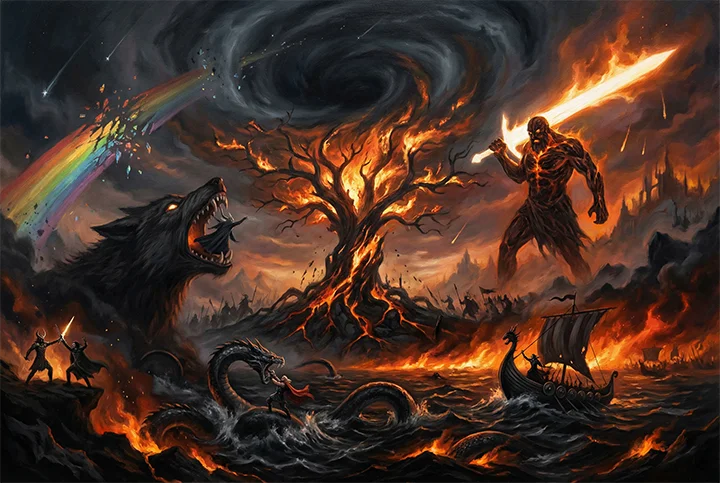
During Fimbulwinter the wolves Sköll and Hati, who have been chasing the sun and moon respectively since the beginning of time, finally catch them. The sun goes dark. The stars fall from the sky. The earth shakes. The mountains collapse. Every tree falls. The bonds that hold Fenrir break. The ship Naglfar, built from the fingernails and toenails of the dead, floats free from its moorings. Loki breaks free from the cave where he has been bound since the death of Baldur. Jörmungandr releases its tail from its mouth and comes up onto the land, spewing venom across the sky and sea.
The Advance of the Forces of Destruction
From all directions, the forces that will end the world converge on Ásgarðr and the plain of Vígríðr. From the south comes Surtr, the lord of Muspelheim, carrying a sword that blazes brighter than the sun, at the head of the sons of Muspel. From the north comes the ship Naglfar carrying the army of the dead from Hel, steered by Loki. Fenrir runs with his mouth open so wide that his upper jaw scrapes the sky and his lower jaw drags along the earth. Jörmungandr advances alongside Fenrir, filling the air with its venom. The fire giants of Muspelheim ride across Bifrost and the bridge shatters under their weight. Heimdall blows the horn Gjallarhorn to summon the gods.
The Battle on Vígríðr
The battle of Vígríðr is the most detailed combat sequence in the Norse mythological tradition. The sources describe each major confrontation individually, and each ends in mutual destruction.
Odin fights Fenrir. The wolf swallows him. Odin is killed inside the wolf's stomach. Víðarr, Odin's son who has been prepared for this moment since the beginning of time, steps forward. He places his iron-shod foot on Fenrir's lower jaw, seizes the upper jaw with his hands, and tears the wolf apart. Odin is avenged.
Thor fights Jörmungandr. He kills the World Serpent with Mjolnir. He walks nine steps away from the serpent's body before falling dead from the venom it has sprayed across the field.
Freyr fights Surtr. Freyr has no sword: he gave it away to his servant Skírnir as payment for the journey to Jötunheimr to woo Gerðr on his behalf. He fights with an antler and falls. Surtr kills him.
Tyr fights the hound Garm. They kill each other. Heimdall and Loki fight each other and kill each other. When the combat is done, Surtr casts fire over the world. The earth burns. The sky splits. The sea rises and swallows the burning land. The Nine Worlds are consumed.
After Ragnarök: The Renewal
The Voluspa does not end with the destruction. From the sea, a new earth rises green and fertile, with waterfalls flowing and eagles flying over mountains. Fields will grow without having been sown. Baldur and Höðr return from Hel and meet on the fields of the new world. Víðarr and Váli, the sons who survived, are there. Móði and Magni, Thor's sons, carry Mjolnir into the new world. The surviving gods meet and remember the events of the old world, finding the golden game pieces that the old Aesir had used in their games, scattered in the grass of the renewed earth.
Two human beings, Líf and Lífþrasir, have survived the destruction by hiding in Hoddmímis holt, a forest or grove that was not consumed by Surtr's fire, protected by the morning dew. They emerge into the new world and repopulate it.
Ragnarök and the Structure of Norse Cosmology
Ragnarök is not an accident or an intrusion from outside the Norse cosmos. It is the necessary consequence of the cosmos's own structure. The gods bound Fenrir with deception, creating an obligation of vengeance. They allowed Loki's monstrous children to exist. They killed Ymir and made the world from his body, but the frost giants descended from Ymir did not disappear. The death of Baldur removed the one being whose survival might have given the gods a chance at the final battle. The Norns wove Ragnarök into the fabric of fate from the beginning. Odin knows this. His entire mythological career is a preparation for a battle he cannot win, conducted by a being who cannot stop preparing because the alternative to preparation is simply waiting for the end.
Legacy and Significance
Ragnarök is among the most fully developed eschatological narratives in world mythology, distinguished by the precision of its prophetic detail, the individuality of each divine death, and the inclusion of a renewal that prevents the narrative from ending in simple annihilation. It has influenced modern conceptions of apocalyptic narrative extensively, from Wagner's Götterdämmerung to contemporary fantasy literature and visual media. The concept of a cosmos that contains from its beginning the seeds of its own destruction, and of beings who know this and act anyway, is among the Norse tradition's most philosophically distinctive contributions to world mythology.
OTHRAVAR — Musical Tribute
Experience the fire that ends the world and the green earth that rises from the sea through the ancient sounds of Norse folk music. This original composition draws from the skaldic tradition, performed with traditional instruments including tagelharpa, lur and frame drum.