The Radiant, Beloved God
Overview
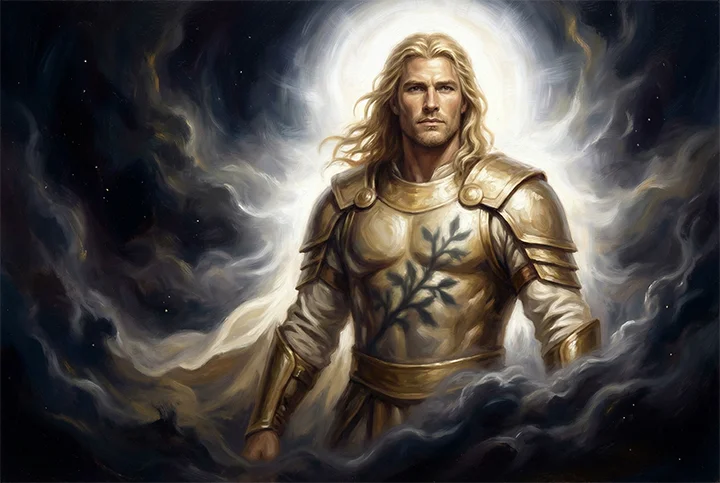
Baldur, known in Old Norse as Baldr, is the most beloved of all the Aesir gods and the most radiant figure in the Norse pantheon. He is the son of Odin and the goddess Frigg, husband of the gentle Nanna and father of the god Forseti. Light emanates from him; his beauty is such that flowers spring up wherever he walks and even the darkest halls brighten in his presence. He embodies everything the gods cherish most, which is precisely why his death becomes the crack through which the entire Norse cosmos begins to fracture.
Baldur is characterised in the sources as wise, gracious, merciful and so fair of face that light shines from him. He lives in his hall Breiðablik, the Broad Gleaming, where nothing impure is permitted to enter. Among all the gods he alone inspires neither fear nor suspicion; every being in the Nine Realms loves him instinctively, and that universal love is what makes the oath sworn to protect him both remarkable and ultimately futile.
His story is the great tragedy of Norse mythology. Unlike the deaths of other figures who fall in battle or sacrifice themselves for knowledge, Baldur dies through treachery, through the manipulation of innocence, and through a single oversight in an otherwise perfect protection. His death does not happen at Ragnarök but before it, and the grief it sends through Asgard is so profound that it sets in motion the chain of events that will end the world.
Origins & Mythology
The Prose Edda presents Baldur as one of the twelve principal Aesir gods, born of Odin and Frigg in Asgard. His hall Breiðablik is described as the most beautiful of all the divine halls, standing on the plains of heaven with its golden roof and silver walls, a place so pure that falsehood and treachery cannot enter it. He is married to Nanna Nepsdóttir, whose love for him is absolute. When Baldur dies, Nanna's grief is so overwhelming that she dies of it on the funeral pyre beside him, the two departing together into the realm of Hel.
The dreams that precede his death are among the most ominous in Norse mythology. Baldur began dreaming of his own destruction, and these were not ordinary dreams but visions that the Norse tradition recognised as prophetic warnings. When he told the gods, the entire assembly was shaken. Odin rode his horse Sleipnir to the realm of Hel and woke a dead völva, a seeress, to ask her who the hall of Hel was being prepared for. Her answer confirmed the gods' worst fears: the hall was being dressed for Baldur.
Frigg responded by extracting oaths from every thing in existence that it would not harm her son. She travelled through all the Nine Realms and obtained sworn promises from fire and water, iron and all metals, stones, earth, trees, diseases, animals, birds, poison and serpents. Every element of creation swore not to harm Baldur. Every element except one: the mistletoe, which Frigg considered too young and too harmless to bother with.
Key Stories & Appearances
Once the oath had been sworn, the gods amused themselves with a game that tested Baldur's new invulnerability. They threw things at him — weapons, stones, anything to hand — and everything bounced harmlessly off him. The hall rang with laughter. It seemed the greatest threat the cosmos had thrown at him could do nothing, and for a time even the shadow of the prophetic dreams lifted.
Loki, watching this, felt something that the sources do not name directly but that the consequences make clear. He disguised himself as an old woman and went to Frigg, drawing out in conversation the one thing that had not sworn the oath. Then he fashioned a dart from mistletoe and went to Höðr, Baldur's blind brother, who stood apart from the game because he could not see to aim. Loki guided his hand. The mistletoe dart flew true and Baldur fell dead.
The silence that followed is described in the Prose Edda as one of the most terrible moments in all the mythological narratives. No one could speak. No one could act. The gods stood around the body of the most beloved among them and could do nothing because the one who had done it was still present among them, and the sacred laws of the divine assembly prevented violence in that place. When the silence finally broke, it broke into weeping, and all the gods and all the creatures of Asgard wept for Baldur.
The god Hermóðr, Odin's son, volunteered to ride to Hel and negotiate for Baldur's return. Hel agreed on one condition: every being in all the Nine Realms must weep for Baldur. If even one refused, he would remain. Every creature wept. Every rock and every tree shed tears. Only one being refused: a giantess named Þökk, widely understood to be Loki in disguise, who declared she had no use for Baldur and would not weep. And so Baldur stayed in Hel.
Legacy & Significance
Baldur's death is the most discussed event in Norse mythology precisely because its meaning is the hardest to fix. He is not a warrior who dies gloriously, not a sage who sacrifices himself for knowledge. He is simply the most beloved, the most innocent, and he is taken by treachery through the manipulation of his own brother's hand. His death signals something irreversible: that the age of the gods is ending, that the forces of entropy and betrayal have found their way into Asgard, and that Ragnarök is no longer a distant prophecy but an approaching reality.
Yet the mythology does not end with despair. Baldur is one of the few figures prophesied to survive Ragnarök and return in the new world that rises from the wreckage of the old. After the fires die and the seas recede and the earth rises green again, Baldur will return from Hel, reconciled even with his killer, to preside over a world reborn. He is the promise embedded in the darkest moment of the Norse tradition: that what is most beautiful and most beloved is not destroyed forever, only waiting.
OTHRAVAR — Musical Tribute
Experience the light and tragedy of Baldur through the ancient sounds of Norse folk music. This original composition draws from the skaldic tradition, performed with traditional instruments including tagelharpa, bukkehorn and frame drum.