The Man Who Became a Dragon Through Greed and the Gold That Cursed Everything It Touched
Overview
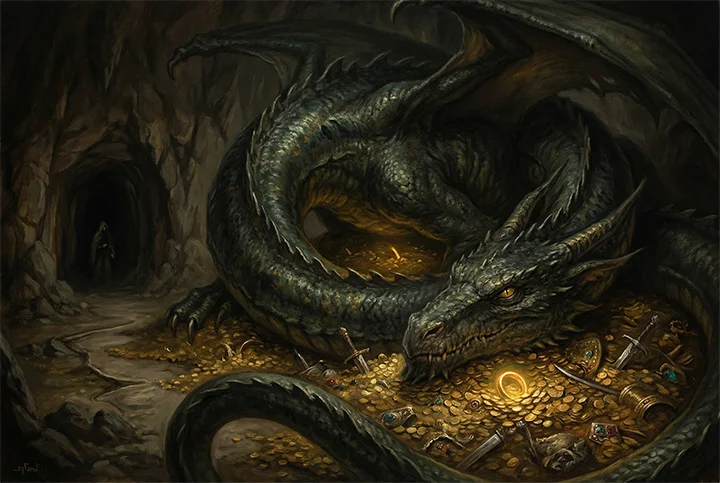
Fafnir is one of the most psychologically distinctive figures in Norse mythology, a being who began as a man, or at least as a dwarf or the son of a sorcerer, and transformed himself into a dragon through the force of his own greed. He is the guardian of the cursed gold of the dwarf Andvari, a hoard that had already destroyed his father Hreidmar and which Fafnir himself killed his father to obtain. By the time Sigurd encounters him in the Völsunga Saga and the Fáfnismál of the Poetic Edda, Fafnir has been lying on the gold for an unspecified length of time, poisoning the earth around him with his venom, and has retained enough of his original intelligence to hold a philosophical conversation with the hero who has just killed him about fate, gold and the nature of death. He is the dragon that defines the Norse conception of the dragonhoard, and his myth is the foundational narrative for the portion of the Sigurd cycle that deals with the cursed gold, the death of Regin, and the beginning of the chain of consequences that will eventually destroy Sigurd, Brynhild, the Nibelungs and the dynasty of Atli.
Sources
The primary sources for Fafnir are the Völsunga Saga, the prose compilation of the Volsung heroic cycle composed in Iceland in the thirteenth century, and the Fáfnismál in the Poetic Edda, a poem in the form of a dialogue between Fafnir and Sigurd during and after the dragon's death. Additional details appear in the Reginsmál, which describes the background of Andvari's gold and the relationships between Hreidmar, Fafnir and Regin. The same legendary material appears in a significantly different form in the Old High German Nibelungenlied, where the figure corresponding to Fafnir is absent and the dragon-slaying episode takes a different narrative form, confirming that the Fafnir legend is specifically a Norse development of the broader Volsung-Nibelung material.
The Origin of Andvari's Cursed Gold
The gold that Fafnir guards has a history before it reaches him. The dwarf Andvari kept his gold in a pool in the form of a pike, a fish, using it to accumulate wealth in the water. The gods Odin, Loki and Hœnir accidentally killed a man named Otter, who was the son of the sorcerer Hreidmar and who had been swimming in the river in the form of an otter. The gods were seized by Hreidmar and forced to pay compensation. Loki caught Andvari by fishing him out of his pool in net form, and took all of Andvari's gold including a ring called Andvaranaut. Before surrendering the last ring, Andvari cursed all the gold, declaring that it would bring death and destruction to everyone who possessed it. Loki placed the gold over the otter skin to satisfy the compensation, and told Hreidmar about Andvari's curse. Hreidmar accepted the gold anyway.
Hreidmar, Fafnir and Regin
Hreidmar's other two sons were Fafnir and Regin. Fafnir was described as the largest and most ferocious of the three. After Hreidmar received the cursed gold, Fafnir killed him to obtain it and drove his brother Regin away. The Völsunga Saga and the Fáfnismál describe Fafnir as then taking himself to a waste place called Gnitaheiðr, where he transformed himself into a dragon and lay down upon the gold. The transformation is presented as deliberate and as the product of his own desire: Fafnir chose to become a dragon in order to guard the gold more effectively, poisoning the earth around his lair with his venom and driving away anyone who approached. He has no interest in using the gold, only in possessing it.
Sigurd, Regin and the Sword Gram
Regin, driven from his share of the inheritance by Fafnir, eventually became the foster father of Sigurd, the greatest hero of the Norse tradition and the son of the Volsung king Sigmund. Regin shaped Sigurd into the warrior he needed for his own purposes: he wanted Fafnir dead and the gold recovered. He forged Sigurd a series of swords, each of which Sigurd tested by striking the anvil and each of which shattered. Finally Sigurd brought Regin the fragments of his father Sigmund's sword Gram, which had been broken in Sigmund's final battle by Odin himself. Regin reforged Gram. Sigurd tested it on the anvil and it held. He tested it on the Rhine by floating a piece of wool downstream and holding the blade against the current: the wool was cut cleanly in two. Gram was the weapon he needed.
The Killing of Fafnir
Sigurd and Regin traveled to Gnitaheiðr. Odin, disguised as an old man, appeared to Sigurd and advised him to dig a pit in the track that Fafnir takes each day from his lair to the water, and to thrust upward from the pit into the dragon's unprotected belly as it passes over. Sigurd dug the pit and hid in it. When Fafnir crawled over it toward the water, Sigurd drove Gram upward into the dragon's belly. The earth shook. Fafnir stopped and spoke to the hidden Sigurd, asking who had wounded him and who his father was. Sigurd refused to give his true name, as the dying believed a man who revealed his name to them could be cursed. The exchange that follows is one of the most philosophically resonant in the Norse heroic tradition.
The Death Conversation
The Fáfnismál records the conversation between Sigurd and the dying Fafnir in detail. Fafnir tells Sigurd that the gold will destroy him as it has destroyed everyone who has touched it. Sigurd acknowledges this but says that every man must die once and that he would rather die rich than live poor. Fafnir identifies the golden helmet he wears, called the Helm of Awe or Ægishjálmr, as the source of his power to inspire fear, and warns Sigurd specifically about Regin, telling him that his foster father will betray him. He asks Sigurd what the Norns are, implying a desire to understand the fate that has overtaken him. Sigurd answers him. When Fafnir dies, his death is slow and dignified, the dragon retaining his intelligence and his capacity for philosophical exchange until the end.
The Aftermath: Regin's Betrayal and the Speech of Birds
After Fafnir's death, Regin returned and cut out Fafnir's heart, asking Sigurd to roast it for him while he recovered from a wound. While roasting the heart, Sigurd tested it for doneness by touching it, burning his finger and putting it in his mouth instinctively. The moment Fafnir's blood touched his tongue, Sigurd gained the ability to understand the speech of birds. The birds in the trees above him were discussing his situation: Regin planned to kill him and take all the gold. They advised Sigurd to kill Regin first and take the gold himself. Sigurd drew Gram and killed Regin. He ate Fafnir's heart himself, loaded the cursed gold onto his horse Grani, and rode away toward the ring of fire that surrounded the sleeping valkyrie Brynhild. The curse of Andvari's gold continued to work.
Legacy and Significance
Fafnir is the most fully realized monster in Norse mythology precisely because he is not simply a monster. He is a man who chose monstrousness, who transformed himself deliberately into a dragon to satisfy a desire for possession that had already led him to commit patricide. His death conversation with Sigurd, in which he demonstrates greater wisdom about the gold's curse than the hero who has just killed him, places him in the tradition of the wise opponent who understands more than the victor and who speaks truths that the victor will only understand later. The Norse tradition's willingness to give its monsters interiority, to make them capable of speech and reflection at the moment of their destruction, is one of its most distinctive qualities, and Fafnir is its most fully developed example.
OTHRAVAR — Musical Tribute
Experience the poisoned earth of Gnitaheiðr and the dying dragon's final words to the hero who killed him through the ancient sounds of Norse folk music. This original composition draws from the skaldic tradition, performed with traditional instruments including tagelharpa, bukkehorn and frame drum.