The Allfather
Overview
Odin, known in Old Norse as Óðinn, stands as the supreme deity of the Norse pantheon. He is the Allfather who presides over Asgard and all the Nine Realms. A god of wisdom, war, death, poetry, magic and fate, he embodies the contradictions at the heart of Norse spirituality: a king who wanders as a beggar, a warrior who seeks knowledge above all else, a ruler who willingly sacrifices himself to himself. No other figure in Germanic mythology commands such complexity or casts such a long shadow across human history.
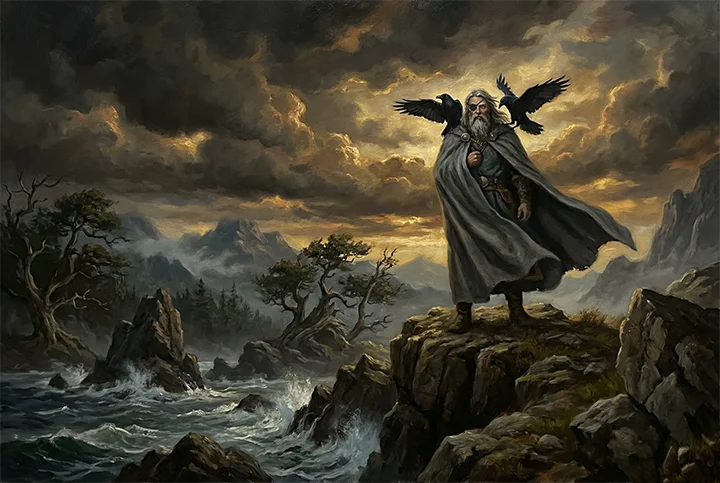
Odin is depicted as a tall, cloaked wanderer with a wide-brimmed hat pulled low, a staff in hand and two ravens perched upon his shoulders. He travels the worlds not from restlessness but from hunger for wisdom, for the secrets of fate, for anything that might delay the coming of Ragnarök. His two ravens, Huginn (Thought) and Muninn (Memory), fly across the world each day and return to whisper all they have witnessed into his ear.
Odin possesses a single eye. The other he surrendered willingly, casting it into the well of Mímir in exchange for a single drink of the waters of cosmic wisdom. This sacrifice captures his character entirely: he is a god who pays terrible prices for terrible knowledge, and he never flinches from the cost.
Origins & Mythology
The Prose Edda, compiled by the Icelandic scholar Snorri Sturluson in the 13th century, presents Odin as the son of Borr and the giantess Bestla, grandson of Búri, the first of the Aesir gods. Together with his brothers Vili and Vé, Odin slew the primordial frost giant Ymir and from his body fashioned the world: the earth from his flesh, the seas from his blood, the sky from his skull and the clouds from his scattered brains. The first humans, Askr and Embla, were crafted from an ash tree and an elm, with Odin breathing life and consciousness into them.
The Poetic Edda, preserved in the 13th-century Codex Regius, reveals Odin's pursuit of wisdom in vivid and often harrowing detail. In the poem Hávamál, Odin himself narrates how he hung upon Yggdrasil, the World Tree, for nine days and nine nights, pierced by his own spear, with no food or water, sacrificed to himself in order to receive the knowledge of the runes. These sacred symbols of power underpin all magic in the Norse cosmos. "I know that I hung on a wind-rocked tree," he declares, "nine whole nights, with a spear wounded, and to Odin offered, myself to myself."
He rules from his great hall Valaskjálf, where his throne Hliðskjálf grants him sight over all the Nine Realms. His primary hall is Valhöll, the Hall of the Slain, where the Einherjar — warriors chosen by his Valkyries from the battlefield dead — feast and train each day for the final battle at Ragnarök.
Key Stories & Appearances
Among the most powerful myths surrounding Odin is his quest for the mead of poetry, Óðrerir. Crafted from the blood of the wise being Kvasir, who was born from the mingled saliva of the Aesir and Vanir gods during their peace treaty, the mead granted whoever drank it the gift of poetry and wisdom. Odin seduced the giantess Gunnlöð who guarded it, drank all three vats and escaped in the form of an eagle, bringing the gift of poetic inspiration to gods and worthy mortals alike.
Odin is also deeply entangled in the fate of the hero Sigurðr and the tragedy of his beloved son Baldr. When Baldr began dreaming of his own death, Odin rode his eight-legged horse Sleipnir down to the realm of Hel to consult a dead völva, a seeress, about what was to come. Her prophecy confirmed his worst fears. Despite all efforts to protect Baldr, he was slain by a mistletoe dart guided by Loki. Odin accepted it with open eyes, knowing that Baldr would return after Ragnarök in the new world born from the ashes of the old.
Throughout the myths Odin appears in disguise among humans as a one-eyed stranger, an old ferryman or a wandering counsellor to kings. He tests, inspires and destroys in equal measure, always working toward purposes that mortals cannot fully understand. He is the god of kings and poets, of the hanged and the fallen, of those who seek truth at any cost.
Legacy & Significance
Odin's influence reaches far beyond the Viking Age. Wednesday takes its name directly from Wōdnesdæg, Old English for Odin's day. Countless place names across Scandinavia, England and Germany carry his mark. His archetype as the wandering seeker of wisdom echoes through Western literature: J.R.R. Tolkien explicitly modelled Gandalf on the cloaked, staff-bearing Allfather, and scholars have drawn connections between Odin and figures ranging from Merlin to the archetypal wise old man found across world mythology.
In the modern revival of Norse paganism known as Ásatrú, Odin remains the most widely venerated deity. He represents the relentless human pursuit of knowledge, the willingness to sacrifice comfort for truth and the courage to look clearly at the darkness at the end of all things. He is not a god of easy comfort. He is a god for those who understand that wisdom is always earned, never given freely.
OTHRAVAR — Musical Tribute
Experience the power of Odin through the ancient sounds of Norse folk music. This original composition draws from the skaldic tradition, performed with traditional instruments including tagelharpa, bukkehorn and frame drum.