The First War in the World and the Peace That Shaped the Gods
Overview
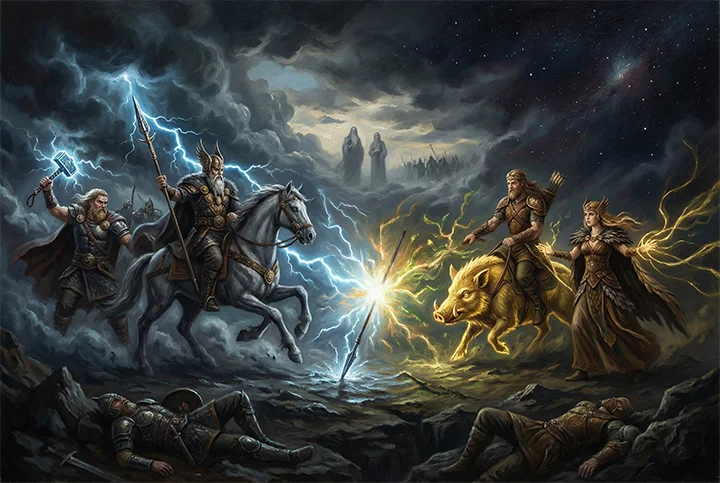
The Aesir-Vanir War is the first conflict in Norse cosmology, the war that preceded all human wars and established the conditions under which the world of gods, giants and mortals would function for the rest of mythological time. It was fought between the Aesir, the family of gods centered on Asgard and associated with kingship, war and wisdom, and the Vanir, an older family associated with fertility, nature, magic and the sea. It ended not in the annihilation of either side but in a truce, a mutual exchange of hostages and a sharing of knowledge that left both families permanently changed and permanently intertwined. The gods who came to Asgard as hostages from the Vanir, Njord, Freyr and Freya, became three of the most important deities in the entire pantheon.
The war is also the origin of Kvasir, the wisest being ever created, and therefore the indirect origin of all poetry and intellectual culture in the Norse world. The peace was sealed by the act of both divine families spitting into a common vessel, and from that combined spittle the gods fashioned Kvasir as a living symbol of their reconciliation. That Kvasir was subsequently murdered by dwarves and his blood brewed into the Mead of Poetry is characteristic of the Norse tradition's refusal to let any settlement remain pure: the peace produced something extraordinary, and the extraordinary thing was immediately stolen and turned into something else.
Origins and Mythology
The primary sources for the Aesir-Vanir War are Snorri Sturluson's Prose Edda, particularly the Ynglinga Saga which forms part of the Heimskringla, and the Voluspa in the Poetic Edda. The Voluspa's account is the oldest and most compressed: the seeress identifies the first war in the world as beginning when the Aesir struck Gullveig with spears and burned her three times in the hall of the High One, and three times she was reborn. She is called Heiðr when she is reborn, a seeress who practiced seidr magic, beloved of all wicked women. The Voluspa does not name a cause or a resolution; it simply marks the war as the first thing that happened after the world was made.
Gullveig is the central figure in the war's origin and one of the most disputed in Norse scholarship. Her name means gold power or gold drink, and the episode of her triple burning and triple rebirth connects her to the Vanir, whose association with fertility magic and the seidr tradition is well established. The Aesir's attack on her is usually interpreted as a reflection of cultural tension between the martial, hierarchical values of the Aesir gods and the older, more nature-oriented religious practices associated with the Vanir. Whether Gullveig is the same figure as Freya, as some scholars argue, or a separate Vanir figure whose destruction triggered the war, remains unresolved.
The Course of the War
The Prose Edda provides the fullest account of the war's conduct and conclusion. Both sides attacked each other's fortifications. The Aesir broke down the wall of the Vanir; the Vanir devastated the fields of the Aesir. Neither side could achieve a decisive victory. The war continued inconclusively until both families, exhausted and recognizing the stalemate, agreed to meet and make peace.
The peace was confirmed through the exchange of hostages, a standard practice in the ancient world for guaranteeing truces between powers that did not fully trust each other. The Vanir sent Njord and his son Freyr to live among the Aesir, along with Freya and the figure Kvasir. The Aesir sent the god Hoenir and the wise man Mimir to live among the Vanir. The exchange was not equal in the event: Hoenir was tall and impressive in appearance but entirely dependent on Mimir for his judgments, saying only when uncertain that others should decide. When the Vanir realized Hoenir was useless without Mimir, they felt cheated, cut off Mimir's head and sent it back to Odin. Odin preserved the head with herbs, spoke incantations over it, and it continued to speak wisdom to him, becoming one of his primary sources of counsel. Mimir's Well, over which Odin later sacrificed his eye for knowledge, is named for this figure.
The Hostages and Their Significance
The Vanir hostages who came to Asgard transformed the divine order permanently. Njord became one of the twelve principal Aesir, the god of sea and wind and coastal prosperity, widely worshipped across Scandinavia. Freyr became one of the most beloved gods in the entire tradition, the deity of sunlight, rain, fertility and abundance, whose cult at Uppsala was among the most important religious institutions in the pre-Christian north. Freya became the foremost goddess of the Vanir in Asgard, associated with love, fertility, war and death, the most powerful practitioner of seidr magic among the gods, and the one to whom half of those who die in battle are given.
The integration of these Vanir figures into the Aesir pantheon is not presented as a conquest or an assimilation. They brought their own knowledge, their own practices and their own domains, and these enriched the Aesir world rather than being absorbed into it. Freya, in particular, taught the Aesir the seidr magic that had been exclusively Vanir knowledge, including Odin, who became its most powerful male practitioner despite the tradition that seidr was considered unmanly for men to practice. The knowledge transfer that began with the war's hostage exchange permanently altered the character of the Aesir gods.
Kvasir and the Peace
The creation of Kvasir from the combined spittle of both divine families is the most symbolically significant act of the peace settlement. It literalized the concept of combined wisdom: Kvasir was not a compromise or a representative of one side, but a new being formed from the union of both. His capacity to answer any question put to him was the direct product of having been made from everything both families knew. That this being was then murdered by dwarves and his blood turned into the Mead of Poetry is the Norse tradition's characteristic movement from the symbolic to the practical: the concept of combined divine wisdom was beautiful, but it was the liquid made from the murdered body of that concept that actually entered the world and had effects in it.
Legacy and Significance
The Aesir-Vanir War is foundational to Norse cosmology in ways that go beyond its narrative content. It establishes that the divine order is not a fixed hierarchy descending from a single source but the outcome of a conflict between different kinds of power that ended in negotiation rather than domination. The gods who sit in the councils of Asgard include figures from both families, and the traditions they represent, the martial clarity of the Aesir and the fertile, magic-rich wisdom of the Vanir, coexist in permanent tension and permanent interdependence.
The war also establishes the principle that the gods make mistakes, that their first response to difference was destruction, and that the world they subsequently built was improved by the peace they were forced to make when destruction failed. The Mead of Poetry, Freya's seidr, Njord's mastery of the sea, Freyr's command of growth and abundance: all of these came to the wider divine world as a consequence of a war that neither side won and a peace that neither side initially wanted. The Norse tradition, with its characteristic combination of pessimism and pragmatism, presents this as the normal condition of things: the good that exists in the world generally arrived through violence and accident, and the gods who preside over it were not always wise enough to choose it voluntarily.
OTHRAVAR — Musical Tribute
They were called hostages. They became the bridge that held two worlds together.