The First Humans and the Gift of Life at the Edge of the World
Overview
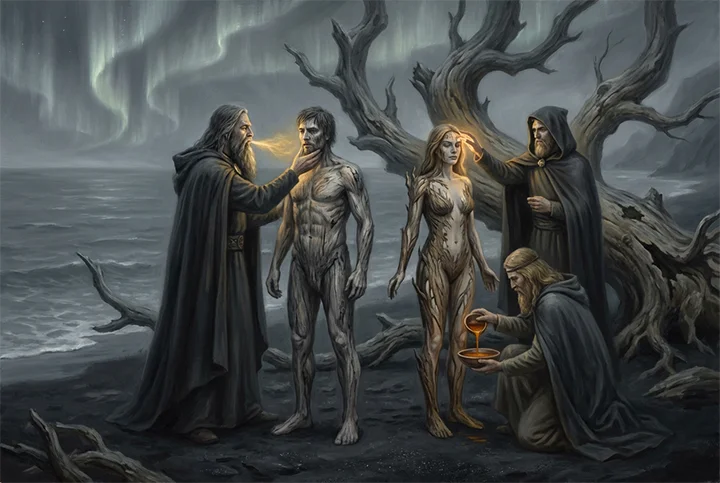
Ask and Embla are the first humans in Norse mythology, the man and woman from whom all of humanity descends. Their creation is one of the most philosophically rich episodes in the Norse tradition: two trees found on the edge of the land, lifeless and without purpose, transformed into conscious beings through the gifts of three gods who gave them everything that separates a living person from a piece of wood. The myth is brief in the sources, but what it says in that brevity is precise. Human beings did not emerge from the earth or descend from the divine. They were made from trees, by gods who were walking and happened to find them, and they were given life, sense and appearance as gifts that could just as easily not have been given.
The names themselves carry meaning. Ask is the Old Norse word for ash tree, the same species as Yggdrasil, the world tree that holds the Nine Worlds together. Embla's etymology is disputed: some scholars connect it to elm, others to vine or to a word meaning busy or industrious. The ash and the elm, or whatever Embla represents, are the raw materials from which consciousness was carved. The Norse tradition's choice of trees as the origin of humanity is not incidental: trees are the living things most like humans in their uprightness, their longevity, their deep roots and their visible growth toward the light.
Origins and Mythology
The primary sources for Ask and Embla are the Voluspa in the Poetic Edda and Snorri Sturluson's account in the Gylfaginning section of the Prose Edda. The two accounts are broadly consistent but differ in some details, particularly in the names of the gods involved.
The Voluspa, the great prophetic poem narrated by a seeress to Odin, places the creation of humans in a precise sequence. After the world has been shaped, after the gods have built Asgard and the dwarves have been made from the primordial giant Ymir's flesh, three gods walk together and find Ask and Embla on the land, with little power and without fate. They are described as lacking everything that makes a person: breath, warmth, color and the capacity for movement and speech. The three gods give them these gifts one by one. The Voluspa names the three as Odin, Hoenir and Lodurr. Odin gives breath and life. Hoenir gives sense and movement. Lodurr gives blood and good color.
Snorri's account in the Gylfaginning substitutes different names for two of the three gods. He identifies them as Odin, Vili and Ve, the three brothers who also killed the primordial giant Ymir and shaped the world from his body. In Snorri's telling, Odin gave breath and life, Vili gave wit and feeling, and Ve gave hearing, sight and good color. The substitution of Vili and Ve for Hoenir and Lodurr is one of the minor inconsistencies that characterize the Norse mythological tradition as it survived into writing, a tradition assembled from multiple regional and historical sources that did not always agree.
The Gifts of the Gods
The structure of the myth, in which three gods each contribute specific gifts to the creation of humans, is one of its most distinctive features. Ask and Embla do not receive life as a single undifferentiated gift but as a series of distinct capacities, each one necessary and each one contributed separately. This suggests a Norse understanding of personhood as composite: a human being is not a single thing but an assembly of different qualities, each of which has a divine origin and could theoretically be absent.
The gift of breath and life from Odin is the most fundamental, the capacity to exist as a living thing at all. The gifts of sense, movement and feeling from Hoenir or Vili address the inner experience of being alive: the ability to perceive, to think, to feel. The gifts of blood, color and appearance from Lodurr or Ve give the human body its visible, physical identity: the warmth of living flesh, the color that distinguishes a person from a stone or a piece of dead wood. Together, the three sets of gifts constitute a complete account of what a human being is: alive, conscious and embodied.
What the gods do not give, and what the myth conspicuously does not mention, is fate. The Voluspa describes Ask and Embla before the gifts as beings without fate, and the gift of fate is not listed among what the three gods provide. Fate belongs to the Norns, not to the gods who made the first humans, and the Norns arrive in the world independently, from the hall of the giants. Humans receive life and consciousness from the gods, but they receive their destiny from a source the gods themselves cannot control. This is characteristic of the Norse tradition's consistent insistence that fate operates above and outside the divine order.
The World Given to Humans
After their creation, Ask and Embla are given Midgard, the middle world, as their dwelling place. Midgard was made from the eyebrows of the giant Ymir and placed in the middle of the world that was shaped from his body, surrounded by an ocean in which the great serpent Jormungandr lies coiled. It is a protected space, set apart from the realm of giants by the sea and by the wall the gods built from Ymir's own brows. The first humans do not wander into a wilderness but are placed in a space specifically prepared for them, bounded on all sides by the larger cosmic architecture that the gods have already put in order.
From Ask and Embla all human beings descend. The Norse tradition does not elaborate on the generations between the first couple and the historical peoples of Scandinavia, but the genealogical connection is implicit in the myth's structure: human beings are the product of three divine gifts and the raw material of two trees, and everything that makes them what they are was given to them at the edge of the land, by gods who were walking and happened to look down.
Legacy and Significance
The Ask and Embla myth is remarkable for what it does not claim. It does not assert that humans were made in the image of the gods or that they share divine nature. It does not suggest that the gods made humans for a purpose or that the creation was planned. Three gods were walking. They found two trees without life or fate. They gave them gifts. The economy of the narrative is striking: human existence is presented not as the crown of creation but as something that happened, a gift given at a chance encounter on the edge of the world.
This is consistent with the broader Norse understanding of the relationship between gods and humans: one of mutual dependence rather than hierarchy. The gods need human worship to sustain their power; humans need divine favor to survive in a dangerous world. The relationship was established at the moment of creation, when the gods gave something irreplaceable to beings who had nothing, and it persists across the mythological tradition as a bond of obligation running in both directions.
The choice of the ash tree as the material for the first man connects Ask directly to Yggdrasil, the cosmic ash that holds the Nine Worlds together. The first human was made from the same species as the axis of the cosmos, a connection that is unlikely to be accidental. The tree from which Ask was carved and the tree that holds the world in place are the same kind of tree, and the implication is that human beings and the structure of the universe share a common material nature, a kinship between the scale of the person and the scale of everything.