The Life of the Poet Warrior Who Fought Kings, Loved Gold and Mourned His Sons
Overview
Egils saga Skalla-Grímssonar, the Saga of Egill Skallagrímsson, is one of the greatest of the Icelandic family sagas and the fullest biographical account of any individual in the medieval Norse literary tradition. It follows the life of Egill Skallagrímsson from the history of his grandfather Kveld-Úlfr in Norway through Egill's own extraordinary career as a Viking raider, mercenary, landowner, legal disputant and skaldic poet, to his death in Iceland in old age. Egill is one of the most psychologically complete characters in the saga literature, combining extraordinary physical ugliness and ferocity with genuine poetic gifts of the highest order, an outsider temperament with intense personal loyalties, and a lifelong conflict with royal authority alongside deep and genuine love for specific individuals.
The saga is believed by many scholars to have been composed by Snorri Sturluson in the early thirteenth century, based on stylistic and structural similarities with his other known works and on his own descent from Egill's family. Whether or not this attribution is correct, the saga represents the fullest engagement with a single individual's psychology in the Old Norse literary tradition, and it preserves three complete skaldic poems by Egill himself, including the Höfuðlausn and the Sonatorrek, which are among the most important texts in the history of Norse poetry.
The Family Background: Kveld-Úlfr and Skalla-Grímr
The saga begins two generations before Egill with his grandfather Kveld-Úlfr, whose name means evening wolf, a shape-changer who becomes most powerful and most dangerous at twilight and who opposes the growing power of Harald Fairhair in Norway. Kveld-Úlfr's son Þórólfr serves Harald loyally and is killed through the king's false suspicion, an injustice that Kveld-Úlfr does not survive to avenge in person. He dies at sea on the voyage to Iceland, ordering his sons to build his farm wherever the driftwood coffin containing his body comes ashore. The coffin comes ashore at a place that is named Borgarnes, and his son Skalla-Grímr builds his farm there.
Skalla-Grímr, Egill's father, is described as large, dark, and formidable, bald from early in life, a berserker fighter whose rages are described as making him temporarily insane. He establishes himself in Iceland as a farmer, metalworker, shipbuilder and hunter of an extraordinary range of skills, and he passes his physical gifts and his conflict with royal authority to his sons. His elder son Þórólfr is handsome, popular and eventually killed in the service of the Norwegian king Eiríkr Blóðöx, repeating the pattern of his great-uncle's death. Egill is Skalla-Grímr's other son, dark and ugly like his father from birth, and it is Egill's career that constitutes the main body of the saga.
Egill's Character and Early Life
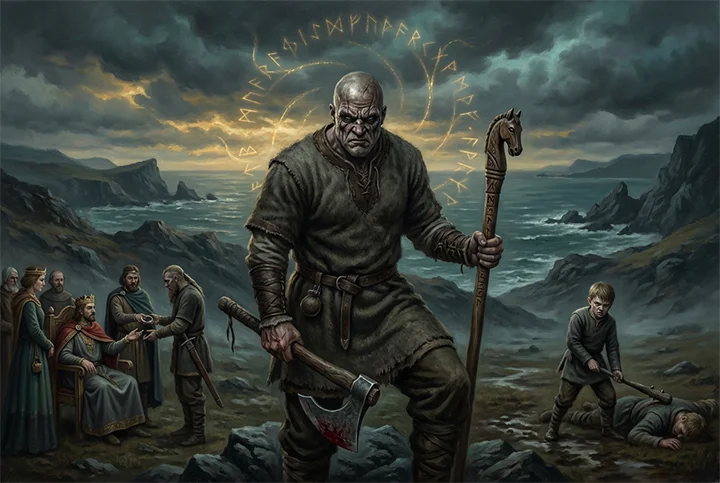
Egill's character is established in the saga through a series of incidents in childhood that foreshadow his adult life with remarkable consistency. At the age of three he composes his first verse, celebrating a gift of money. At the age of six or seven he kills a boy twice his size in a ball game after a dispute, and when his mother praises him for it, saying he will make a fine Viking, he goes immediately to his father for weapons. Skalla-Grímr gives him an axe. He uses it that same day to kill a man who has struck him.
His physical description in the saga is arresting: large, broad-shouldered, thick-necked, with a big skull described as unusually thick-boned, heavy eyebrows, a wide nose and dark hair. Medical historians reading the saga have suggested that his physical description, combined with certain behavioral details, is consistent with Paget's disease of bone, a condition that causes abnormal bone growth and can affect the skull and facial bones. Whether this diagnosis is correct or not, the saga's description of Egill's appearance is among the most detailed physical descriptions of any individual in medieval Norse literature.
Egill in Norway: The Conflict with Eiríkr Blóðöx and Gunnarr
Egill makes his first voyage to Norway as a young man and immediately comes into conflict with the Norwegian king Eiríkr Blóðöx and his wife Gunnhildr, who becomes his most persistent enemy. A dispute at a feast results in Egill killing Bárðr, a man under the king's protection, and composing a níð verse against the king, an act of formal poetic defamation that was legally and socially equivalent to a public accusation of cowardice and unmanliness. The conflict with Eiríkr and Gunnhildr runs through the saga's Norwegian sections and continues after both Egill and the royal couple settle in different parts of England.
In Norway Egill also kills the sons of a landed man named Gunnarr and takes their money, an act of opportunistic violence that results in a legal case against him. His conduct in Norway establishes the pattern of his adult life: he is brave, skilled, quick-tempered, willing to use violence to get what he considers rightfully his, and equally willing to use poetry and law to achieve the same ends when physical force is unavailable or inappropriate.
Egill in England: The Battle of Brunanburh and the Höfuðlausn
Egill's most consequential visit to England takes place during the reign of King Æthelstan, who is fighting to maintain his kingdom against a coalition of Norse and Scottish forces. Egill and his brother Þórólfr serve Æthelstan as mercenaries and fight at the Battle of Brunanburh in 937, a major engagement that resulted in a decisive English victory. Þórólfr is killed in the battle. Egill himself fights with such distinction that Æthelstan rewards him lavishly.
On a subsequent visit to England, Egill is captured by Eiríkr Blóðöx, who has been deposed from Norway and is ruling in York under Æthelstan's overlordship. Egill spends the night composing a poem in praise of Eiríkr, the Höfuðlausn or Head Ransom, twenty stanzas in the drottkvaett meter that praises the king's military achievements. He performs the poem before Eiríkr and his court the following morning. Eiríkr releases him. The Höfuðlausn is the oldest complete long drottkvaett poem preserved from any individual skald, and its composition and performance as an act of self-ransom is one of the most dramatic episodes in the history of Norse poetry.
Egill's Legal Battle in Norway
Returning to Norway after Eiríkr's death, Egill becomes involved in a legal dispute over the inheritance of his wife Ásgerðr, whose father Björn had been defrauded of his property by a man named Önundr. The saga describes Egill's conduct of his legal case at the Gulaþing in detail, including his arguments, his opponents' counterarguments and the eventual outcome. When the legal case goes against him through the corrupt influence of King Eiríkr's son Eiríkr, Egill plants a níð pole on a headland, impaling a horse's head on it and directing a formal curse at King Eiríkr and Queen Gunnhildr and the land spirits of Norway for supporting injustice. He then composes a verse of formal defamation. The níð pole and its associated curse are described in the sources as a serious magical and legal act, and their use here reflects the full range of weapons available to a man like Egill in his conflicts with authority.
The Sonatorrek
The Sonatorrek, the Lament for My Sons, is the most personally immediate and the most theologically radical of Egill's surviving poems. It was composed after the deaths of two of Egill's sons: the elder, Böðvar, who drowned in a shipwreck, and the younger, Gunnar, who died of illness shortly after. Egill is described in the saga as going to his bed and refusing to eat or drink after Böðvar's death, lying there without speaking until his daughter Þorgerðr persuades him to live by telling him she will die with him unless he composes a poem for Böðvar. He composes the Sonatorrek, twenty-five stanzas, while he is still lying on his bed, and speaks it aloud when it is finished.
The poem is addressed partly to the sea, which Egill accuses of stealing his son, and partly to Odin, whom he accuses of breaking the compact between them. Egill has served Odin faithfully as a poet, he argues; Odin has rewarded him with grief. He considers refusing to worship Odin further. He considers tearing down the altars of the gods. He does not do so because, as he acknowledges, Odin gave him the gift of poetry, and that gift is the one thing Egill cannot reject. The poem ends not with resolution but with exhausted acceptance: Egill will go on living because Odin's gift is inside him and he cannot remove it. The Sonatorrek is widely regarded as one of the most remarkable lyric poems in the medieval European tradition, unique in its direct and angry engagement with the god who is normally addressed only with praise.
Egill's Old Age and Death
In old age Egill goes blind and deaf. He is described as increasingly difficult to manage, wandering around the farm bumping into things and getting in the way, irritating the household. His last significant act is one of characteristic contrariness: he wants to ride to the Althing with his two chests of silver and scatter the coins among the crowd to cause a commotion and watch people fight over them. His household refuses to let him go. He buries the silver instead, in a location that was never found. The saga notes that he killed two men who saw him bury it. The location of Egill's silver remains unknown.
Egill dies in the winter, old and blind. He is initially buried in a mound at Tjalðanes. When Iceland converts to Christianity, his bones are moved to the church at Mosfell. The saga's final detail about Egill's skull, described by the priest who excavates the mound as unusually large and heavy, its bone table as thick as the back of a hand and marked by no blow that would have caused death, is the source of the Paget's disease hypothesis and is the last physical detail in a saga that has been deeply attentive to Egill's body throughout.
Sources and Historical Basis
Egill Skallagrímsson is accepted as a historical figure. Several of his poems survive in the saga and in other sources, providing external evidence for his existence and his poetic activity. The Battle of Brunanburh in which he participates is historically attested and datable to 937. The Norwegian kings and English kings who appear in the saga are historical. The family genealogies in the saga connect to other Icelandic genealogical records. The saga is understood as a biographical account of a historical person substantially shaped by the literary craft of its author, rather than as either pure fiction or pure historical record.
Legacy and Significance
Egils saga is the fullest portrait of an individual in medieval Norse literature, a text that follows a single life from birth to death with a psychological consistency and a quality of observation that has no parallel in the saga tradition. Its three complete skaldic poems, the Höfuðlausn, the Sonatorrek and the Arinbjarnarkviða, are among the most important texts in the history of Old Norse poetry. The Sonatorrek in particular has attracted sustained scholarly and literary attention as an example of genuine personal expression within the constraints of a highly conventional poetic form, a private grief shaped into public art.