The Outlaw Who Found Greenland and the Voyages That Reached the New World
Overview
Eiríks saga rauða, Eirik the Red's Saga, is one of the two Vinland sagas, the primary Old Norse sources for the Norse discovery and exploration of North America. Together with the Grænlendinga saga, it provides the documentary evidence for Norse voyages to the continent they called Vinland, the only written accounts of pre-Columbian European contact with North America. The saga is preserved in two manuscript versions, the Hauksbók and the Skálholtsbók, which differ substantially from each other in several sections, suggesting that the text existed in multiple versions in the medieval period. It is generally dated to the thirteenth century, though the events it describes belong to the late tenth and early eleventh centuries.
The saga covers the life of Eiríkr Þorvaldsson, known as Eirik the Red because of his red hair and beard, from his family's departure from Norway following a killing through the settlement of Iceland, his outlawry from Iceland and his exploration and settlement of Greenland, to the voyages of his son Leif Eriksson and the merchant Thorfinn Karlsefni to Vinland. It is a saga of displacement, exploration and the failure of permanent settlement, and its central characters, from Eirik's defiance of authority to Guðríðr Þorbjarnardóttir's extraordinary life spanning two continents, are among the most memorable in the saga tradition.
Eirik the Red: Outlawry and the Discovery of Greenland
Eiríkr Þorvaldsson's father Þórvaldur was outlawed from Norway for manslaughter and emigrated to Iceland, settling in Drangar in Hornstrandir in the northwest. Eirik was born in Norway and grew up in Iceland. After his father's death, Eirik moved south and married Þjóðhildr. A dispute over borrowed wooden planks called house beams, the sétstokkr, led to killings on both sides and Eirik's three-year outlawry from the settlement district of Dalir. During this outlawry he lived on the island of Öxney and fought additional conflicts with a neighbour named Þorgestur, resulting in his full outlawry from Iceland for three years.
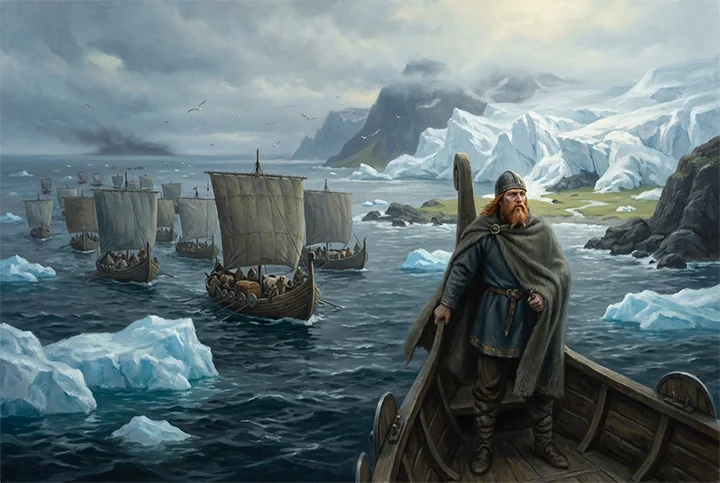
During his three-year outlawry from Iceland, Eirik sailed west to explore land that had been sighted but not settled, which had been reported by a Norwegian sailor named Gunnbjörn Ulfkrakuson who had been driven off course. Eirik spent three years exploring this land, which he named Greenland, Grænland, deliberately choosing a name that would attract settlers. He returned to Iceland, gathered settlers, and led a fleet of twenty-five ships back to Greenland around 985 or 986. Only fourteen of the ships completed the voyage; eleven turned back or were lost. The settlers established two main areas of settlement, the Eastern Settlement and the Western Settlement, which endured for approximately five centuries.
Leif Eriksson and the Mission from King Óláfr
The saga describes Leif Eriksson, Eirik's son, as having spent time in Norway at the court of King Óláfr Tryggvason, who reigned from 995 to 1000. Óláfr charged Leif with bringing Christianity to Greenland when he returned. The saga presents Leif's discovery of Vinland as occurring on his return voyage from Norway, when he was driven off course, though the Grænlendinga saga gives a different account in which Leif deliberately sets out to find land that Bjarni Herjólfsson had sighted.
According to the Eiriks saga rauða, Leif and his crew made landfall on an unknown coast on their voyage home, where they found self-sown wheat fields, vines and wood of maple. They rescued a shipwrecked Norse crew on the same voyage. When Leif returned to Greenland with his news, his father Eirik initially agreed to lead an expedition to the new land but fell from his horse on the way to the ship, which he interpreted as a bad omen, and turned back. Leif brought Christianity to Greenland as charged, and Þjóðhildr, his mother, converted and built a church near the farm at Brattahlíð, but Eirik refused to convert to the end of his life.
Þorsteinn Eiríksson's Failed Voyage
Leif's brother Þorsteinn Eiríksson attempted to sail to Vinland with a crew of twenty men and his wife Guðríðr Þorbjarnardóttir, who had recently arrived in Greenland. They sailed all summer but were driven by storms and could not find Vinland, eventually returning to Greenland exhausted. Þorsteinn spent the winter at the Western Settlement and died there of an illness that swept through the settlement killing many people. Before dying, Þorsteinn reportedly spoke in a prophetic state, announcing information about the futures of those present, and told Guðríðr that she would marry an Icelander, travel to Iceland, live a long and distinguished life, and make a pilgrimage to Rome, all of which the saga records as having come true.
Thorfinn Karlsefni's Expedition
The central expedition to Vinland in the saga is that of Þorfinnr Karlsefni, an Icelandic merchant of good family who had come to Greenland on a trading voyage and had married the recently widowed Guðríðr Þorbjarnardóttir over the winter at Brattahlíð. Karlsefni organized an expedition of three ships carrying approximately one hundred and sixty people, including women and livestock, with the intention of establishing a permanent settlement in Vinland.
The expedition sailed first to a land of flat stone which they named Helluland, then to a forested land they named Markland, then further south to Vinland, where they found wild wheat and grapes and good pasture. They built houses at a place they called Straumfjörðr. In their second winter, Guðríðr gave birth to a son, Snorri, the first child of European descent born in North America, a detail recorded consistently in both Vinland sagas.
The saga's account of the encounters with the indigenous inhabitants, called Skrælingar, is extensive and detailed. The first meeting is peaceful: the Skrælingar arrive in skin boats, are surprised by the Norse bull who escapes and charges among them, and flee. After a winter, they return in greater numbers to trade. The trading goes well initially, the Skrælingar exchanging furs for red cloth and Norse dairy products, which they had not seen before and which they valued highly. The Norse refuse to trade weapons.
The second encounter turns violent. The bull escapes and charges the Skrælingar again, who attack the Norse settlement. The saga records a scene in which a woman named Freydís Eiríksdóttir, Eirik's illegitimate daughter, who is pregnant at the time, faces the attacking Skrælingar alone when the Norse men have fled into the forest. She picks up a sword from a fallen man, slaps it against her bare breast, and shouts at the Skrælingar. They retreat in apparent fear or confusion. This episode is one of the most vivid individual scenes in either Vinland saga.
Karlsefni concluded after three years that the land could not be settled permanently due to the hostility of the indigenous inhabitants despite its natural abundance. The expedition returned to Greenland and then to Iceland. Karlsefni and Guðríðr settled in Iceland, bought a farm called Glaumbær in Skagafjörðr, and lived there. Their son Snorri, born in Vinland, became the ancestor of several prominent Icelandic bishops. Guðríðr eventually made her pilgrimage to Rome as Þorsteinn's prophecy had foretold, and on returning to Iceland became a nun and anchoress, living in a cell beside the church at Glaumbær until her death.
Freydís Eiríksdóttir
Freydís, Eirik the Red's illegitimate daughter, appears in both Vinland sagas but in substantially different roles. In the Eiriks saga rauða she is the heroic figure who faces down the Skrælingar alone. In the Grænlendinga saga she is the villain of a separate expedition to Vinland, during which she arranges the killing of all the Norse members of the other party, including several women whom no man was willing to kill and whom she kills herself with an axe. The two accounts present irreconcilable portraits of the same person, and the question of which, if either, reflects a historical reality cannot be resolved.
Sources, Manuscripts and Historical Evidence
The Eiriks saga rauða survives in the Hauksbók, compiled by the Icelandic lawyer Haukr Erlendsson between approximately 1302 and 1310, and in the Skálholtsbók, a manuscript from around 1420. The two versions differ significantly in the section describing Leif's discovery of Vinland and in several other details. The saga is generally considered by scholars to be the later and more literarily elaborated of the two Vinland sagas, with the Grænlendinga saga preserving older and more reliable traditions about the voyages themselves. The archaeological site at L'Anse aux Meadows in northern Newfoundland, excavated from 1960 onward and dated to approximately 1000, provides independent confirmation of Norse presence in North America consistent with the saga accounts.
Guðríðr Þorbjarnardóttir
Guðríðr Þorbjarnardóttir is one of the most remarkable individuals in the saga tradition, a woman whose documented travels across the North Atlantic rival those of any figure in the medieval world. She traveled from Iceland to Greenland, from Greenland to Vinland, back to Greenland, then to Norway, then to Iceland, then to Rome, then back to Iceland, where she ended her life as a nun at Glaumbær. Her son Snorri, born in North America, became the ancestor of several Icelandic bishops, making her a figure whose physical and genealogical reach extends across two continents and into the institutional history of the Icelandic church.
Legacy and Significance
Eiríks saga rauða is one of the foundational documents of Norse exploration history, recording in narrative form the furthest reach of medieval European expansion before the age of Columbus. Together with the Grænlendinga saga, it provides the documentary basis for the Norse discovery of North America and the context within which the archaeological evidence at L'Anse aux Meadows is understood. Its principal characters, from the defiant Eirik who explored an unknown ocean rather than submit to outlawry to the extraordinary Guðríðr who traveled from America to Rome and back in a single lifetime, represent the full range of the Norse world's capacity for geographical and personal adventure.