Bound Until the End of the World
Overview
The punishment of Loki is the final act of a long reckoning. For centuries Loki had moved between worlds as a trickster, a companion, an agent of chaos who always returned to Asgard and always found forgiveness or at least tolerance. That era ended at the feast of Aegir, where Loki walked into the hall of the gods and said aloud what could not be unsaid. What followed was not a battle but a capture, a binding so thorough and so precise that it mirrors the binding of Fenrir in its cruelty: a being restrained not by walls but by something taken from his own body, held in place by the loyalty of a wife who cannot save him and the venom of a serpent that will not stop.
The punishment is inseparable from what preceded it. Loki had guided the hand that killed Baldur. He had then disguised himself as the giantess Thokk and refused to weep, ensuring Baldur could not return from Hel. The gods had known for some time what he had done. What finally broke the arrangement was Loki's appearance at Aegir's feast, where he used the tradition of guest-right to say things to each god and goddess that could not be answered with violence. When he left, the reckoning could no longer be deferred.
Origins and Mythology
The primary source for Loki's punishment is the Lokasenna, a poem in the Poetic Edda in which Loki attends the feast of the sea giant Aegir and systematically insults every god and goddess present. He accuses Odin of practicing seidr magic, which was considered unmanly. He accuses Frigg of infidelity. He accuses Freya of taking every god and elf in Asgard as a lover. He accuses Tyr of cowardice, Njord of being used as a chamber pot by the daughters of Hymir, Skadi of having slept with him. The accusations vary in their credibility and in how much they sting, but their cumulative effect is to expose every grievance and every secret the gods had hoped to keep.
The feast ends when Thor arrives and threatens Loki with his hammer Mjolnir. Loki leaves, telling Thor he has only departed because of him and not because of any of the other gods. This detail matters: Loki is not driven out by the collective will of Asgard but by the specific threat of physical force from a specific god. He goes on his own terms, which is entirely in keeping with his character.
After fleeing Asgard, Loki hid in a house on a mountain near a waterfall. During the day he transformed himself into a salmon and hid in the pool at the base of the falls. He spent his time calculating what the gods might use to catch him and in doing so invented the fishing net, then threw it into the fire when he sensed the gods approaching. The gods found the ash pattern of the net in the embers, understood what it was, made a new one and used it to drag the pool. Loki leapt over the net. Thor caught him in midair, gripping him by the tail. This is given in the Prose Edda as the reason salmon have tapered tails.
Key Events
The gods brought Loki to a cave beneath the earth. They took his son Narfi and his son Vali. Vali was transformed into a wolf and tore Narfi apart. The entrails of Narfi were then used as the bonds to chain Loki to three rocks: one under his shoulders, one under his hips, one under his knees. The bonds hardened into iron the moment they were in place.
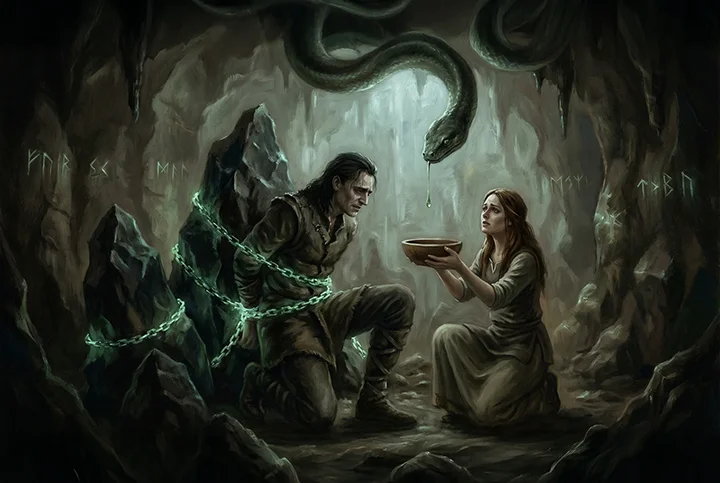
Skadi, the giantess whom Loki had insulted at Aegir's feast and whose father Thiazi he had helped kill years before, placed a serpent above him so that its venom would drip onto his face. The venom burns like acid wherever it touches. Loki's wife Sigyn remained beside him. She holds a bowl above his face to catch the drops before they land. She does not leave. When the bowl is full she must carry it away to empty it, and in the moments when she is gone the venom falls and Loki writhes with such force that the earth shakes. The Norse tradition identifies these convulsions as the cause of earthquakes.
He will remain there until Ragnarok. When the final days come, the bonds will break. Loki will sail on the ship Naglfar, which is built from the fingernails and toenails of the dead and will be crewed by the denizens of Hel. He will fight against the gods he once traveled with, and at the end of that battle neither he nor they will remain.
Legacy and Significance
Loki's punishment is one of the most psychologically dense episodes in Norse mythology because it refuses simple moral accounting. Loki did monstrous things: he engineered the death of Baldur, he prevented his return, he dismantled the dignity of every god at Aegir's feast. The punishment the gods chose is also monstrous: they used his own son's body as the material of his chains. The myth does not invite the reader to feel that justice has been done. It invites the reader to feel the weight of a situation in which every actor has gone too far and there is no longer any path back to before.
The figure of Sigyn deserves particular attention. She appears rarely in the sources and almost nothing is said about her personality, her opinions or her inner life. What is recorded is only that she stays. She holds the bowl. She does not abandon her husband despite everything he has done and everything that has been done to him and everything that will come. In a tradition that values loyalty above almost all other virtues, Sigyn's silent, unrecognized endurance is one of the most quietly powerful images in the entire mythology.
The Lokasenna, the poem that precipitates the punishment, is unusual in the Norse corpus for the directness of its accusations. Scholars debate whether the insults Loki delivers reflect genuine mythological traditions about the gods or whether they are comic exaggerations for the purposes of the poem. Either way the poem functions as a kind of audit of divine reputation, and Loki's role in it is that of a figure who has nothing left to lose and therefore says everything that cannot otherwise be said.
OTHRAVAR — Musical Tribute
Experience the weight of Loki's chains and the silence of his long imprisonment through the ancient sounds of Norse folk music. This original composition draws from the skaldic tradition, performed with traditional instruments including tagelharpa, bukkehorn and frame drum.