How the Gods Stole the Source of All Wisdom and Verse
Overview
The Mead of Poetry is the mythological explanation for the origin of all creative and intellectual excellence in the Norse world. It is a liquid brewed from the blood of the wisest being ever created, mixed with honey, and whoever drinks it becomes a poet of the highest order or a scholar of the deepest learning. It was made by the dwarves Fjalarr and Galarr from the body of Kvasir, a being formed from the mingled saliva of the Aesir and Vanir gods at the conclusion of their war, a living embodiment of the peace and combined wisdom of two divine families. It passed through murder, deception, a giant's household, three stone vessels, a mountain, an eagle, and Odin's stomach before arriving in Asgard, and somewhere along the way a portion of it was lost and fell to the earth, where it became the portion available to inferior poets and those who versify without true inspiration.
The myth is one of the most structurally intricate in the Norse tradition, a sequence of nested deceptions in which nearly every actor is both deceiver and deceived, and the object at the center keeps moving between containers and keepers without ever being secure. It is also a myth about what wisdom and poetry actually are in the Norse worldview: not gifts that descend from above to the deserving, but specific substances with a specific origin and a specific history of violence and theft behind them, obtained by the chief of the gods through a shape-shifting campaign of seduction, trickery and outright theft, and brought back to Asgard at the cost of almost everything.
Origins and Mythology
The primary source is Snorri Sturluson's Prose Edda, specifically the Bragaraeður section of the Skaldskaparmal, where Bragi tells the story to the sea giant Aegir. The myth begins at the conclusion of the Aesir-Vanir War, when the two families of gods made peace by meeting and each spitting into a vessel. From this combined spittle they fashioned a man named Kvasir. Kvasir was so full of wisdom that he could answer any question put to him, and he traveled the worlds dispensing knowledge to anyone who asked. He had no malice and no capacity for suspicion: a being made from an act of cooperation, incapable of imagining betrayal.
The dwarves Fjalarr and Galarr invited Kvasir to their home, killed him in private, and drained his blood into two vats called Son and Bodn and a kettle called Odrerir. They mixed the blood with honey to make the mead. When the Aesir asked what had become of Kvasir, the dwarves said he had drowned in his own intelligence, that there was no one wise enough to ask him the questions that would have kept him in conversation long enough to save his life. This is presented without comment in the source, which is itself a kind of dark humor: the wisest being in existence was killed because he lacked the one specific kind of knowledge that might have protected him.
The Giant Suttungr and Gunnlod
The dwarves did not keep the mead for long. They subsequently killed the giant couple Gillingr and his wife, and Gillingr's son Suttungr came to take revenge. The dwarves bargained for their lives by offering him the mead. Suttungr took it, carried it to his mountain Hnitbjorg, sealed it in a chamber carved from the rock, and set his daughter Gunnlod to guard it. The mead was now inside a mountain, inside a stone chamber, guarded by a giant's daughter. It was as secure as anything in the Norse cosmos could be made.
Odin came for it. He traveled to a farm near Hnitbjorg where nine thralls were cutting hay, disguised as a traveler named Bolverk. He offered to sharpen their scythes and when the sharpening stone worked miracles, each thrall wanted to buy it. Odin threw the stone in the air and the nine thralls cut each other down scrambling for it. Odin then presented himself to the farm's owner, the giant Baugi, who was Suttungr's brother, and offered to do the work of the nine dead men through the summer in exchange for a single drink of the mead. Baugi agreed, though he admitted the mead was his brother's to give, not his own. Odin worked all summer under the name Bolverk, the evil deed, which the myth does not present as accidental.
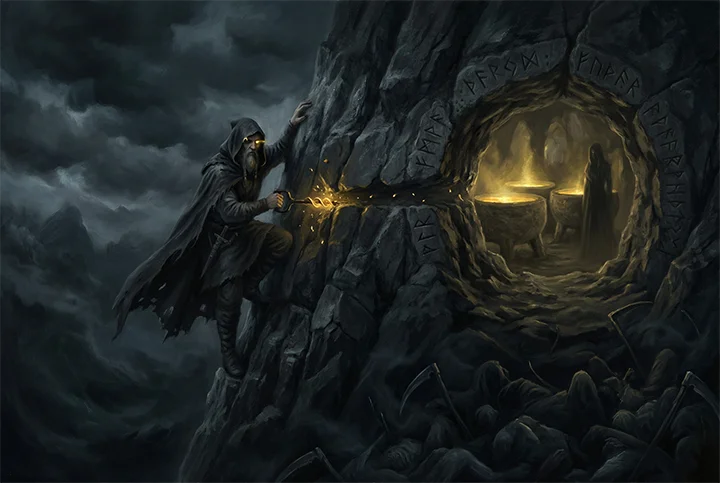
At summer's end Baugi took Odin to Suttungr, who refused to give any of the mead. Odin produced a drill called Rati and asked Baugi to bore into the mountain. Baugi tried to deceive him by boring only partway through, but Odin blew through the hole and the debris came back in his face, proving the tunnel was incomplete. Baugi bored the rest of the way. Odin transformed himself into a snake and slipped through the hole. Baugi stabbed after him with the drill but missed.
Inside the mountain Odin found Gunnlod. He spent three nights with her, and for each night she gave him one drink from the mead. Three drinks was all he needed: in three draughts he emptied all three vessels completely, Son, Bodn and Odrerir. He transformed into an eagle and flew for Asgard at full speed. Suttungr saw him, transformed into an eagle himself, and pursued. The gods saw Odin coming and set out vessels in the courtyard of Asgard. Odin flew over the courtyard and spat the mead into the vessels. Suttungr was so close behind him that Odin let a small portion escape from the other end during his flight, and this portion fell to earth below. Snorri notes with dry humor that this is the portion available to bad poets.
Legacy and Significance
The Mead of Poetry myth does several things simultaneously. It provides the cosmological origin of poetic and intellectual gift. It establishes the Eddic kenning for poetry, skaldic mead or Kvasir's blood, which appears throughout the literature as a standard reference to verse. It demonstrates Odin's character in its most fully developed form: the Allfather as an entity willing to commit multiple murders by proxy, to seduce a giant's daughter under false pretenses, to work as a farm laborer under an assumed name, and to steal with maximum efficiency when all other options are exhausted.
The figure of Kvasir deserves particular attention. He is the only being in Norse mythology created specifically from an act of reconciliation between two divine families, a living synthesis of everything the Aesir and Vanir together knew. His death at the hands of the dwarves, who could not contain or use what he represented but could reduce it to a liquid and trade it for their lives, is one of the bleakest images in a tradition not known for sentimentality. Wisdom, in the Norse world, does not protect its possessor. It makes him a target.
The myth also raises a question that it does not answer: what happened to Gunnlod? She gave Odin everything he asked for, paid the price that Suttungr presumably extracted from her afterward, and is not mentioned again. One of the Havamal's most famous stanzas is sometimes read as Odin reflecting on this episode, acknowledging that he gave her grief in exchange for what she gave him, and that he would do it again. The Norse tradition is honest about its gods in this way: Odin gets the mead, Asgard gets poetry, Gunnlod gets nothing, and the poem records all three facts in the same breath.