The Eye Given for Wisdom
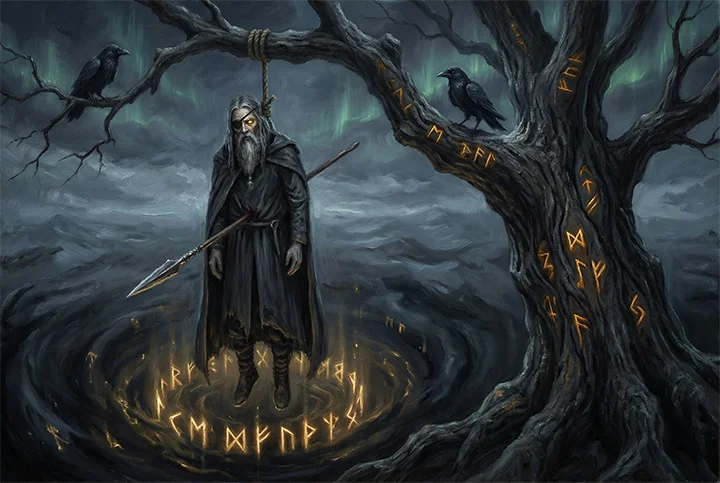
Overview
Among all the acts of self-denial and sacrifice that define Odin's character across the Norse mythological tradition, none is more fundamental than the loss of his eye at the Well of Mímir. It is the act that established the template for everything that follows: the idea that wisdom is not given but purchased, that the price must be commensurate with what is sought, and that the greatest knowledge requires the greatest cost. Odin did not lose his eye by accident or in battle. He removed it himself, deliberately, and cast it into the well as payment. The eye sank to the bottom of Mímisbrunnr, where it remains, seeing in the depths what the living eye sees only in the light.
This myth is inseparable from Odin's broader identity as a god who accumulates knowledge through suffering. The same impulse that drove him to the Well of Mímir also drove him to hang on Yggdrasil for nine days to receive the runes, to send his ravens across the world each day to gather intelligence, and to wander the Nine Realms in disguise gathering wisdom from every source he can find. The eye is the most visible symbol of this compulsion: the permanent, physical mark of what it costs to know what Odin knows.
The myth also establishes something important about the nature of the cosmic well itself. Mímisbrunnr is not a well that gives its water freely. It is guarded by Mímir, one of the oldest and most knowing beings in the Norse cosmos, and its waters must be paid for. The fact that even Odin, the chief of the gods, must pay this price reinforces a central Norse insight: knowledge of the deepest kind recognises no rank or privilege. It demands the same of everyone.
Origins & Mythology
The story of Odin's eye is told most directly in the Prose Edda, where Snorri Sturluson describes Odin coming to the well beneath the root of Yggdrasil that reaches into the realm near Jötunheimr. Mímir, the guardian of the well, kept the water of cosmic wisdom there, and he drank from it each morning with the horn Gjallarhorn. When Odin arrived and asked for a drink, Mímir told him the price. Odin did not hesitate. He plucked out his own eye and dropped it into the well, and Mímir fulfilled his part of the bargain.
The Poetic Edda approaches the same event from a different angle. In the poem Völuspá, the völva who narrates the poem speaks of seeing Odin's eye hidden in the well of Mímir, a detail that places this act at the very beginning of the mythological timeline, among the foundational events that shaped the cosmos as it exists. The eye in the well is not merely a detail of biography but a permanent feature of the Norse universe, a piece of Odin himself lodged at the root of everything, still perceiving in the dark water.
What exactly Odin received in exchange is described broadly as wisdom, but the sources make clear that this is cosmic wisdom of the deepest kind: understanding of the hidden workings of fate, of the forces driving the cosmos toward Ragnarök, and of how those forces might be delayed or mitigated. The drink from Mímisbrunnr did not make Odin omniscient but it gave him a perspective on the deep structure of reality that no other being possessed. It is the foundation of everything he does from that point on.
Key Stories & Appearances
The loss of Odin's eye resonates through the entire Norse mythological cycle as the explanation for his relentless pursuit of knowledge through every other means available to him. After paying such a price for one source of wisdom, his hunger for more became if anything more intense. The ravens Huginn and Muninn, Thought and Memory, who fly the world each day and return to whisper what they have seen, are a direct extension of the same impulse. Having given one eye to the well, Odin compensates with the eyes of thought and memory that range across all the worlds.
Odin's one-eyed appearance is also his most consistent disguise. When he travels through Midgard as a wandering old man, the wide-brimmed hat pulled low over the missing eye is the detail that sometimes reveals him to those who know what to look for. In the sagas, the appearance of a one-eyed old stranger giving advice or setting events in motion is a recurring motif, a signal to the reader that Odin is present and operating, even when his name is never spoken.
The eye in the well also appears in Odin's final consultations before Ragnarök. When the völva in Völuspá speaks of the end of the world, she addresses Odin directly, and the image of his eye still lying in Mímir's well is present as a reminder of everything he gave to understand what was coming. He paid for the knowledge of Ragnarök with his eye, and the myth implies that he has always known, since that moment at the well, exactly how the story ends.
Legacy & Significance
The sacrifice of Odin's eye is the Norse tradition's most powerful statement about the relationship between knowledge and cost. It refuses the comfortable idea that wisdom is a gift or a reward or something that accumulates naturally over time. In the Norse understanding, the deepest knowledge is extracted from the universe at a price that the universe itself sets, and no one — not even the chief of the gods — is exempt from paying it. The eye in the well is permanent proof of this principle, visible to anyone who looks into the depths of Mímisbrunnr.
What makes this myth so enduring is its psychological honesty. The desire to understand the deep structure of reality, to see past the surface of things into the forces that actually drive events, is one of the most fundamental human impulses. Odin's eye represents the acknowledgment that this desire has a cost: that to see more clearly you must give up something of yourself, that knowledge and sacrifice are not separate things but aspects of a single transaction. He chose to pay. The empty socket is the proof, and the wisdom he gained with it shapes everything that follows.
OTHRAVAR — Musical Tribute
Experience the weight of Odin's sacrifice through the ancient sounds of Norse folk music. This original composition draws from the skaldic tradition, performed with traditional instruments including tagelharpa, bukkehorn and frame drum.