The Dragon Slayer, the Shield-Maiden and the Legend That Outlasted the Viking Age
Overview
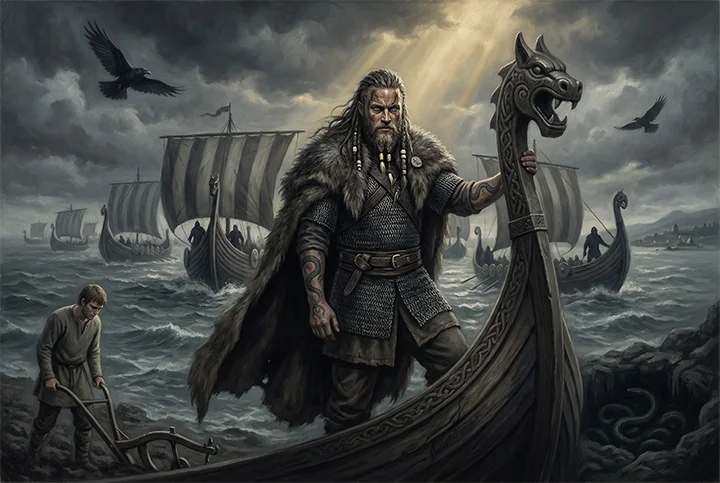
Ragnar Lothbrok is the most famous Viking in the Norse legendary tradition, a figure who straddles the boundary between mythology and history with more force and ambiguity than almost any other name from the Norse world. He appears in multiple sagas, in the poetry of his own sons, in accounts of the Viking Age written by Frankish and Anglo-Saxon chroniclers who encountered his forces on their raids, and in the living oral tradition of Scandinavia for centuries after his death. Whether he was a single historical person, a composite of multiple raiders whose deeds were gathered under one name, or a legendary figure who accumulated historical events around himself as he traveled through time, is a question that has not been definitively resolved. What is certain is that Ragnar Lothbrok became the defining image of the Viking hero: restless, brilliant, fatalistic, driven by the conviction that a death in battle was the only ending worth having.
The saga tradition surrounding Ragnar is extensive and not always internally consistent. The primary texts are the Ragnars saga Lodbrókar, the Krákumál, a death poem attributed to Ragnar in the snake pit of King Ælla of Northumbria, and the Ragnarssona þáttr. Surrounding these are the stories of his sons, particularly the Tale of Ragnar's Sons, which chronicles the great heathen army that his sons Ivar, Björn, Halfdan, Ubba and Sigurd led against England in revenge for their father's death. The saga of Ragnar and the saga of his sons together form one of the longest continuous narrative sequences in the Norse legendary tradition.
The Dragon and the Beginning
The saga begins with Ragnar as a young man performing an act that establishes him immediately in the heroic tradition: he kills a giant serpent, described in some versions as a Lindworm or a creature of supernatural size, that has grown to monstrous proportions in the household of a jarl named Herruðr, coiled around the chest containing the dowry of Herruðr's daughter Þóra. Ragnar makes himself a protective garment of boiled leather and tar, kills the serpent, and wins Þóra as his wife. The boiled leather garment gives him his cognomen: Lothbrok means hairy breeches or shaggy trousers, an unglamorous epithet for a man who becomes the most celebrated Viking of the age.
Þóra dies young, and Ragnar's attention turns to a woman he has heard of called Kráka, a woman of extraordinary beauty living in poverty with peasant foster parents on a Norwegian island. The conditions he sends her to prove herself are characteristically Norse in their combination of the precise and the impossible: she must come to him neither dressed nor undressed, neither eating nor fasting, neither alone nor in company. Kráka arrives wrapped in a fishing net with a bite taken from a leek in her hand and a dog by her side. Ragnar marries her.
Kráka is later revealed to be Áslaug, daughter of Sigurd the dragon slayer and the valkyrie Brynhild, making her of the most distinguished possible lineage in the Norse heroic tradition. The revelation comes when Ragnar's men, sent on an errand, see her true beauty and tell Ragnar he should find a more appropriate wife. Ragnar considers it. Áslaug proves her lineage by predicting, correctly, that she will give birth to a son with a snake in his eye. This son is Sigurd Snake-in-the-Eye, one of the five sons who will avenge their father's death.
The Raids and the Legend
The historical dimension of Ragnar's legend is entangled with the Viking Age's most dramatic events. A Viking leader named Ragnar or Reginherus is recorded in Frankish sources as having sailed up the Seine in 845 and sacked Paris, forcing the Frankish king Charles the Bald to pay a ransom of seven thousand pounds of silver to make him leave. Whether this was the same Ragnar of the sagas is not established, but the event became part of the legendary tradition. The sagas credit Ragnar with extensive raiding throughout England and France and with a restlessness that no kingdom could satisfy.
The saga tradition is explicit about the psychological structure behind Ragnar's endless raiding: he feared that his sons would surpass him if he did not constantly push further. The sons were already remarkable, and Ragnar's response to their growing reputation was not paternal pride but competitive anxiety, driving him to take greater and greater risks. This is not presented as a character flaw but as the logical extension of the heroic ethic: a man for whom standing still was a form of dying.
The Snake Pit and the Krákumál
Ragnar's death, as the saga tradition tells it, is the most famous death in the Norse heroic tradition after Sigurd's. He invades Northumbria with an inadequate force, is captured by King Ælla, and is thrown into a pit of snakes. His death poem, the Krákumál, is attributed to him dying in the snake pit, composed and recited as the serpents strike. It is one of the most sustained performances of the heroic death aesthetic in the literary tradition: a man listing his battles and his deeds, declaring his satisfaction with the life he lived, and ending with the statement that he will die laughing.
The poem's most famous lines describe the valkyries inviting him to drink beer with the gods in Odin's hall, and Ragnar's declaration that he goes to his death gladly because he knows his sons will avenge him. The death is not a defeat; it is a transmission. Ragnar dies knowing that what comes next will be larger than anything he accomplished in his own lifetime.
What comes next is the Great Heathen Army. Ragnar's sons, on hearing of their father's death in Ælla's snake pit, assembled a force of extraordinary size and sailed for England in 865. The Anglo-Saxon Chronicle records the arrival of a great heathen army that proceeded to spend the next fourteen years conquering large portions of England, deposing kings, extracting tribute and establishing settlements. Ælla was captured and subjected, according to Norse sources, to the blood eagle, a ritual execution in which the ribs are cut from the spine and the lungs pulled out to form wings. Whether the blood eagle was a historical practice or a literary elaboration remains debated among scholars, but its attribution to Ragnar's sons as the act of vengeance for their father's death is one of the most vivid moments in the saga tradition.
Legacy and Significance
Ragnar Lothbrok's legacy is one of the most complicated in the Norse tradition because it operates simultaneously on multiple levels. As a historical figure, he may represent real Viking leaders whose careers have been conflated and mythologized over time. As a literary figure, he is the fullest expression of the Viking heroic ideal: a man who chose the quality of his death over the length of his life, who measured himself against the greatest challenges available, and who understood his sons as his continuation in the world. As a cultural figure, he has proven extraordinarily durable, appearing in adapted forms in literature, film and television for a century and remaining the most recognizable individual name from the Viking Age in global popular culture.
The saga of Ragnar Lothbrok is also a story about legacy in the most literal sense: a father whose death was designed to inspire the greatest possible revenge, and sons who delivered it on a scale that reshaped the political landscape of England. The relationship between Ragnar's individual heroism and the collective achievement of his sons is one of the saga tradition's most sophisticated explorations of what it means to leave something behind. Ragnar goes into the snake pit knowing exactly what he is doing. He is not being defeated; he is commissioning a war.