The God of Thunder and the World Serpent at the Edge of the Cosmos
Overview
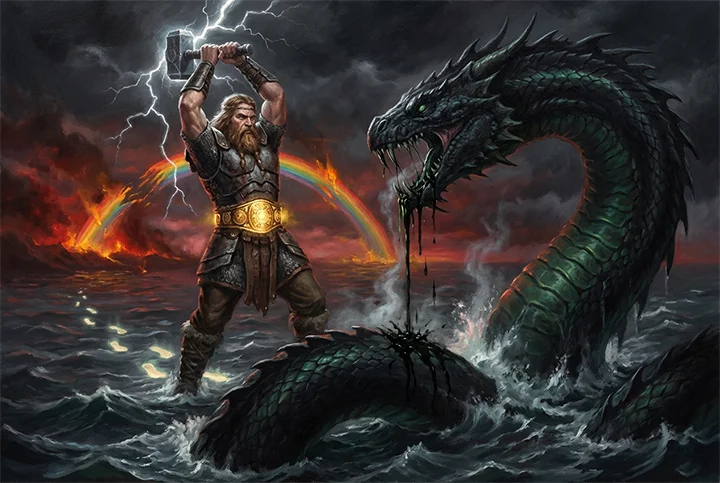
Thor and Jörmungandr, the Midgard Serpent, are the two greatest adversaries in Norse mythology, locked in a relationship of mutual destruction that spans the entire mythological tradition from its cosmological background to its eschatological conclusion. Jörmungandr, the World Serpent, is the son of Loki and the giantess Angrboða, and was thrown by Odin into the ocean that encircles Midgard, where it grew until it was large enough to bite its own tail and encircle the entire world. Thor and Jörmungandr are fated enemies: the prophecy that governs Ragnarok states explicitly that they will kill each other, Thor dying nine steps after striking the killing blow, poisoned by the serpent's venom. Their confrontations before Ragnarok, particularly the fishing trip with the giant Hymir and the failed crossing of the river Eitr, are described in detail in the sources and represent two of the most dramatic mythological narratives in the Norse tradition.
Sources
The primary sources for the Thor-Jörmungandr mythology are the Hymiskviða and Voluspa in the Poetic Edda, the Gylfaginning and the Skaldskaparmal of the Prose Edda, and a substantial body of skaldic poetry including the Ragnarsdrápa of Bragi Boddason and several poems by Úlfr Uggason. The myth also appears in visual art, most notably on several Gotlandic picture stones and on the Altuna stone in Uppland, Sweden, which depicts what is generally accepted as the fishing trip scene. The distribution of visual representations of this myth across multiple regions and periods testifies to its wide currency in the Norse world from the early Viking Age onward.
Jörmungandr: The World Serpent
Jörmungandr, also called the Midgard Serpent or Miðgarðsormr, is one of three monstrous children of Loki and Angrboða, the others being Fenrir the wolf and Hel the death goddess. When the gods became aware of these three children, they acted against each of them on the basis of prophecy. Jörmungandr was thrown into the ocean encircling Midgard, the world of humans. In the ocean it grew and grew, the sources say, until it encircled all of Midgard and was large enough to bite its own tail. This ouroboros image, the serpent encircling the world and biting its own tail, is the standard description of Jörmungandr's resting state between its mythological appearances.
The name Jörmungandr means great wand or mighty wand, and the serpent's alternative name Miðgarðsormr means Midgard's worm or Midgard's serpent. It is also called the World Serpent, the Great Serpent and the Serpent of the Ocean. In skaldic kennings, Thor is frequently referred to by circumlocutions that identify him as the enemy of the Midgard Serpent or the killer of the serpent, and Jörmungandr is referred to as the enemy of the Aesir, the enemy of Thor, and the girdle of the earth.
The Fishing Trip with Hymir
The most extensively narrated direct encounter between Thor and Jörmungandr before Ragnarok is the fishing trip recorded in the Hymiskviða and described additionally in the Gylfaginning and in skaldic verse. Thor, disguising himself as a young man, travels to the hall of the giant Hymir to borrow a large enough cauldron for Ægir's feast and to fish in the deep ocean. Hymir is reluctant and dismissive, but Thor demonstrates his strength by catching two whales with a single haul of the line before the fishing trip proper begins.
For bait, Thor takes the head of Hymir's largest ox, Himinhrjótr, whose name means sky-bellower. He rows Hymir out beyond the fishing grounds the giant considers safe, into the deep ocean. He drops the line baited with the ox head into the depths. Jörmungandr takes the bait. Thor pulls with such force that his feet go through the bottom of the boat. He draws the serpent up from the ocean floor until he can look it in the eyes. The staring contest between Thor and Jörmungandr at the surface of the ocean is one of the most vivid images in Norse mythology: the thunder god and the world serpent face to face, the serpent pouring poison, Thor preparing to strike with Mjolnir.
At the crucial moment, Hymir cuts the fishing line. The serpent sinks back into the ocean. Thor throws Mjolnir after it but the sources are unclear on whether he hits it. In the Hymiskviða the scene ends with Thor striking Hymir overboard in fury. In the Gylfaginning Snorri says that Jörmungandr sank back to the bottom and that some say Thor struck it with Mjolnir and cut off its head but that this was likely not true because the serpent is present at Ragnarok. The Gylfaginning preserves the version that fits the overall mythological chronology, in which Jörmungandr survives to its fated encounter with Thor at Ragnarok.
The Altuna runestone in Uppland, Sweden, carved in the eleventh century, depicts a scene identified by scholars as this fishing trip. It shows a figure in a boat pulling a large serpent upward on a line, with feet pushing through the bottom of the boat, while a second figure cuts the line. The image is one of the clearest contemporary visual representations of a Norse mythological narrative available in the archaeological record.
The Attempted Crossing of Eitr
A separate encounter between Thor and Jörmungandr is described in skaldic verse, in which Thor wades across the river Eitr, a river of venomous water associated with primordial cosmic geography. The encounter in this context positions Thor as actively seeking out the serpent in its oceanic domain, an inversion of the fishing trip narrative in which the serpent is drawn up to the surface. The skaldic poem Ragnarsdrápa of Bragi Boddason, the earliest named skald in the Norse tradition, describes a shield painting depicting this or a closely related scene, making it one of the earliest visual representations of the Thor-Jörmungandr conflict in any medium.
Thor's Visit to Útgarðaloki
A version of the Thor-Jörmungandr encounter appears in a different register in the story of Thor's visit to the hall of the giant Útgarðaloki, preserved in the Gylfaginning. In this narrative, the giant challenges Thor and his companions to a series of tests that they fail. One of the tests involves Thor being asked to lift a large grey cat off the ground. He struggles with all his strength and can only raise one paw. The cat is revealed afterward to be Jörmungandr in disguise, and the giant explains that the fact that Thor managed to raise one paw at all was a remarkable achievement, as the serpent encircles all of Midgard. This encounter frames the world serpent as so immense that its weight is effectively identical with the weight of the world, making Thor's inability to lift it not a failure of strength but a statement about the scale of what he was attempting.
Jörmungandr at Ragnarok
The Voluspa and the Prose Edda describe Jörmungandr's role at Ragnarok. The serpent releases its tail from its mouth, comes up onto land, and advances on the gods. It spews venom across the sky and the sea as it moves. Thor meets it and kills it with Mjolnir. But the serpent's venom has already done its work. Thor walks nine steps after striking the killing blow before falling dead, poisoned by the venom that Jörmungandr has sprayed across the battlefield.
The nine steps Thor walks correspond to the nine nights Odin hung on Yggdrasil. The number nine marks the moments of greatest cost in the Norse tradition: the price of runic wisdom, the price of killing the world serpent. Thor's nine steps before death are the measure of exactly how much of himself he could carry through the killing of the most dangerous opponent in the Norse cosmos.
Visual Representations
The Thor-Jörmungandr conflict is among the most widely depicted mythological subjects in Norse visual art. In addition to the Altuna stone, the conflict appears on several Gotlandic picture stones and on a number of Scandinavian runestones. The Gosforth Cross in Cumbria, England, carved in the early tenth century by a Norse craftsman and combining Christian and Norse iconographic elements, has been interpreted by several scholars as including a depiction of the fishing trip on its shaft. A bronze figurine from Eyrarland in Iceland, dated to approximately 1000, shows a seated figure holding what appears to be a large hammer, identified by most scholars as Thor, and is among the most commonly reproduced images of a Norse god in any medium.
Legacy and Significance
The relationship between Thor and Jörmungandr is the most clearly predetermined conflict in Norse mythology, more fully documented across more sources and media than any other pair of adversaries in the tradition. Its significance is cosmological as well as narrative: Jörmungandr encircles Midgard and holds the world in its embrace; Thor is the god whose primary function is the protection of Midgard from the forces that threaten it from outside. The serpent and the defender are the same age, both placed at the boundaries of the world, one as its encircler and one as its protector, and their mutual destruction at Ragnarok dissolves both the threat and the protection simultaneously, leaving the new world that rises afterward to organize itself differently.
OTHRAVAR — Musical Tribute
Experience the meeting of the thunder god and the world serpent at the surface of the ocean, the raising of the great hammer and the nine steps before the fall through the ancient sounds of Norse folk music. This original composition draws from the skaldic tradition, performed with traditional instruments including tagelharpa, bukkehorn and frame drum.