The Longship, the Knarr and the Technology That Built the Viking Age
Overview
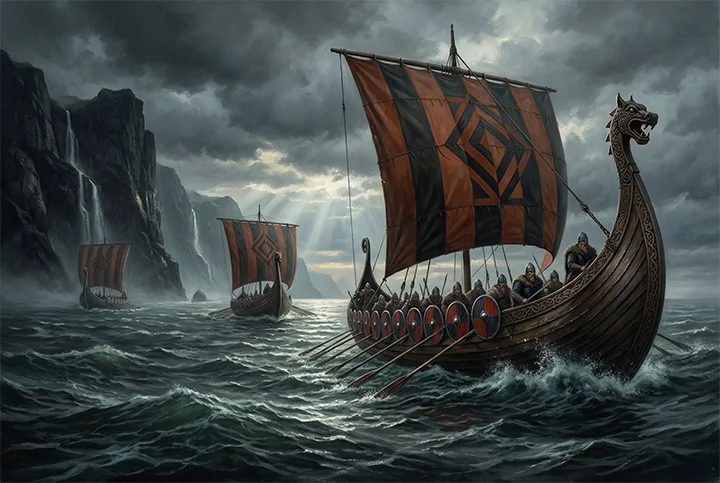
The Norse ship is the defining technological achievement of the Viking Age, the invention that made everything else possible. Without it there are no raids on Lindisfarne, no settlement of Iceland and Greenland, no exploration of North America, no trade networks stretching from Scandinavia to Constantinople and Baghdad. The longship in particular is one of the most sophisticated pieces of engineering produced anywhere in the medieval world: light enough to be carried overland between rivers, shallow enough to beach directly on a shore without a harbor, fast enough under sail and oar to outrun anything else on the water, and strong enough to survive the open North Atlantic. It was not simply a vessel; it was a weapon, a home, a statement of identity and a piece of cosmological symbolism all at once.
The Norse relationship with ships ran deeper than practical utility. Ships appeared in Norse burials from the Bronze Age onward, used as the vehicle for the dead on their journey to the next world. The greatest warriors and kings were buried in ships or cremated in them, their possessions arranged around them as if ready for a voyage. The ship Hringhorni, on which Baldur's funeral pyre was built, was described as the greatest of all ships. Naglfar, the ship that will carry the forces of chaos at Ragnarok, is built from the fingernails and toenails of the dead. In the Norse imagination, the ship was not merely a means of crossing water; it was the structure that carried you between one state of existence and another.
Ship Types and Construction
The Norse produced several distinct ship types for different purposes, and the conflation of all of them under the single term longship is a modern simplification that obscures the sophistication of Norse naval architecture. The three primary types were the langskip, the knarr and the snekkja, each optimized for a different set of conditions and requirements.
The langskip, the true longship, was a warship: long, narrow, low in the water, built for speed and for carrying a large number of warriors. Its length-to-width ratio of approximately seven to one made it exceptionally fast under oar and gave it a flexibility in the water that wider, deeper vessels could not match. The Gokstad ship, excavated in Norway in 1880 and dating to approximately 890, is one of the finest surviving examples: twenty-four meters long, five meters wide, with space for thirty-two oarsmen and capable of reaching speeds of twelve knots under favorable conditions. The construction technique was clinker-built, meaning the hull planks overlapped each other like scales, a method that produced a hull that could flex with the movement of the water rather than rigidly resisting it, dramatically reducing the stress on the structure in open-sea conditions.
The knarr was the trading vessel, broader and deeper than the langskip, with a higher freeboard to accommodate cargo and less reliance on oars in favor of sail. It was the knarr that made long-distance Norse trade possible and that carried the settlers to Iceland and Greenland. Where the longship was optimized for speed and military capability, the knarr was optimized for load capacity and range, capable of carrying livestock, timber, grain and manufactured goods across the North Atlantic and the Baltic.
The snekkja was a smaller, lighter vessel used for coastal raiding and river navigation, shallow enough to penetrate far inland along river systems and quick enough to make the rapid strikes and retreats that characterized Norse raiding in its early phase. It was the snekkja that first appeared in English and Frankish chronicles as the terrifying new presence on the rivers of western Europe.
Navigation and Seamanship
Norse navigation in the open ocean was accomplished without magnetic compasses, which were unknown in Scandinavia until the twelfth century, and without detailed charts. The Norse navigated by the sun, the stars, the patterns of birds and sea life, the color and temperature of the water, the direction of prevailing winds and swells, and by accumulated experience encoded in oral traditions passed between generations of sailors. The solar compass, a wooden instrument that used the sun's shadow to determine direction, has been found in archaeological contexts and was almost certainly in use during the Viking Age.
The sagas also reference a mysterious object called a sólarsteinn, a sunstone, which some scholars have interpreted as a calcite crystal that can polarize light and reveal the position of the sun even through cloud cover. Laboratory experiments with Icelandic spar, a form of calcite, have confirmed that it can function this way with remarkable accuracy, and a piece of Icelandic spar found on an Elizabethan shipwreck suggests the technology persisted in use for centuries. Whether the Norse used it routinely is not definitively established, but the navigational capabilities they demonstrated, crossing the North Atlantic to reach Iceland, Greenland and the coast of North America, require some explanation.
The Ship in Norse Culture and Religion
Ship burial was among the most prestigious forms of interment in the Norse world. The Oseberg ship, excavated in 1904 and dating to 834, contained the remains of two women buried with extraordinary wealth: textiles, carved wooden furniture, a wagon, sledges, beds, kitchen equipment and animals. The ship itself was ornately decorated with carved wooden prow posts in the form of serpents. Whatever its precise religious meaning, the ship burial placed the dead within the structure that, in Norse cosmology, carried beings between worlds.
Ships also appear throughout Norse mythology as the preferred vessels of the gods. Skidbladnir, made by the dwarves for Freyr, is described as the finest of all ships, capable of carrying all the gods with their weapons and armor and yet foldable into a pocket when not in use. It always finds a fair wind the moment its sail is raised. The divine ship exists at the extreme end of what the actual Norse shipbuilder aspired to: a vessel so perfectly made that it works with the world rather than against it.
Legacy and Significance
The Norse ship changed the history of the medieval world more directly than almost any other technology of the period. The Viking Age it made possible reshaped the political boundaries of England, France, Ireland, Russia and the Byzantine Empire. Norse settlers reached North America five centuries before Columbus. The trade networks established by Norse merchants connected the Baltic, the North Sea, the Mediterranean and the river systems of eastern Europe into a single economic zone that persisted long after the Viking Age formally ended.
The ship also changed Norse society from within. The investment required to build and maintain a longship concentrated resources and authority in the hands of those who could organize and fund the effort, creating the social structures around which the petty kingdoms of Scandinavia coalesced. The ship was not just the technology of expansion; it was the technology of state formation, the mechanism through which scattered coastal communities organized themselves into the kingdoms that eventually became Norway, Sweden and Denmark.
OTHRAVAR — Musical Tribute
Experience the creak of the clinker hull and the bite of oars in cold northern water through the ancient sounds of Norse folk music. This original composition draws from the skaldic tradition, performed with traditional instruments including tagelharpa, lur and frame drum.