The Norse City That Shaped Ireland for Three Centuries
Overview
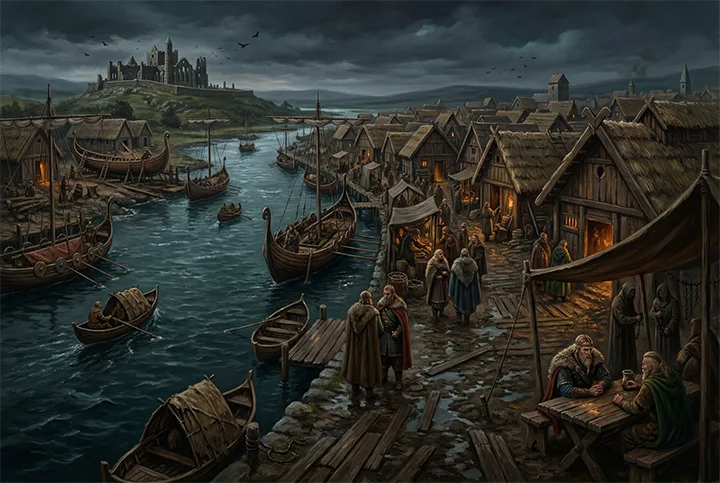
Viking Dublin, known in Old Norse as Dyflin and in Old Irish as Áth Cliath, was the principal Norse settlement in Ireland and one of the most important urban centers in the Viking Age Atlantic world. Founded as a longphort, a fortified ship harbor, by Norse raiders in 841, it developed over the following three centuries into a prosperous trading city, a significant political power, a center of Norse and Norse-Irish culture, and the headquarters of the Uí Ímair dynasty that at its height claimed authority over Norse settlements across Ireland, the Irish Sea and northern Britain. Dublin's history as a Norse city lasted from 841 until the Battle of Clontarf in 1014, which ended Norse political ambitions in Ireland, though a Hiberno-Norse community continued to inhabit the city for more than a century afterward.
Sources
The primary sources for Viking Dublin are the Irish annals, particularly the Annals of Ulster, the Annals of the Four Masters, the Annals of Inisfallen and the Fragmentary Annals of Ireland. Archaeological sources are equally important: the excavations conducted at Wood Quay and High Street in Dublin between the 1960s and the 1980s revealed the physical remains of the Norse city in extraordinary detail, producing one of the largest and best-preserved bodies of Viking Age urban archaeology anywhere in the world. Finds from these excavations are preserved in the National Museum of Ireland.
The Foundation of the Longphort
The Annals of Ulster record the establishment of a longphort at Dublin in 841. A longphort was a fortified harbor or ship camp constructed by Norse raiding parties as a secure base for overwintering and for the storage of plunder and captives. The Dublin longphort was established at the confluence of the River Liffey and the River Poddle. The early Norse presence was a military base that facilitated raiding across Leinster and into other provinces of Ireland, from which captives were taken and either sold locally or exported to slave markets. The Annals record extensive raiding activity from the Dublin base, including raids on major monastic centers such as Clonmacnoise, Armagh and Glendalough.
The Expulsion of 902 and the Return of 917
In 902 a combined force of Leinster and Brega Irish drove the Norse from Dublin, forcing them to abandon their settlement. The Annals record that they left Ireland abandoning a good number of their ships, and escaped half dead after they had been wounded and broken. This expulsion, lasting approximately fifteen years, demonstrates that the Norse hold on Dublin was not unchallenged and that Irish political forces were capable of coordinated action against Norse settlements. The Norse returned to Dublin in 917 under the leadership of Sitric Cáech and Rögnvaldr, members of the Uí Ímair dynasty, accomplished by force. After 917 the Norse presence was considerably more robust and politically organized than before 902, and the city began to develop the characteristics of an urban trading center.
The Urban Development of Norse Dublin
The archaeological excavations at Wood Quay, conducted from 1974 to 1981 under the direction of Pat Wallace, revealed that Norse Dublin had developed by the tenth century into a densely occupied urban settlement with defined property boundaries, a regular street pattern, and substantial timber buildings. The houses were typically long and rectangular with a central hearth and sleeping benches along the long walls, following a building tradition continuous with the Norse longhouse of Scandinavia. The finds from Wood Quay and from subsequent excavations at High Street, Fishamble Street and Christ Church Place include tools, weapons, jewelry, textiles, leather goods, bone and antler objects, pottery, coins and organic materials. Imported goods including cloth from England, pottery from the Rhineland, and amber from the Baltic demonstrate the integration of Norse Dublin into the wider Norse commercial network.
The Uí Ímair Dynasty and Dublin's Political Role
From the return of 917 until the Battle of Clontarf in 1014, Dublin was the seat of the Uí Ímair dynasty, the successors of the historical or legendary Ivar the Boneless. The Dublin kings intervened repeatedly in Irish political conflicts, allying with one Irish king against another. The Dublin Norse also maintained close connections with Norse communities in the Isle of Man, the western and northern isles of Scotland, and the Norse settlements in northern England. Members of the Uí Ímair dynasty ruled or claimed authority over York at various points in the tenth century, and the connections between Dublin and York formed one of the principal axes of Norse political activity in the Irish Sea region.
The Battle of Clontarf
The Battle of Clontarf, fought on Good Friday 1014 near Dublin, is the most famous military engagement in early medieval Irish history. It was fought between the forces of the High King of Ireland Brian Boru and a coalition that included the Dublin Norse under their king Sitric Silkenbeard, the Norse of the Orkney Islands under Sigurd the Stout, Norse mercenaries from Scandinavia, and their Irish allies from Leinster. The battle was a decisive victory for Brian's forces: the coalition army was destroyed, Sigurd the Stout was killed, and large numbers of Norse warriors died. Brian himself was killed in his tent after the battle, allegedly by a fleeing Norse warrior named Bróðir. Sitric Silkenbeard, who had not fought in the battle but watched from the walls of Dublin, continued to rule the city for more than twenty years afterward. What Clontarf ended was the Norse political ambition of dominating Irish politics from Dublin.
The Hiberno-Norse City After Clontarf
After Clontarf, Dublin continued as a prosperous commercial city under its Hiberno-Norse kings. The Dublin Norse converted to Christianity in the tenth century: Sitric Silkenbeard founded Christ Church Cathedral in Dublin around 1030, and the city's ecclesiastical connections were primarily with Canterbury and the English church. Norse Dublin was absorbed into the Irish political world through the Norman conquest of Ireland beginning in 1169, when Anglo-Norman forces under Strongbow captured the city and established English political authority over it.
Legacy and Significance
Viking Dublin is one of the most thoroughly excavated and best understood Norse urban settlements anywhere in the world, and its archaeological record provides an unparalleled window into the material culture of the Viking Age in an Irish context. Its three centuries of Norse history shaped the development of Ireland's principal city, established the patterns of Irish Sea trade that persisted through the medieval period, and produced the Hiberno-Norse cultural synthesis that influenced Irish art, language and material culture in ways still traceable in the medieval and early modern Irish record. The Wood Quay excavations remain one of the most important archaeological projects in the history of medieval urban archaeology.