Norse Exploration and the First European Attempt to Colonize North America
Overview
The Vinland settlement refers to the Norse attempt to establish a permanent colony on the coast of North America, undertaken in the early eleventh century by expeditions originating from the Norse settlements in Greenland. The only archaeologically confirmed Norse site in North America is L'Anse aux Meadows in northern Newfoundland, Canada, excavated from 1960 onward by Helge Ingstad and Anne Stine Ingstad and dated to approximately 1000. This site provides physical proof that the Norse reached the continent regardless of how one interprets the sagas. The Norse presence in North America predates Columbus's 1492 voyage by approximately five centuries but did not result in permanent colonization, ending after approximately three years of settlement attempts due to conflicts with the indigenous inhabitants.
Sources
The two Vinland sagas are the primary textual sources. The Grænlendinga saga, generally considered by modern scholars to preserve the older and more reliable tradition, gives Bjarni Herjólfsson credit for the first sighting of the North American coast and Leif Eriksson credit for the first landing. The Eiriks saga rauða, the later and more literarily elaborated text, makes Leif's discovery incidental to his return voyage from Norway carrying a Christian mission for Greenland. Adam of Bremen's Gesta Hammaburgensis Ecclesiae Pontificum, written around 1075, contains an independent reference to Vinland as an island where wild grapes grow, providing external non-Norse confirmation that Norse knowledge of Vinland existed in the mid-eleventh century.
The Discovery Voyages
According to the Grænlendinga saga, Bjarni Herjólfsson accidentally sighted the North American coast around 985 or 986 when blown off course sailing from Iceland to Greenland. He sighted land but did not go ashore. Leif Eriksson subsequently purchased Bjarni's ship and organized an expedition westward. He made landfall at three successive locations: Helluland, flat stone land, generally identified with Baffin Island; Markland, forest land, generally identified with the Labrador coast; and Vinland, where he made his winter camp. The etymology of Vinland has been debated continuously. A crew member named Tyrkir, described as coming from a grape-growing region, found wild vines and grapes, providing the primary textual basis for interpreting Vinland as wine land.
The Settlement Attempts
After Leif's initial voyage, his brother Thorvald Eriksson led an expedition that explored the coast more extensively and resulted in the first recorded violent contact with the indigenous inhabitants, whom the Norse called Skrælingar. Thorvald was killed by an arrow during this encounter, making him the first European known to have died in North America. The most sustained settlement attempt was led by the Icelandic merchant Thorfinn Karlsefni, who had married Leif's widowed sister-in-law Guðríðr Þorbjarnardóttir in Greenland. Karlsefni organized an expedition of several ships and approximately one hundred and sixty people, including women and livestock, with the explicit intention of establishing a permanent colony. The settlement lasted at least two winters, during which Guðríðr gave birth to a son named Snorri, described consistently in both sagas as the first child of European descent born in North America. The colony was abandoned after approximately three years due to escalating conflicts with the Skrælingar. The Eiriks saga rauða includes the famous episode of Freydís Eiríksdóttir facing the attacking Skrælingar alone, slapping a sword against her bare breast and driving them off.
L'Anse aux Meadows
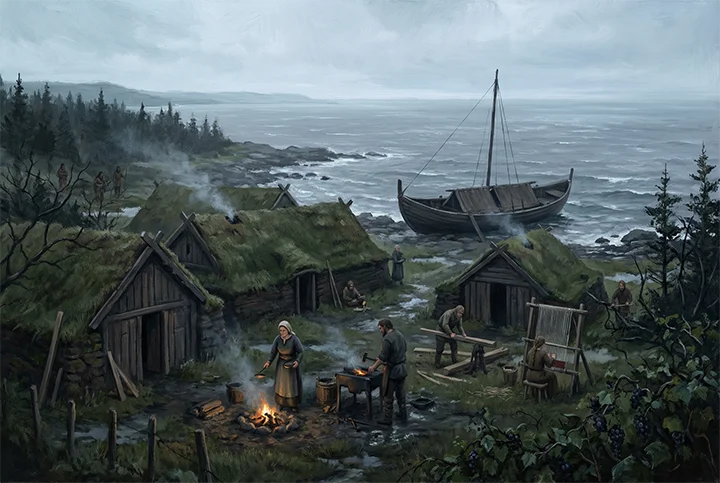
The archaeological site at L'Anse aux Meadows was discovered by Helge and Anne Stine Ingstad between 1960 and 1968. Excavations revealed the remains of three large halls, several smaller outbuildings, a smithy producing iron from bog ore, and a carpentry workshop. Artifacts include iron rivets, a Norse-style spindle whorl indicating the presence of women, a bronze ringed pin of Norse type, and a small whetstone of Norwegian quartzite. The site shows no evidence of permanent occupation over multiple generations and was apparently used as a base camp for a limited period consistent with the saga accounts. Recent analysis of butternuts found at the site has attracted scholarly attention because butternut trees do not grow in Newfoundland, suggesting the Norse traveled further south or obtained them through trade with indigenous peoples who ranged more widely.
Legacy and Significance
The Vinland settlement is the first documented European contact with the North American continent, established by archaeology beyond reasonable doubt. The Norse failure to establish a permanent colony despite the natural abundance of Vinland reflects the limitations of the Greenland settlement as a demographic base for colonization: the Greenland colonies never exceeded a few thousand people and could not sustain the flow of settlers and supplies necessary to overcome the resistance of established indigenous populations. The contrast with later permanent European colonization of the Americas reflects differences in scale, state organization and disease environment rather than any failure of Norse capacity for exploration or settlement.