Swords, Axes, Spears and the Warrior Equipment of the Viking Age
Overview
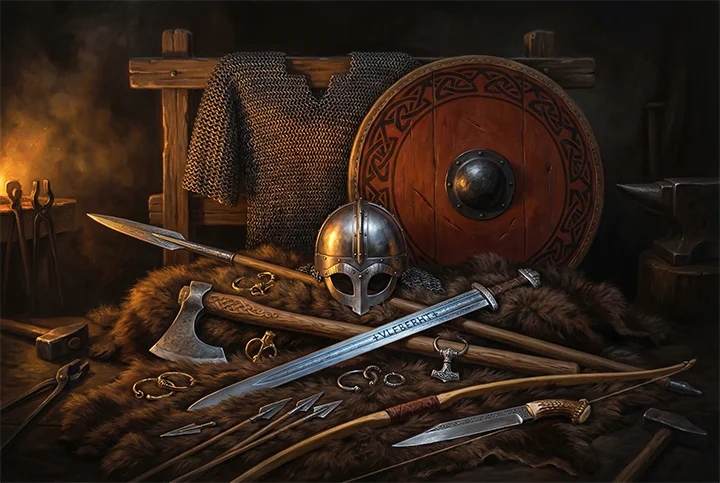
The weapons and armor of the Viking Age represent some of the finest examples of early medieval European metalwork and craft production, combining functional effectiveness with artistic elaboration in objects that served simultaneously as tools of violence and displays of social status. Norse warriors were equipped with a range of weapons suited to different combat roles, from the spear that was the primary weapon of the common warrior to the sword that marked the social elite, from the axe that became the iconic symbol of the Viking in popular imagination to the bow that provided ranged capability in both land and naval combat. The quality and quantity of a warrior's equipment reflected his social status, wealth and military experience, and the archaeological record of Viking Age graves provides detailed evidence for the range of equipment in use.
The Spear
The spear was the primary weapon of the Norse warrior, more commonly carried and used than any other offensive weapon in the Viking Age. It was inexpensive to produce relative to the sword, effective in both formation fighting and individual combat, and versatile enough to be used for both thrusting and throwing. Norse spearheads were produced in a range of sizes and designs, from lightweight throwing spears with narrow heads to heavy broad-bladed heads designed for close combat. Odin's spear Gungnir, made by the dwarves of Svartalfheim and described as never missing its mark, is the mythological expression of the spear's cultural centrality in the Norse world. The practice of consecrating a battle to Odin by throwing a spear over the enemy's forces before the engagement began reflects the ritual significance of the spear as the weapon of choice for divine dedication of violence.
The Sword
The sword was the prestige weapon of the Norse warrior elite, expensive and time-consuming to produce, requiring specialized metallurgical knowledge and craft skill, and carrying an enormous social weight as a marker of status, lineage and military achievement. The finest Norse swords of the Viking Age combined pattern-welded blades of exceptional quality with elaborately decorated hilts inlaid with precious metals and decorated with animal ornament in the Borre, Jelling or Mammen styles depending on the period. The manufacture of high-quality sword blades was concentrated in the Rhineland, and Frankish blades were imported into Scandinavia in large numbers, where they received Norse-style hilts.
The Ulfberht swords, a group of approximately forty swords bearing the inscription VLFBERHT in inlaid letters on the blade, represent the finest class of Viking Age swords in the archaeological record. Analysis of surviving examples has shown that true Ulfberht swords used crucible steel with a carbon content and homogeneity not achievable by the bloomery iron technology current in medieval Europe, suggesting access to steel imported from Central Asia via the Volga trade routes. Counterfeit Ulfberht swords, made in inferior steel with the same inscribed name, also survive in the archaeological record, demonstrating that the name functioned as a quality mark that was worth faking.
The Axe
The axe is the weapon most closely associated with Viking warriors in popular imagination, and while the association is not without basis, it somewhat overstates the axe's role relative to the spear in actual Viking Age warfare. Two distinct types of axe were used in combat. The bearded axe or skeggjöx, with an extended lower blade edge, was designed to hook an opponent's shield and drag it down to expose the body behind it, a technique requiring training to use effectively. The Dane axe or breiðöx, a large two-handed weapon with a thin blade on a long shaft, was a genuine battlefield weapon of considerable power capable of cutting through mail armor, but its two-handed grip meant the warrior using it could not simultaneously hold a shield. Varangian Guards in Byzantine service were particularly associated with the Dane axe, which Byzantine sources describe as their characteristic weapon.
The Shield and Armor
The shield was the most universally carried defensive equipment of the Norse warrior and was used offensively as well as defensively. Norse shields were round, approximately ninety centimeters in diameter, made of planks of linden or other light wood with a central iron boss that protected the hand. The shield wall formation, in which warriors stood side by side with overlapping shields presenting a continuous barrier to the enemy, was the fundamental tactical unit of Norse land combat. The Gokstad burial contained sixty-four shields arranged along the sides of the ship, providing the best-preserved examples of complete Viking Age shields in the archaeological record.
Mail armor, the interlocked rings of iron that formed the primary body protection of the Norse warrior elite, was expensive and time-consuming to produce but provided substantial protection against cutting blows while allowing freedom of movement. A mail shirt, brynja in Old Norse, could contain thirty thousand or more individual rings and required weeks of skilled labor to produce. The distribution of mail shirts in Viking Age graves reflects their high cost: they appear predominantly in the richest warrior graves and are absent from the majority of burials, indicating that most warriors fought without mail protection. The Norse helmet is one of the most persistently misrepresented objects in popular culture: the horned helmet has no basis in the Viking Age archaeological record and appears to have been invented in nineteenth-century romantic art. The Gjermundbu helmet, found in a Norwegian grave and dating to approximately 970, is the only complete Viking Age helmet in the archaeological record and shows the typical iron cap design with a nose guard and riveted iron band construction.
Sources
The primary sources for Norse weapons and armor are archaeological: thousands of weapon deposits in Viking Age graves and hoards across Scandinavia and the Norse settlement areas have provided the physical evidence for what warriors actually carried and wore. Textual sources including the Icelandic sagas, the Kings' Sagas, and the skaldic poetry tradition describe weapons in considerable detail and sometimes allow specific weapon types to be connected to named individuals or events. The sagas in particular preserve detailed accounts of specific weapons, their makers and their histories, reflecting the enormous cultural weight that individual weapons carried in Norse society as markers of lineage and achievement.
Legacy and Significance
The weapons and armor of the Viking Age represent the highest achievement of early medieval European military technology in the Norse context, combining functional effectiveness with artistic elaboration at the highest level of the tradition. The finest swords, mail shirts and decorated shield bosses of the period are among the most technically and artistically accomplished objects produced in pre-Christian northern Europe. Their distribution in the archaeological record documents the social hierarchy of Norse society more directly than almost any other category of material evidence.