The World Tree
Overview
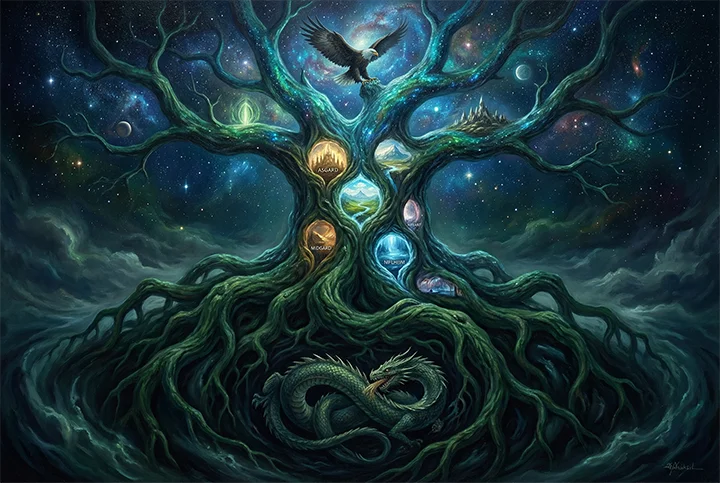
Yggdrasil is the immense sacred tree that stands at the centre of the Norse cosmos, the axis around which all existence is organised. Its branches extend into the heavens and its three roots reach down into three different realms: one into the well of Urðarbrunnr in Asgard where the Norns weave fate, one into the well of Mímisbrunnr where cosmic wisdom is kept, and one into Niflheim where the dragon Níðhöggr gnaws endlessly at the wood. Everything that exists in the Norse universe is contained within, upon or beneath this tree. It is not a symbol of the world; it is the structure of the world itself.
The name Yggdrasil is generally interpreted as "Odin's horse" in Old Norse: Yggr is one of Odin's names, meaning "the terrible one", and drasill means horse. The connection is to the practice of hanging, as the gallows was kenned as "the horse of the hanged man" in Norse poetic tradition. This reading connects the tree directly to Odin's self-sacrifice, when he hung upon Yggdrasil for nine days and nights to receive the knowledge of the runes. The tree that bore him in that ordeal carries his name in that act.
Yggdrasil is described in the sources as an ash tree, askr Yggdrasils, of unimaginable size. It shelters and connects all the Nine Realms, and the various beings that inhabit it form a complete ecosystem of divine life: gods, giants, dwarves, dragons, serpents, eagles, a squirrel and four stags all have their places within or upon it. To understand Yggdrasil is to understand the Norse universe not as an empty space containing things but as a living, breathing, interconnected whole.
Origins & Mythology
The Prose Edda and the Poetic Edda both describe Yggdrasil in considerable detail, and together they paint a picture of a tree under constant stress. The dragon Níðhöggr and countless serpents gnaw at the roots from below. The four stags Dáinn, Dvalinn, Duneyrr and Duraþrór browse the foliage from above. The squirrel Ratatoskr runs up and down the trunk carrying malicious messages between the eagle at the top and Níðhöggr at the bottom, fostering enmity between them. Despite all of this constant damage, Yggdrasil endures, sustained by the Norns who water it daily from Urðarbrunnr and coat its bark with the sacred white clay of the well.
The three wells at the base of Yggdrasil's three roots are among the most significant locations in Norse cosmology. Urðarbrunnr, the Well of Urð, is where the three Norns — Urð (What Was), Verðandi (What Is) and Skuld (What Shall Be) — sit and weave the threads of fate for gods and mortals alike. The gods themselves ride to this well each day across the Bifrost bridge to hold their divine assembly, the þing. Mímisbrunnr, the Well of Mímir, holds wisdom so profound that Odin gave his eye for a single drink. The third root reaches into Niflheim, the primordial realm of cold and mist, where the well Hvergelmir is the source of all rivers.
The Eddic poem Völuspá describes Yggdrasil as shaking and shuddering at the onset of Ragnarök, the tree trembling as the cosmic order it supports begins to collapse. Even the World Tree, which has endured the gnawing of serpents and the browsing of stags since the beginning of time, cannot stand unchanged against the end of everything. Yet the same poem also implies that something survives: the earth rises green from the sea after the destruction, and the renewed world suggests a renewed Yggdrasil at its centre.
Key Stories & Appearances
Yggdrasil's most direct narrative role is as the site of Odin's self-sacrifice. In the poem Hávamál, Odin describes hanging on the tree for nine days and nights, wounded by a spear, offered to himself by himself, with no food or water, in order to receive the knowledge of the runes. The tree is described as one whose roots no one knows. This ordeal is explicitly modelled on shamanic initiation traditions: the descent to death and return, the acquisition of secret knowledge through suffering, the transformation that cannot happen without the willingness to be completely undone.
The assembly of the gods at Urðarbrunnr places Yggdrasil at the centre of divine governance. Every day the Aesir ride across Bifrost and gather beneath the tree to deliberate, judge and decide. The tree is not merely backdrop but the physical location of the highest authority in the Norse cosmos, the place where the laws of existence are interpreted and applied. Even Odin, for all his wandering and scheming, comes to the tree to sit in council with the other gods.
The creatures of Yggdrasil form one of the most detailed pieces of Norse cosmological description outside of the main creation and destruction narratives. The unnamed eagle who sits at the top of the tree, wise and old, represents a perspective that sees the whole of the cosmos from above. Níðhöggr below represents entropy, the constant erosion of even the most fundamental structures. Ratatoskr between them, running tirelessly with his poisonous messages, represents the way in which misunderstanding and malice can work at the fabric of the cosmos even without the intention of destroying it.
Legacy & Significance
Yggdrasil is the Norse tradition's most complete expression of the idea that the universe is not a collection of separate things but a single interconnected system. Every realm, every being, every well and every root is part of one structure. The health of that structure depends on all its parts: the Norns must water it, the stags must not browse too much, the serpents must not gnaw through the roots. When the balance is lost, as it is at Ragnarök, everything collapses together.
The image of the World Tree has proven extraordinarily durable in human culture, appearing in mythological traditions across the Indo-European world and resonating strongly in modern consciousness as a symbol of interconnection, of the relationship between the deep past and the living present, and of the idea that existence has a structure that cannot be seen in its entirety from any single point within it. To sit beneath Yggdrasil, as the gods did daily, is to acknowledge that you are part of something larger than yourself and that the roots go deeper than you can see.
OTHRAVAR — Musical Tribute
Experience the ancient majesty of Yggdrasil through the sacred sounds of Norse folk music. This original composition draws from the skaldic tradition, performed with traditional instruments including tagelharpa, bukkehorn and frame drum.
NORSE MYTHOLOGY ENCYCLOPEDIA — Storytelling
Listen to the full story of Yggdrasil narrated aloud the tree that holds the cosmos together, the creatures that dwell within it, and the sacrifice that took place upon its branches.