The Norse Explorer Who Reached North America Five Centuries Before Columbus
Overview
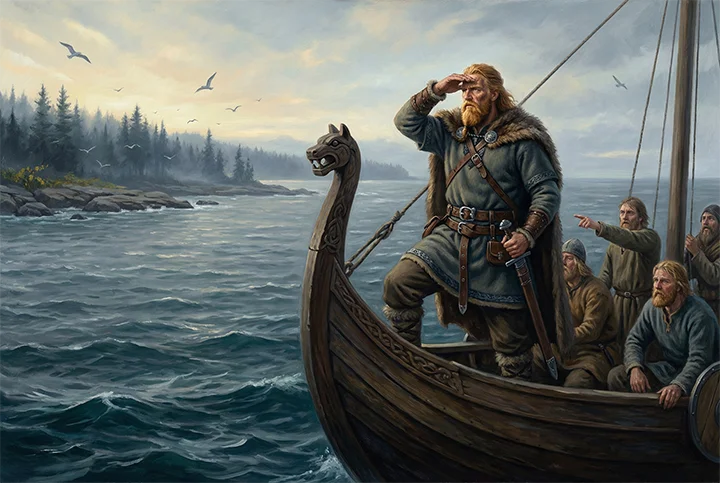
Leif Eriksson was a Norse explorer born in Iceland around 970, the son of Eirik the Red who founded the Norse settlements in Greenland, and the first European known with certainty to have reached the continent of North America. His voyage to the land he called Vinland, believed to have taken place around the year 1000, is documented in two Icelandic sagas, the Grænlendinga saga and the Eiriks saga rauða, and confirmed archaeologically by the discovery of a Norse settlement at L'Anse aux Meadows in Newfoundland, Canada, excavated from 1960 onward and recognized as a UNESCO World Heritage Site in 1978. The Norse presence in North America predates Columbus's 1492 voyage by approximately five centuries.
Family and Background
Leif Eriksson was the son of Eirik Thorvaldsson, known as Eirik the Red, a Norse chieftain born in Rogaland in Norway who was outlawed for manslaughter and emigrated first to Iceland and then, after a further outlawry, led the expedition that established the first permanent Norse settlement in Greenland around 985. Leif's mother was Thjóðhildr, whose name appears in both sagas and who is described in the Eiriks saga as the first Christian woman in Greenland, having converted after Leif brought Christianity to the colony on his return from Norway.
Leif had two brothers, Thorvald and Thorsteinn, and a sister, Freydís, all of whom figure in the Vinland sagas. His father Eirik the Red is described in the Grænlendinga saga as having refused to convert to Christianity despite pressure from Leif, saying he was too old to change his ways, though his wife Thjóðhildr converted and built the first Christian church in Greenland, a small structure whose remains have been identified archaeologically near the farm at Brattahlíð in the Eastern Settlement.
The Voyage to Norway and the Commission to Spread Christianity
The Eiriks saga rauða describes Leif making a voyage to Norway, where he spent time at the court of King Óláfr Tryggvason, who reigned from 995 to 1000. Óláfr commissioned Leif to bring Christianity to Greenland on his return voyage. The Grænlendinga saga gives a different account of how Leif came to reach Vinland, describing him as having heard of land to the west from a merchant named Bjarni Herjólfsson who had sighted but not landed on unknown coasts during a voyage from Iceland to Greenland that went off course. According to this account, Leif purchased Bjarni's ship and organized the expedition himself.
The two sagas differ substantially on the sequence and circumstances of the Vinland discovery, and scholars have debated which account is more reliable since the nineteenth century. The Grænlendinga saga is generally considered by modern scholars to preserve the older tradition, as it gives more consistent geographical detail and a less theologically organized narrative. The Eiriks saga rauða shows signs of literary reworking and gives Leif's discovery a more providential character connected to his mission to spread Christianity.
The Discovery of Vinland
According to the Grænlendinga saga, Leif's expedition sailed westward from Greenland and made landfall at three successive locations before reaching Vinland. The first land sighted was described as flat and covered with stone slabs, which the expedition named Helluland, meaning flat stone land. This is generally identified with Baffin Island. The second land was wooded and flat with white sandy shores, which they named Markland, meaning forest land. This is generally identified with the coast of Labrador. The third land, where they made their winter camp, they named Vinland.
The name Vinland has been subject to long scholarly debate. The element vin has been interpreted as wine, referring to wild grapes, or as meadow or pasture, referring to the grasslands the Norse would have found in the region. The Grænlendinga saga specifically describes a member of Leif's crew, a man named Tyrkir described as a German or southerner who had been with Leif's family since childhood, finding wild vines and grapes, which he recognized because he came from a wine-growing region. The saga states that Leif's party loaded their ship with timber and grapes and returned to Greenland the following spring.
The site of Vinland has been debated since the nineteenth century, with proposals ranging from New England to Newfoundland. The discovery of the Norse settlement at L'Anse aux Meadows in northern Newfoundland by the Norwegian explorer Helge Ingstad and his archaeologist wife Anne Stine Ingstad between 1960 and 1968 provided the first and only archaeologically confirmed Norse site in North America. The site contains the remains of three large halls, several smaller outbuildings, a smithy and a carpentry workshop, along with artifacts including iron rivets, a Norse-style spindle whorl, and a bronze ringed pin. Radiocarbon dating places the occupation of the site to approximately 1000, consistent with the saga accounts.
L'Anse aux Meadows is believed by most archaeologists to be Leifsbúðir, Leif's camp, described in the sagas as the base from which subsequent expeditions into Vinland were made. The site shows evidence of only short-term occupation and no indication of permanent settlement, which is consistent with the saga accounts of the Norse using it as a winter base and departure point rather than establishing a colony.
Subsequent Norse Expeditions to Vinland
The Grænlendinga saga describes several subsequent expeditions to Vinland after Leif's initial voyage. Leif's brother Thorvald Eriksson made an expedition that explored the coast more extensively than Leif's and resulted in the first recorded violent contact between Norse visitors and the indigenous inhabitants of North America, whom the Norse called Skrælingar. Thorvald was killed by an arrow in this encounter and buried on a headland in Vinland, making him the first European known to have died in North America.
A subsequent expedition organized by Thorfinn Karlsefni, an Icelandic merchant who had married Leif's widowed sister-in-law Guðríðr, attempted to establish a permanent settlement in Vinland. Karlsefni's expedition, described in both sagas as comprising several ships and approximately one hundred and sixty people, including women and livestock, lasted three years before being abandoned due to conflicts with the Skrælingar. The Eiriks saga rauða describes a son born to Guðríðr in Vinland, named Snorri, who is described as the first child of European descent born in North America.
A final expedition described in the Grænlendinga saga was led by Leif's sister Freydís, who is portrayed as a forceful and violent figure who arranged the killing of the other Norse members of the expedition, including several women, and returned to Greenland with their ships and goods. This episode is treated in the saga as a source of lasting shame.
Leif Eriksson in Historical Sources
Apart from the two Vinland sagas, Leif Eriksson appears in the Landnámabók, the medieval Icelandic book of settlements, which records genealogical information about the Norse settlers of Iceland and their descendants, and in Adam of Bremen's Gesta Hammaburgensis Ecclesiae Pontificum, written around 1075, which contains a reference to Vinland as an island in the ocean where wild grapes grow, attributed to information provided by King Sveinn Estridsen of Denmark. Adam of Bremen's reference is significant as an independent non-Norse source that confirms the existence of Norse knowledge of Vinland in the mid-eleventh century.
Leif Eriksson's conversion to Christianity and his role in bringing the faith to Greenland is mentioned in the kings' sagas, particularly in Óláfs saga Tryggvasonar as preserved in the Heimskringla of Snorri Sturluson, which describes Óláfr commissioning Leif for the mission and Leif's partial success in converting the Greenland colony.
Legacy and Significance
Leif Eriksson's voyage to Vinland is confirmed as the first documented European contact with the North American continent. The archaeological evidence at L'Anse aux Meadows establishes the physical reality of Norse presence in North America beyond reasonable doubt. The significance of the discovery in the context of Norse expansion is that it represents the westernmost reach of the Norse world, extending the chain of Norse settlement from Norway through the Faroes, Iceland and Greenland to the coast of the North American continent.
The Norse did not establish a permanent presence in North America, and the reasons for this are addressed in the sagas themselves: conflicts with the indigenous inhabitants, the difficulty of supplying a distant colony, and the small population of the Greenland settlements from which the expeditions were mounted. The contrast with the later permanent European colonization of the Americas reflects the difference in scale and resources between the Norse expeditions of around 1000 and the state-backed enterprises of the late fifteenth century rather than any failure of Norse seamanship or exploration.
Leif Eriksson Day is observed on October 9 in the United States, established by Congress in 1964 and signed into law by President Lyndon B. Johnson. A statue of Leif Eriksson stands outside the Hallgrímskirkja church in Reykjavik, Iceland, a gift from the United States in 1930 to mark the one thousandth anniversary of the Althing. His name is also commemorated in the names of streets, institutions and a crater on the Moon.