Ornament, Animal Style and the Visual Language of the Viking Age
Overview
Norse art of the Viking Age is one of the most distinctive visual traditions of the medieval world, characterized by interlaced animal forms, complex geometric ornament, and a preference for surface decoration over representational imagery. It was produced across an exceptionally wide range of materials, including metal, wood, bone, antler, stone, ivory and textile, and it appeared on objects ranging from the smallest personal adornment to the largest architectural elements, from the carved prow posts of ships to the decorated doorways of stave churches. The art of the Viking Age developed through a sequence of clearly defined styles, each named for the location of a key find, that together span roughly from 550 to 1100 and document the continuous transformation of an artistic tradition across five and a half centuries of Norse history.
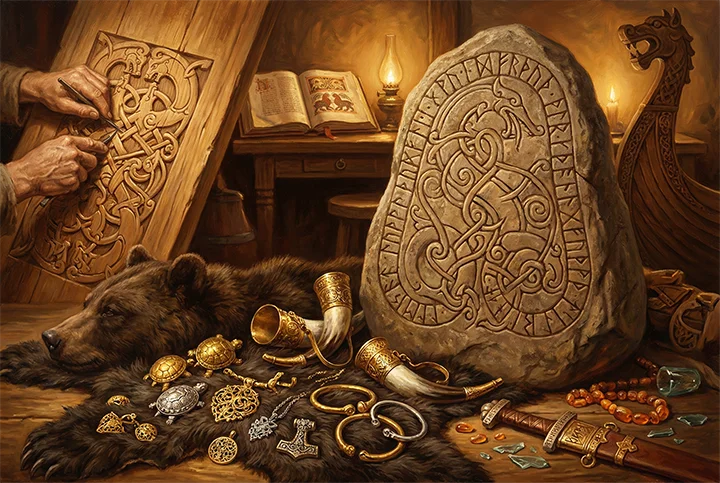
The primary characteristic of this tradition across all its periods is the animal style, a mode of decorating surfaces with animal forms that are stretched, twisted, interlaced and combined with each other and with abstract geometric elements to fill the available space with continuous, energetic pattern. The animals depicted are rarely identifiable as specific species; they are generic creature-forms whose heads, limbs and bodies are extended into ribbons of ornament that weave across and through each other in patterns of controlled complexity. This is not decorative carelessness but a deliberate aesthetic program: the animals of Norse art are simultaneously creatures and patterns, simultaneously representational and abstract, simultaneously readable as animals and as pure ornament.
The Styles of Viking Age Art
Art historical scholarship has divided the visual art of the Norse and wider Germanic migration period and Viking Age into a sequence of named styles. The sequence begins before the Viking Age proper with the Vendel period styles and extends through several distinct phases during the Viking Age itself.
The Oseberg style, named for the ornamental carving found on the Oseberg ship burial of approximately 834, is the earliest recognizable Viking Age style. It is characterized by a gripping beast motif, a compact animal form whose claws grasp the border of the decorated surface or the bodies of adjacent animal figures. The Oseberg ship itself, excavated from a burial mound at Oseberg in Vestfold, Norway in 1904, preserves the most extensive body of early Viking Age decorative carving anywhere in the archaeological record, including the richly ornamented prow post, a wagon, sledges, bed posts and tent poles, all carved by multiple craftsmen whose individual styles can be distinguished within the overall decorative program.
The Borre style, named for gilt-bronze harness mounts found in a ship burial at Borre in Vestfold, Norway, is contemporary with and overlaps the Oseberg style. It is characterized by ring-chain patterns, interlaced geometric designs, and a back-biting animal with a round head that became one of the most widely distributed motifs of the mid-Viking Age. Borre-style metalwork has been found from Ireland to Russia, reflecting the extent of Norse movement and trade during the ninth and early tenth centuries.
The Jelling style, named for two silver cups found at Jelling in Jutland, Denmark, emerged in the first half of the tenth century. It is characterized by a sinuous, ribbon-like animal with a clearly defined head, open jaws, almond-shaped eyes and a pigtail or tendril curling from the back of its neck. The Jelling animal is often depicted in profile, S-shaped, interacting with interlaced ribbon patterns. The great Jelling stone, erected by Harald Bluetooth around 965 and often described as Denmark's birth certificate, bears a runic inscription proclaiming Harald's unification of Denmark and Christianization of the Danes, and on its carved face carries one of the most important examples of the Jelling style in stone: a Christ figure entangled in interlace patterns.
The Mammen style, named for an axe found in a grave at Mammen in Jutland, is dated to the second half of the tenth century and is characterized by large, fleshy plant tendrils and a boldness of form that represents a shift away from the tighter interlace of earlier styles. The Mammen axe itself, inlaid with silver on both faces, shows on one face a large bird with extended wings surrounded by plant ornament, and on the other a human or supernatural figure similarly surrounded. The style shows influences from the Carolingian and Ottonian art of the Frankish world, reflecting the increasing contact between the Norse world and Christian Europe in this period.
The Ringerike style, named for stone monuments in the Ringerike district of Norway, developed in the late tenth and early eleventh centuries from the Mammen style. It is characterized by tightly scrolling plant tendrils, cross-hatched bodies and a preference for clearly outlined forms on a plain background. Ringerike-style ornament appears on a wide range of objects including the great Vang stone in Norway, a bone trial piece from Dublin, and a weather vane from Heggen in Norway that is one of the finest surviving examples of the style in three dimensions.
The Urnes style, named for the carved wooden portal of the stave church at Urnes in Norway, is the final and most refined phase of Viking Age art, dated to the mid to late eleventh century. It is characterized by sinuous, attenuated animal forms of great elegance, with thin bodies that loop and intertwine in patterns of exceptional complexity and refinement. One animal form typically dominates the composition, while smaller serpentine creatures bite and entwine around it. The Urnes portal itself, carved in the second half of the eleventh century, is one of the most technically accomplished pieces of wood carving from anywhere in the medieval world. The style continued into the twelfth century in Romanesque church carving in Scandinavia and in metalwork and stone carving in Ireland, where it blended with the pre-existing Hiberno-Norse ornamental tradition.
Metalwork
The most technically demanding and most widely distributed medium of Norse art was metalwork, particularly the production of jewelry, weapons fittings, horse harness mounts and other prestige objects in silver, gold and gilt bronze. Norse metalworkers worked in a range of techniques including casting, filigree, granulation, repoussé, niello inlay and silver inlay on iron, and the best surviving examples demonstrate a level of technical mastery comparable to the finest work produced anywhere in the medieval world.
The most common form of Norse jewelry for women was the oval or tortoise brooch, a large convex bronze brooch worn in pairs on the shoulders to fasten the straps of the overdress called the apron dress. These brooches were cast in molds and then finished by hand, and their upper surfaces carry densely packed animal ornament in the styles current at their time of production. Hundreds of oval brooches have been recovered from female graves across the Norse world, and their distribution maps the extent of Norse settlement from Scandinavia to Ireland, the northern and western isles of Scotland, Iceland, Greenland and the east Baltic.
Male Norse jewelry included ring-headed pins and ringed pins used to fasten cloaks, arm rings and neck rings in silver and gold, finger rings, and buckles. Sword fittings, including guards, pommels and scabbard mounts, were decorated with ornament in the current style and represented a significant investment of both material and craft skill. The finest swords, many of which bear the inscribed name ULFBERHT in their blades, were produced in the Rhineland and traded into the Norse world, where they received Norse-style hilts and fittings.
Hoard finds of Norse silver jewelry are among the most important sources for Viking Age metalwork. The Galloway Hoard, discovered in Scotland in 2014 and dating to the late ninth or early tenth century, is one of the largest and most varied Viking Age hoards ever found in Britain, containing wrapped silver objects, gold and silver jewelry, ingots and hack silver, and a small collection of Carolingian objects. The Cuerdale Hoard, found in Lancashire in 1840, is the largest Viking Age silver hoard found outside Russia, containing approximately eight thousand five hundred items and dating to around 905.
Wood Carving
Wood carving was the primary three-dimensional art form of the Norse world, applied to the structural and decorative elements of ships, buildings, furniture, sledges, wagons and a wide range of portable objects. The preservation of wood in Norse contexts is exceptional only in waterlogged or frozen conditions, which means that the surviving corpus of Norse wood carving is smaller than the original production but still includes some of the finest examples of medieval European decorative carving.
The Oseberg burial, already mentioned in connection with the Oseberg style, preserves the largest single collection of Norse wood carving, including five carved animal-head posts, each produced by a different craftsman working in a personal variant of the current style, as well as the elaborately carved wagon, sledges and bed posts. The animal-head posts are among the most powerful images in all of Norse art: large, fierce carved heads on long curved necks, designed to project from the front of a structure in a posture of aggression or warning.
The stave churches of Norway, of which approximately twenty-eight survive from the twelfth and thirteenth centuries, preserve the tradition of Norse wood carving into the Christian period. The Urnes stave church portal and the carved panels from the Hylestad stave church, which depict scenes from the Sigurd legend, are among the most important surviving examples. The Hylestad carvings show Sigurd killing the dragon Fafnir, roasting the dragon's heart, tasting the blood that gives him the speech of birds, and killing Regin, in a pictorial narrative that corresponds closely to the written accounts in the Volsunga Saga and the Eddic lays.
Runestones
The runestones of Scandinavia, of which approximately three thousand survive, represent the largest surviving body of monumental Norse art. They range from simple slabs with a brief runic inscription to elaborately carved monuments with pictorial scenes, complex interlace patterns and long inscriptions recording the names of the dead, the names of those who raised the stone, genealogical information, and occasionally descriptions of deeds or journeys. The majority of surviving runestones were raised in Sweden between approximately 980 and 1100, with the greatest concentrations in Uppland, Södermanland and Östergötland.
The pictorial scenes on runestones include representations of ships, riders, warriors, mythological scenes and Christian imagery. The Gotlandic picture stones, a series of large standing stones carved in relief from approximately 400 to 1100, are the most extensive body of pictorial Norse stone art and include representations of Valhalla, valkyries, the Norns, scenes from heroic legend and numerous images of ships. The earliest Gotlandic stones predate the Viking Age and show connections to late antique and Germanic migration-period art, while the later stones show Viking Age ornamental styles and narrative scenes.
Textile Art
Norse textile production, particularly the production of decorative tapestries, embroideries and pattern-woven bands, is poorly preserved due to the fragility of organic material, but the surviving examples are of exceptional quality. The Oseberg burial contained fragments of several tapestries woven in a technique related to the Flemish weft-faced tapestry tradition, showing processions of human figures, wagons, animals and trees in a style that has no close parallel elsewhere in the Viking Age material record. The Baldishol tapestry, woven in Norway in the twelfth century and representing the months of April and May as warrior figures, is the most complete surviving medieval Scandinavian tapestry.
Legacy and Significance
Norse art of the Viking Age is significant both as an aesthetic achievement of high quality and as a historical document. The distribution of objects in recognizable Norse styles across the full extent of Norse settlement, trade and activity provides one of the most direct records of Norse movement through the medieval world. The stylistic sequence from Oseberg to Urnes documents five centuries of continuous artistic development, transformation and absorption of external influences within a recognizable tradition. The continuity of the animal style from the pre-Viking Germanic migration period through the Viking Age and into the Romanesque period demonstrates the persistence of a fundamental aesthetic preference across more than a thousand years of northern European art history.